
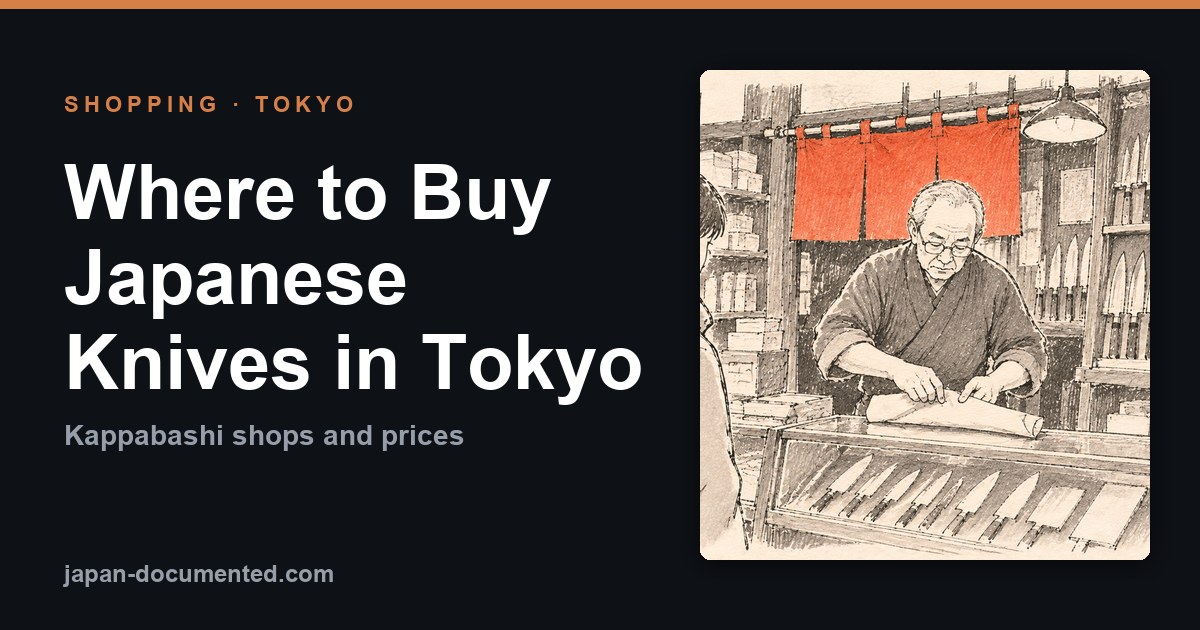
Kappabashi Dougu Street is a kitchenware shopping street in Taito City, Tokyo, with about 170 shops along roughly 800 metres between Asakusa and Ueno, and several of them specialise in Japanese kitchen knives. Most shops open about 10:00 AM to 5:00 PM, and about 30% open on Sundays. Any knife you take home must go in checked baggage, never in your cabin bag.
| Where | Matsugaya and Nishi-Asakusa, Taito City, between Asakusa and Ueno |
|---|---|
| Nearest station | Tawaramachi (Tokyo Metro Ginza Line), 5 minutes on foot |
| Shop hours | Mostly about 10:00 AM to 5:00 PM, set by each shop |
| Sundays | About 30% of shops open, most open on Saturdays |
| Knife prices | Gyuto from 16,720 yen to 77,000 yen at Kama-asa’s online store, October 2026 |
| Tax-free | 5,000 yen or more before tax, per store, per day, refunded after a customs check when you leave Japan (purchases from November 1, 2026) |
| Flying home | Knives go in checked baggage only |
How to get to Kappabashi Dougu Street and when shops open
The street itself is always open, but each shop sets its own hours and holidays. The street association’s access page gives these walking times:
- Tawaramachi Station, Tokyo Metro Ginza Line: 5 minutes
- Asakusa Station, Tsukuba Express: 5 minutes
- Iriya Station, Tokyo Metro Hibiya Line: 6 minutes
- Asakusa Station, Toei Asakusa Line or Tobu Isezaki Line: 13 minutes
- Ueno or Uguisudani Station, JR Yamanote Line and Keihin-Tohoku Line: 15 minutes
Because Ueno Station is a 15-minute walk away, Kappabashi pairs easily with a morning in Ueno. Our Ueno guide covers the park and the old-town streets around it.
Sundays need planning, because only about 30% of shops open. The association publishes a monthly list of shops open on Sundays and national holidays, and its November 2026 list includes the knife shops Kamata Hakensha and Tsubaya. Weekdays and Saturdays are the safer choice if you want to compare several shops.
Each autumn the association holds the Kappabashi Dougu Matsuri, a festival around October 9, which it calls Dougu no Hi (Tool Day). It is the street’s biggest event of the year.
Kappabashi knife shops: three specialists and their hours
These three Kappabashi knife shops publish their address and opening hours on their own websites. Check each site again before you go, because holidays change.
| Shop | Address | Hours | Good to know |
|---|---|---|---|
| Kama-asa | 2-24-1 Matsugaya, Taito-ku | 11:00 AM to 5:30 PM, open all year except the New Year period. Closes at 4:30 PM on the last day of each month. | Founded in Kappabashi in 1908. Knives and kitchen tools. Engraves the knives it sells. |
| Kamata Hakensha | 2-12-6 Matsugaya, Taito-ku | 10:00 AM to 6:00 PM, no fixed holidays. Closed for summer and New Year holidays, and sometimes for stocktaking. | Founded in 1923 as a knife sharpener. More than 800 types of knives in stock. Free engraving while you wait. |
| Tsubaya | 3-7-2 Nishi-Asakusa, Taito-ku | 10:00 AM to 5:00 PM every day, including weekends and national holidays. Closed over the year-end and New Year holidays. | Founded in 1952. More than 1,000 knives on the walls and shelves. Online sales are paused until January 2027. |
Kama-asa also runs stores in Paris and Brooklyn, and sells cookware alongside knives. Kamata Hakensha still sharpens and repairs knives, including ones bought at other shops. Tsubaya says it does not keep its knives in glass cases, so that customers can hold them before choosing.
Where else to buy Japanese knives in Tokyo: Nihonbashi and Tsukiji
Two long-established Japanese knife shops outside Kappabashi fit easily into a day of sightseeing in central Tokyo.
Nihonbashi Kiya
Kiya was founded in 1792. Its main store is on the first floor of Coredo Muromachi 1, 2-2-1 Nihonbashi-Muromachi, Chuo-ku, with an entrance from the Coredo Muromachi underground passage at Mitsukoshimae Station on the Ginza Line. It opens 11:00 AM to 7:00 PM on weekdays and 10:30 AM to 7:00 PM on weekends and national holidays, and closes only on New Year’s Day and on the building’s inspection days.
Tsukiji Masamoto
Tsukiji Masamoto has supplied knives to the cooks and fish traders of the Tsukiji market since the market opened in the early Showa era. Its main shop in the outer market is at 4-9-9 Tsukiji, Chuo-ku, open 6:00 AM to 3:00 PM and closed on Sundays, national holidays and market holidays. A second shop is inside Toyosu Market. It is an early stop, so combine it with breakfast using our Tsukiji Outer Market guide.
How to choose a Japanese knife: gyuto, santoku, petty or nakiri
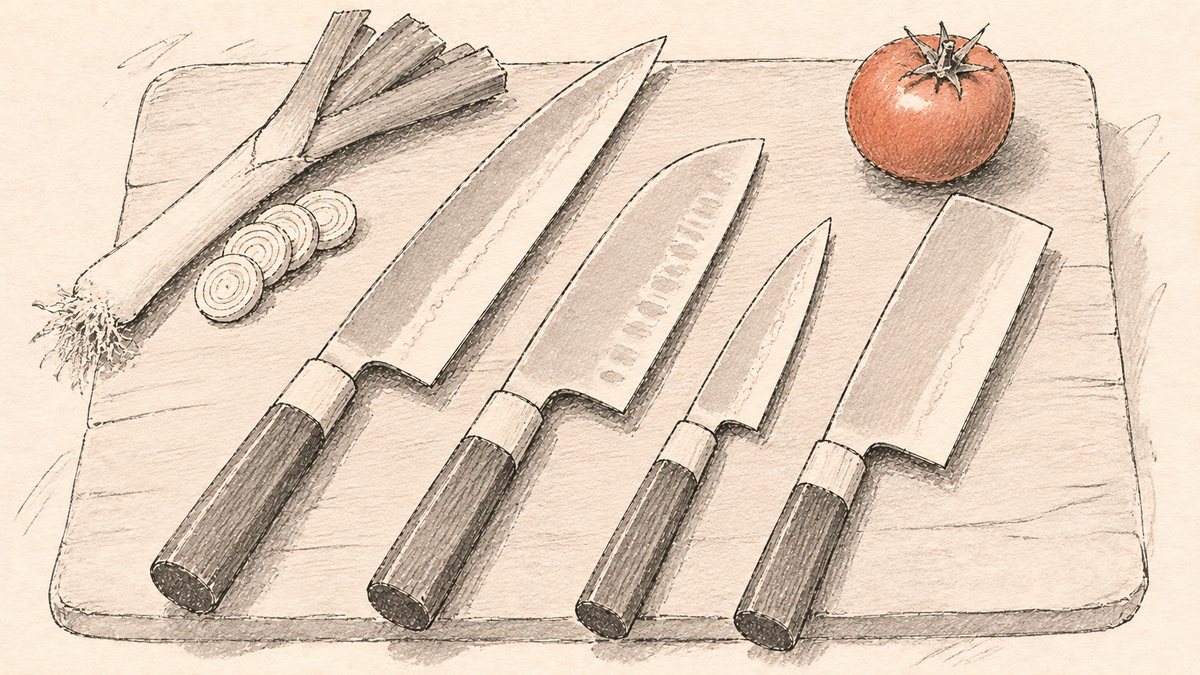
Choose the shape first, then the edge and the steel. The four knives below do different jobs. Prices are what Kama-asa, one Kappabashi shop, listed on its online store in October 2026, tax included.
| Knife | What it is for | Price range |
|---|---|---|
| Gyuto | Chef’s knife for meat, fish and vegetables, narrower and more curved than a santoku and often used with a rocking cut. Blades run roughly 18 cm to 36 cm. | 16,720 yen to 77,000 yen |
| Santoku | All-purpose home knife for meat, fish and vegetables, light and easy to handle. | 14,520 yen to 77,000 yen |
| Petty | Small knife for fruit, small vegetables, fish and fine cutting work. | 10,120 yen to more than 50,000 yen |
| Nakiri | Traditional vegetable knife that makes fine shredding easy. | 14,740 yen to 48,180 yen |
Length and steel move the price within each model. Kama-asa’s FUJITAKE V1 gyuto, for example, starts at 16,720 yen for the 180 mm size and comes in lengths up to 300 mm.
Single bevel or double bevel
A double-bevel (ryoba) knife is sharpened on both sides, works for right- and left-handed cooks, and covers gyuto, santoku and petty knives. Kamata Hakensha calls double-bevel knives extremely useful for everyday cooking. A single-bevel (kataba) knife is sharpened on one side only. It suits detailed Japanese cutting such as sashimi, it is made for one hand, and left-handed versions are often special orders. Tsukiji Masamoto notes that its single-bevel usuba vegetable knife takes some skill for home cooks, even to cut straight down. For a first knife, a double bevel is the easier choice.
Carbon steel or stainless steel
Carbon steel (hagane) takes a sharp edge and is easy to sharpen, while stainless steel is rust-resistant and easy to clean. Carbon steel needs daily care. Tsukiji Masamoto tells owners to polish off water marks and rust the same evening, dry the blade well, and oil it before storing it. Its premium carbon steels, shirogami (white) and aogami (blue), are made at a special steel plant in Yasugi, Shimane.
Stainless steel is the lower-maintenance option, but Kama-asa warns that stainless resists rust without being rust-proof, so wipe it dry after washing. High-carbon stainless steels sit between the two. Masamoto says VG10 stainless contains a lot of carbon and cuts close to carbon steel.
Engraving and tax-free shopping at a Japanese knife shop in Tokyo
Name engraving
Both Kamata Hakensha and Kama-asa engrave knives they sell. Kamata Hakensha engraves by hand, free, while you wait, usually in about three minutes per knife. It normally uses Japanese kanji or katakana, with alphabet stamps possible for short text such as initials. Kama-asa’s online store offers free engraving on knives, with up to 20 characters in English cursive on the blade.
Tax-free knives from November 1, 2026
Japan’s tax-free system changed for purchases made on or after November 1, 2026. You now pay the tax-inclusive price, and the consumption tax is refunded after a customs check at the airport or seaport confirms the goods are leaving Japan. The minimum is 5,000 yen before tax, per store, per day, and the check must happen within 90 days of purchase. Our Japan tax-free shopping guide explains refund methods and fees.
Ask each shop whether it is a tax-free shop and how it pays refunds. Kamata Hakensha’s FAQ says its tax-free procedures are handled at an agency on the street: Smart Refund Kappa-bashi at 3-17-5 Matsugaya, open 10:00 AM to 6:00 PM on weekdays, weekends and national holidays. Its listing still described the older counter process in October 2026, so ask how it works under the refund system.
Bring a credit card or cash. Kamata Hakensha accepts major credit cards but not debit cards or electronic payment. Our guide to payment methods in Japan covers cards and cash.
Carrying knives in Tokyo and packing them for your flight home
Japanese law on carrying blades in public
Japan’s Act for Controlling the Possession of Firearms or Swords and Other Such Weapons, usually called the Firearms and Swords Control Law, bans carrying a blade longer than 6 cm, kitchen knives included, except for work or another legitimate reason (Article 22). Some scissors and folding knives of 8 cm or less are exempt. Breaking Article 22 can mean imprisonment of up to two years or a fine of up to 300,000 yen (Article 31-18).
The Minor Offenses Act separately punishes carrying a concealed blade without a legitimate reason, with short detention or a small fine (Article 1, item 2). Guidance from the Kagoshima Prefectural Police says this can apply even to blades of 6 cm or less.
Buying a knife is not the problem. The same police guidance lists buying a knife and taking it home as an example of a legitimate reason. It does not mention hotels, so keep things simple: leave the knife in the shop’s box and bag, take it straight to where you are staying, and do not carry it around while sightseeing.
Packing knives for the flight
- Kitchen knives cannot go in carry-on baggage. Japan’s Ministry of Land, Infrastructure, Transport and Tourism (MLIT) lists knives as allowed in checked baggage only, and Kamata Hakensha gives the same advice.
- Airlines can set stricter rules, and other countries may add their own restrictions on international flights. Ask your airline before you fly.
- If you bought the knife tax-free, scan your passport at the tax-free kiosk in the departure lobby before you check in. Checked baggage cannot be retrieved if the kiosk then asks Customs to see the goods.
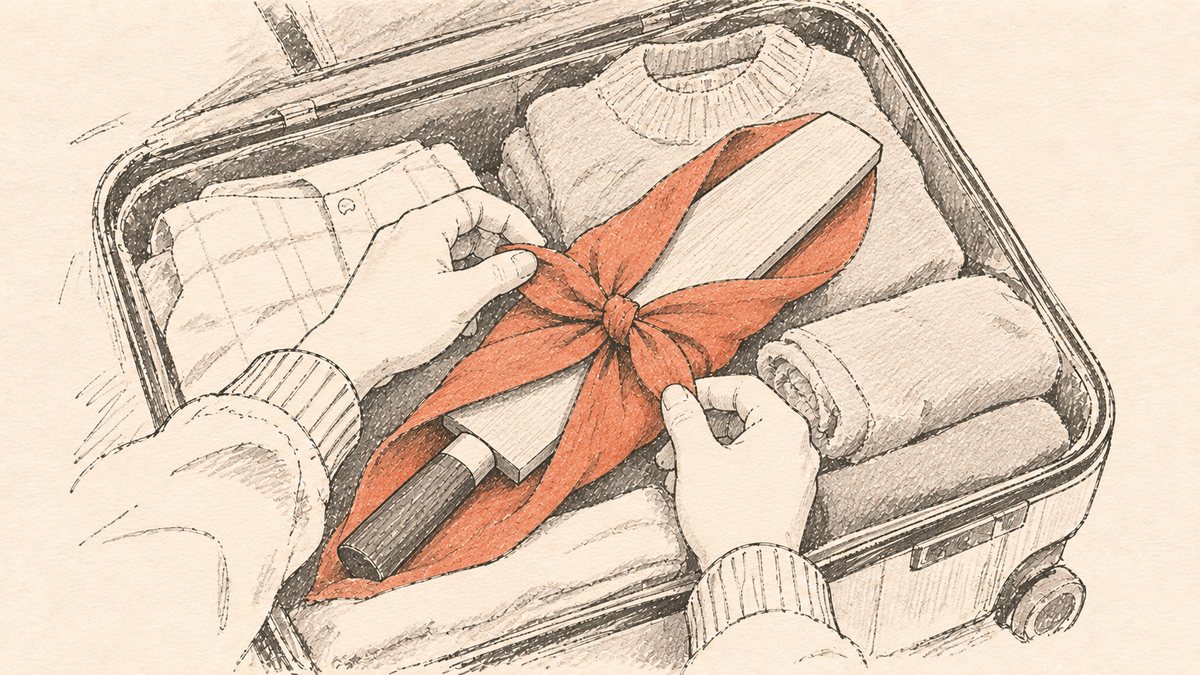
- Keep the blade in its box or sheath and wrap it in clothing in the middle of your suitcase.
- Check your home country’s import rules for knives before you buy.
Shipping is the alternative. Kama-asa’s online store ships abroad by air with tracking, so you can order a knife after you get home instead of carrying one. For other items with flight rules, see our power bank rules for flights from Japan.
Seki knives: how Japan’s blade city fits in
Seki is a city in Gifu Prefecture that calls itself a blade town with more than 700 years of tradition. Gifu Prefecture shipped 55.7% of Japan’s kitchen knives by value in 2022, the largest share of any prefecture, and the prefecture’s statistics office illustrates that figure with Seki’s blades, which carry on the swordsmith tradition. In 2023, Seki’s own kitchen-knife shipments were worth about 11.5 billion yen.
You do not have to travel to Seki to buy a Seki knife. Kappabashi shops carry Seki-made knives. Kama-asa, for example, lists its FUJITAKE V1 gyuto as made in Seki, Gifu. Our guide to Seki knives explains the city’s history and makers, and our Japanese sword guide covers the sword-making tradition behind them.
To go to Seki itself, take a highway bus from Nagoya, about 1 hour 20 minutes, or a train to Gifu and then a 50-minute Gifu Bus ride. At Seki Terrace, the Gifu Seki Hamono Kaikan shop sells Seki knives, scissors, nail clippers and razors, open 9:00 AM to 5:00 PM and closed only over the New Year. Seki’s Hamono Matsuri, with a large cutlery sale, is held every year on the Saturday and Sunday before Sports Day in October. The Seki Kaji Denshokan sword museum is closed for renovation until March 31, 2027, and the city says the dates may change.
Frequently Asked Questions
Can I take a Japanese kitchen knife in my carry-on bag?
No, a Japanese kitchen knife cannot go in your carry-on bag on a flight from Japan. MLIT’s list of restricted items allows knives only in checked baggage, and airlines may set stricter rules. If you bought the knife tax-free, finish the customs kiosk check in the departure lobby before you check the bag.
Is it legal to carry a kitchen knife around Tokyo?
Carrying a kitchen knife around Tokyo is illegal without a legitimate reason when the blade is longer than 6 cm, under Article 22 of the Firearms and Swords Control Law. Police guidance treats taking a newly bought knife home as a legitimate reason, so keep it boxed and take it straight to your accommodation.
Are Kappabashi knife shops open on Sundays?
Some Kappabashi knife shops open on Sundays, but only about 30% of the street’s shops do, according to the street association. Kamata Hakensha and Tsubaya appear on its November 2026 list of shops open on Sundays and holidays, and Kama-asa says it opens all year except over the New Year.
How much does a Japanese knife cost at Kappabashi?
A Japanese knife at Kama-asa in Kappabashi costs from about 10,000 yen for a petty knife to 77,000 yen for its most expensive gyuto and santoku, based on its online prices in October 2026. Length and steel change the price within each model.
Can a Tokyo knife shop engrave my name in English?
Some Tokyo knife shops engrave names in English, but not all. Kama-asa offers up to 20 characters in English cursive on the blade for online orders. Kamata Hakensha engraves for free, usually in kanji or katakana, and can use alphabet stamps only for short text such as initials.
Are Seki knives sold in Kappabashi?
Seki knives are sold in Kappabashi. Kama-asa, for example, lists its FUJITAKE V1 gyuto as made in Seki, Gifu. Gifu Prefecture, home to Seki, shipped 55.7% of Japan’s kitchen knives by value in 2022, more than any other prefecture.
Last checked: October 2026. Shop hours, prices and travel rules change, so confirm with the official sources linked above before you go.
Share