
By the Japan Documented editorial team. Japan Documented is run by JDOC, a Tokyo company that works with Japanese makers and shops selling to overseas customers.
Japan’s tax-free shopping system for foreign visitors switches to a new refund system on November 1, 2026. You pay the full price, consumption tax included, and get the tax back only after Japan Customs confirms at departure that your purchases are leaving the country. Until October 31, eligible shops take the tax off at the register, with no overlap period.
The date that matters is the day you buy, not the day you fly. A trip that spans the switch can put some of your purchases under each system.
Last reviewed: September 2026, before the refund system starts on November 1, 2026. We will update this guide once the new departure check is live and we have seen how it works in practice. General information only, not tax or legal advice; confirm details with the official sources at the end.
The short answer: Japan tax-free shopping from November 1, 2026
- From November 1, 2026, you pay the tax-inclusive price. The shop or its refund provider refunds the tax later, not Customs.
- The minimum spend is still ¥5,000 before tax, per person, per store, per day.
- Within 90 days of purchase, get a customs confirmation as you leave Japan, before checking bags: scan your passport at a departure-lobby kiosk or terminal, or use Visit Japan Web at seven major airports.
- Food, drinks, medicine, and cosmetics that are eaten or used in Japan, even partly, get no refund. One missing item cancels the refund for its whole receipt.
- The refund is about 9.09% of the shelf price for most goods and about 7.41% for food and non-alcoholic drinks, before any fee.
What changes on November 1, 2026
The government’s stated reason is abuse: tax-free goods were being resold inside Japan, and nearly 90% of travelers who bought ¥100 million or more tax-free were not inspected by Customs when they left.
| Rule | Until October 31, 2026 | From November 1, 2026 |
|---|---|---|
| Price at the register | Tax removed on the spot | Full price, tax included |
| Minimum purchase | ¥5,000 before tax, per store, per day | No change |
| General goods vs. consumables | Separate rules | Split abolished |
| Consumables cap | ¥500,000 per store, per day | No yen cap; only what you can carry out yourself |
| Sealed packaging for consumables | Required | Abolished |
| “Ordinary daily use” requirement | Applies | Abolished |
| Where Customs checks (by departure date) | After security | Before security, in the public departure lobby |
| Deadline | Goods leave Japan with you | Customs confirmation within 90 days of purchase |
| Who pays you | Nobody; the tax is never charged | The shop or a refund provider it hires |
Where October purchases are checked on later departures is not officially confirmed; see “Shopping around November 1” below.
From November 1, only three kinds of goods are excluded: gold and platinum bullion, gold and platinum coins (newly added), and goods already exempt from consumption tax.
How the new refund system works, step by step
At the store
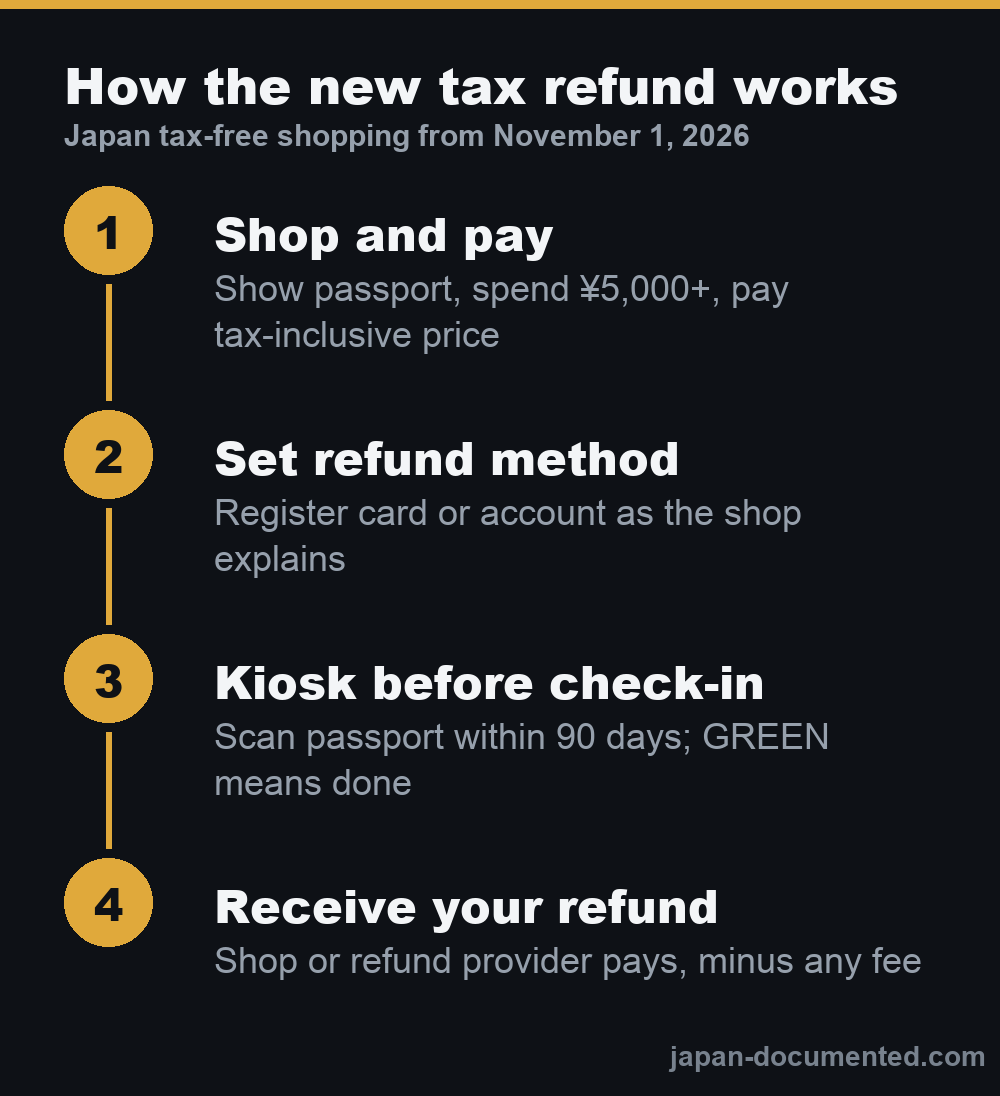
- Show your passport with a landing-permission stamp or sticker, or a Visit Japan Web tax-free QR code.
- Spend at least ¥5,000 before tax at that store on the same day. Separate purchases that day can be combined.
- Pay the full price. The shop sends your purchase record electronically to the National Tax Agency system.
- Set up your refund method (for example, a card) as the shop explains, and ask about fees and any claim deadline.
At the airport or port
- Before airline check-in, go to the departure lobby with your passport and every tax-free item.
- Scan your passport at a tax-free kiosk or electronic terminal. It takes a few seconds.
- GREEN means you are done. RED means you take the goods to the customs inspection area. If the inspection fails, there is no refund.
- Check your bags only after that.
Getting the money
The shop or its refund provider pays you through the method you set up, generally after the customs confirmation. The law sets no timeline, and shops may set claim deadlines.
How much of a tax refund you actually get
The refund is the consumption tax inside the price. Most goods, including cosmetics and medicines, are taxed at 10%, about 9.09% of the shelf price. Food and non-alcoholic drinks are taxed at 8%, about 7.41% of the shelf price. So ¥11,000 of skincare contains ¥1,000 in tax, and ¥10,800 of snacks contains ¥800.
Handling fees can shrink that. No rule says whether the traveler or the shop pays a refund operator’s fee, there is no government cap, and the Japan Tourism Agency notes that travelers usually pay in other countries. Under the current counter system, several major department stores charge 1.55% of the pre-tax price. On a 10%-rate item that leaves about 8.45% of the pre-tax price, or roughly 7.7% of the shelf price: about ¥845 instead of ¥1,000 on ¥11,000 of skincare. New-system fees have not been officially published, so ask the store before you buy.
That 8% could fall. On September 15, 2026, the Cabinet approved an outline to cut consumption tax on food and non-alcoholic drinks (the items now taxed at 8%) to 1% from April 1, 2027 to March 31, 2029. If the Diet passes it, tax-free snacks and tea bought in that period would return only about 1%.
Refund methods vary too: bank transfer, credit card, app-based refunds, or cash at the departure port after the customs check. Some shops may refund in coupons or points usable only in certain places. For cards and cash day to day, see our guide to payment methods in Japan.
Drugstores and Don Quijote
Drugstores and discount stores are where many visitors reach the ¥5,000 minimum. The new rules help: no sealed bags, no ¥500,000 consumables cap, and no separate rules for consumables (such as cosmetics and food) and general goods. Our guide to where to buy body wash and daily necessities in Japan covers the main chains.
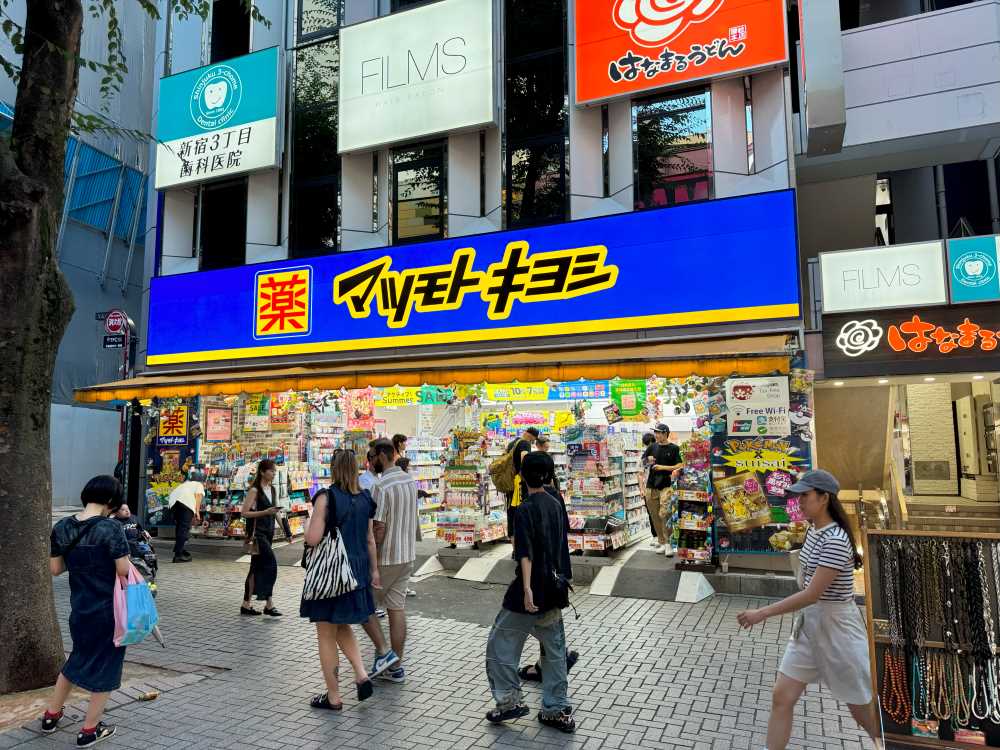
The catch is the per-receipt rule. Customs confirms each purchase record, usually one receipt, as a whole. Use one sheet mask or eat one bag of chips from a tax-free receipt, and nothing on that receipt qualifies; other receipts are unaffected. Pay for anything you will use during the trip in a separate, regular transaction.
- August 2026 media reports said Don Quijote will ask shoppers to register a refund destination, such as a credit card, at purchase. Its own page still shows the current rules, so check at the register.
- Bottles over 100 ml cannot go in your cabin bag. Official materials put the kiosk before check-in and do not require tax-free goods in the cabin, which suggests large liquids can be checked after a GREEN result or a finished inspection. That is our reading, not an official statement, so keep everything accessible until the kiosk is done.
- The liquids exemption for sealed duty-free bags does not cover drugstore cosmetics bought in town.
- For rules on medicine at Japan’s border, see our guide to medications you can’t bring into Japan.
The airport customs check: timing and options
Customs confirmation cannot be done after your bags are checked, so do it first and leave extra time. An abandoned inspection does not count, and nobody compensates you for a missed flight.
At Narita, Haneda, Kansai, Chubu, New Chitose, Fukuoka, and Naha, you can confirm on your smartphone through Visit Japan Web instead. It works on the dedicated departure-lobby Wi-Fi up to security, and you must register with Visit Japan Web beforehand. Elsewhere, including seaports, the kiosk or electronic terminal is the only option.
JNTO says terminals and customs inspection areas are available at each airport and seaport, and the government plans enough terminals for departure numbers. No per-airport counts have been published, so expect lines. If you fly with a power bank, check the battery rules on Japanese airlines before you pack.
Departing by sea, connecting flights, and cruises
- Domestic flight connecting to an international one: do the check where you actually leave Japan.
- Cruises that start and end abroad: do it at the last Japanese port, at the electronic terminal before checking baggage. Official materials do not say what kind of terminal seaports use.
- Fly-and-cruise trips: do it for your whole stay at the departure airport.
What to keep until you leave Japan
- The passport you showed at the shops.
- Every tax-free item, with consumables unused and in their original packaging.
- All receipts. The kiosk does not strictly need them, but Customs may look at them.
- For items of ¥1 million or more per unit before tax: certificates of authenticity or warranties, which Customs may ask to see.
- Each shop’s refund method and claim deadline.
Mistakes that cost you the refund
- Using part of a consumable, or giving one item away. If you have used some, skip the kiosk and tell a customs officer.
- Missing the 90-day deadline. The count starts the day after purchase, so goods bought November 1, 2026 must be confirmed by January 30, 2027.
- Mailing goods home yourself. Goods bought from November 1 and mailed abroad by you get no refund.
- A wrong account number, or never registering a refund method. The shop keeps its exemption and the money is effectively lost.
- Leaving confirmed goods in Japan. The tax is then collected, with penalties.
One option skips all of this: a shop can ship goods directly abroad at the time of purchase as an export sale, tax-free, with no ¥5,000 minimum and no departure check. Ask each shop whether it offers this.
Shopping around November 1
- Bought on or before October 31: current rules. The goods must still be with you when you leave, or Customs collects the tax; transferring them to someone else carries penalties. A store whose business day runs past midnight may book early-hours November 1 sales as October 31 sales, if that is how it normally books them.
- Bought on or after November 1: refund method, 90-day deadline, kiosk check.
- Both, leaving after November 1: official sources confirm the old rules govern your October goods but not where they are checked after the switch. You may need to handle both, so ask Customs at the airport.
Some shops that are tax-free today may stop offering it: shops not on electronic tax-free processing by October 31, 2026 lose their permit that day.
Who is eligible
Eligibility does not change on November 1. Foreign visitors qualify if they are non-residents who entered Japan less than six months ago, such as Temporary Visitors and landing-permit holders. Diplomats, official-status holders, and US military personnel are exempt from the six-month check, but everyone must meet the 90-day customs deadline.
Japanese nationals qualify after living abroad continuously for two years or more, if they have been back for less than six months. Proof can be a Residency Certificate (在留証明), a copy of the Family Register Attachment (戸籍の附票), or, newly, a My Number Card that records the move abroad.
Cruise passengers with a ship landing permit show their passport (or a copy) plus the permit when shopping.
Automated entry gates may not stamp your passport. A passport showing landing permission or a Visit Japan Web tax-free QR code is officially enough; some guides suggest asking for a stamp at entry as a practical backup.
Frequently asked questions
Is shopping in Japan still tax-free from November 1, 2026?
Yes, at shops that keep their tax-free permit, but usually not at the register. You pay full price and get the consumption tax back after Customs confirms at departure that the goods are leaving Japan.
How long does a tax refund in Japan take?
There is no legal timeline. Refunds are generally processed after the customs confirmation at departure, and each shop or refund provider sets its own schedule and claim deadline, so ask when you pay.
Do I get the tax refund at the airport, in cash?
Not from Customs, which only does the check. The shop or its refund provider pays you by the method you set up, and cash at the departure port is allowed if the store offers it. Global Blue advertises downtown refund offices that may pay in advance; the conditions are not clearly documented, so ask the operator.
Are convenience stores tax-free?
Only convenience stores with a tax-free permit offer it, and the ¥5,000 per-store, per-day minimum still applies, so ask at the register. Snacks you eat during the trip would not qualify anyway. For everything else konbini do well, see our guide to Japan’s convenience stores.
What is the minimum spend for tax-free shopping in Japan?
The minimum is ¥5,000 (5,000 yen) before tax, per traveler, per store, per day, and same-day purchases at one store can be combined. From November 1, 2026, there is no upper yen limit, but you can only buy what you can carry out of Japan yourself. Until October 31, the ¥500,000 per-store, per-day cap on consumables still applies.
Can I use tax-free items before I leave Japan?
Clothes, bags, and electronics can be used and still qualify if they leave with you. Food, drinks, medicine, and cosmetics must not be eaten or used, even partly. Keep them in their original packaging.
What if I forget the customs check at the airport?
No customs confirmation means no refund. It cannot be done after check-in, and after 90 days the sale becomes final as a taxable sale.
Before your first tax-free purchase
Ask each shop how it pays, whether it takes a fee, and how long you have to claim. Then register your refund details carefully, keep receipts with their goods, and scan your passport before you check in.
Official sources
- Japan Tourism Agency: Tax-free shopping for travelers
- Japan Tourism Agency: Traveler FAQ on the refund system
- JTA, NTA, and Japan Customs: New tax-free procedure from November 2026 (PDF)
- National Tax Agency: Overview of the refund method (PDF)
- NTA and Japan Customs: Notice to foreign travelers from November 2026 (PDF)
- JNTO: Japan’s tax exemption
Share