
Most people assume a knife from Seki, Japan’s famous blade-making town, was hammered out by hand at a forge. Koji Inohara thought so too. He moved to Seki to work with knives after years as a chef abroad, and one of the first things he learned surprised him.
“I didn’t know they weren’t hand-forging knives in Seki,” he told us. “I thought they were hammered too.”
This guide looks at the other kind of knife: the kind you heat, hammer and temper yourself. In a private four-hour workshop in Seki, you forge your own kitchen knife from tamahagane, the steel used for samurai swords, with a licensed swordsmith beside you. Below we explain what the day involves, who it suits, and what the people of Seki told us about knives, swords and the town they share.
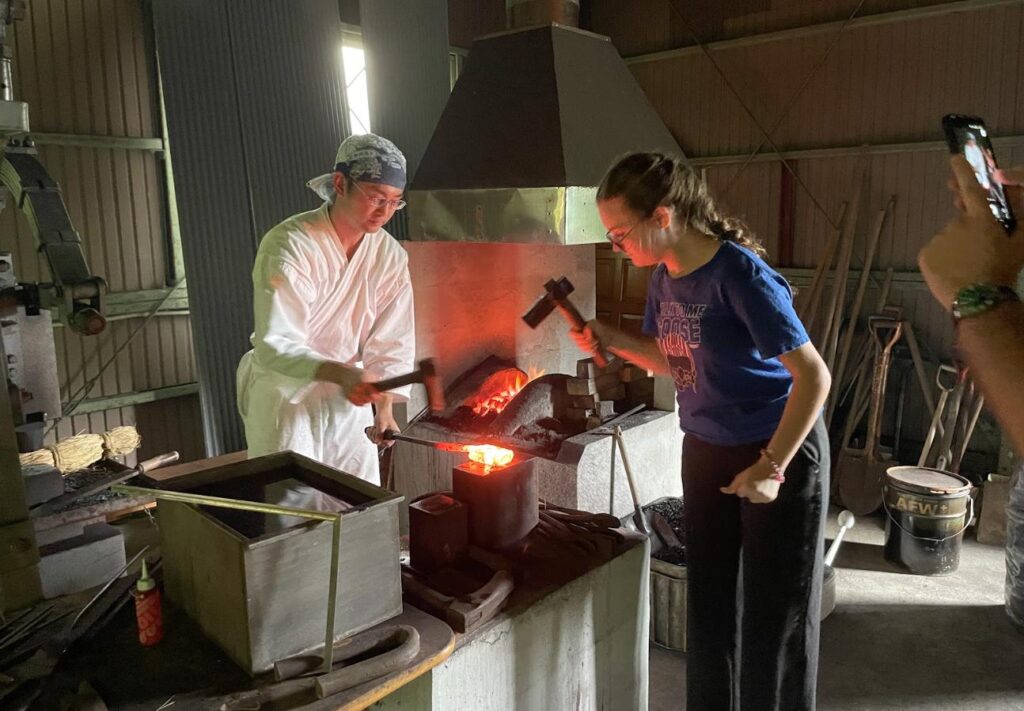
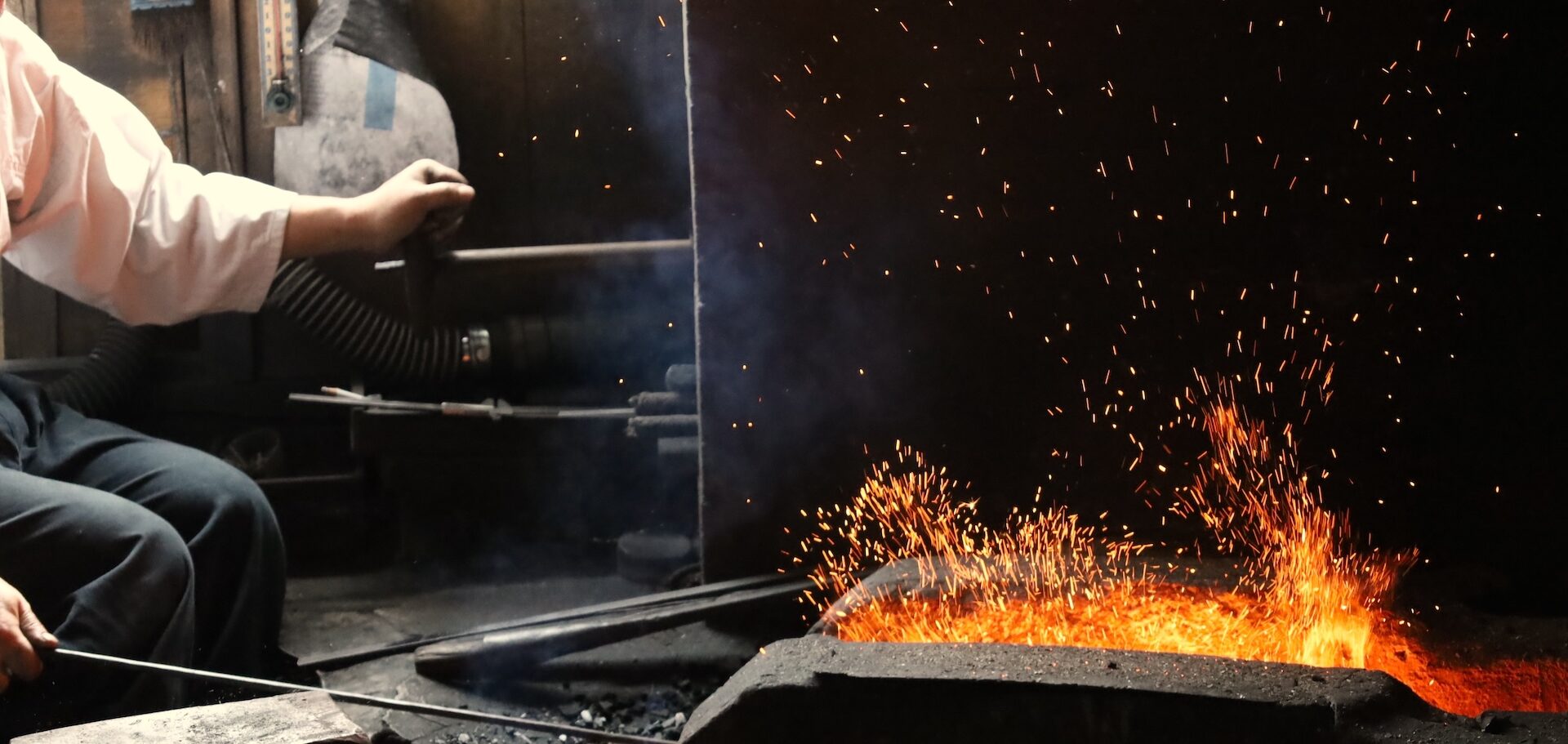
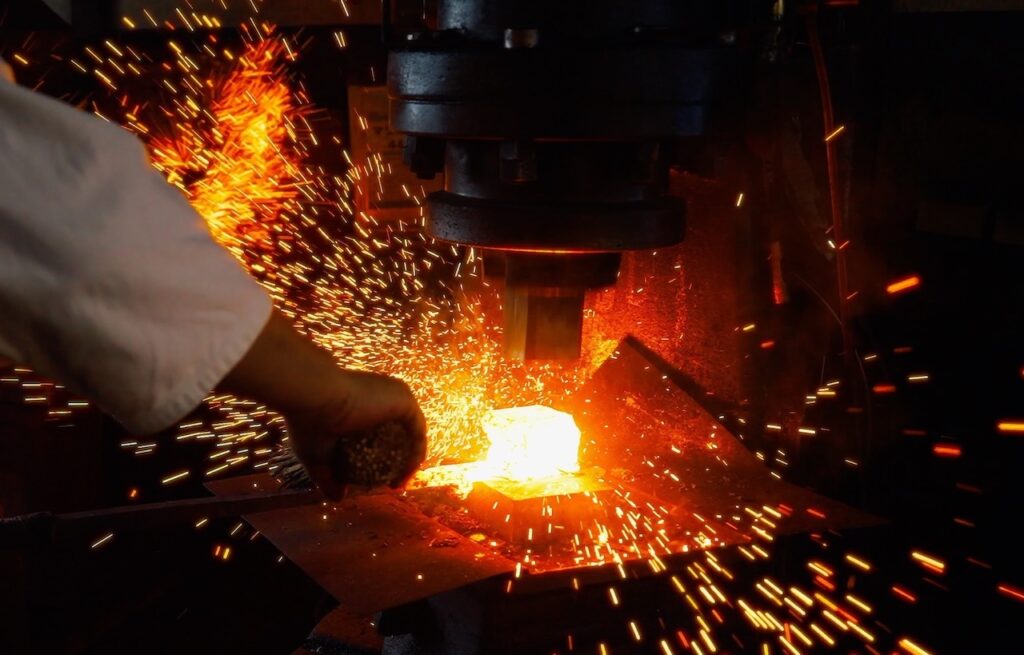
A note on the photos: the images in this guide were not taken during the knife making workshop. They come from other forges in Seki, including the workshop of swordsmith Kanetoki Kojima. Some of what they show, such as working steel under the power hammer, is done by the smith alone and is never handed to guests, because it is too dangerous without years of training.
The knife making workshop at a glance
- What you do: forge a kitchen knife from a raw block of tamahagane, from the first heating to the finished handle
- How long: 4 hours
- Who teaches: an award-winning young licensed swordsmith in Seki, who guides you one on one in English
- Group: private, your party only, up to 4 people
- Age: adults 18 and over
- What you take home: the finished knife you forged
- Getting there: free pickup and drop-off at Mino-Ota Station, the nearest train station, with free parking at the forge
Full details, current pricing and the inquiry form are on the Katana Forging with a Licensed Swordsmith page.
The surprising truth about Seki knives
Seki is often listed alongside Solingen in Germany and Sheffield in England as one of the world’s great blade towns. Inohara, who now runs Blacksmith Japan Inc., a knife and sword shop in Seki, explained how it earned that reputation, and it is not the story most visitors expect.
“In a word, Seki knives are industrial products. Rather than making each one by hand, the makers mechanized so that anyone could produce them in large numbers.”
He does not say this as a criticism. Industrialization is exactly what made Seki famous. Because a knife could be made to the same quality by whoever was on the line, Seki could produce a great many of them, sell them around the world, and build a name. Some makers in Seki now also produce high-end knives with Damascus steel and other premium materials.
What changed over time is the method. A sword is hammered at a forge. Most Seki kitchen knives today are not.
“Swords are hammered by hand, one at a time. But Seki knives today are cut out with a die and then heat-treated. They aren’t hammered.”
That was the shock for Inohara, who had come to Seki expecting the opposite. He has heard that perhaps one or two workshops in the town still forge knives by hammering. This is why a workshop where you hammer your own knife from sword steel, in Seki, with a licensed swordsmith, is less common than it sounds.
A chef who came for the steel
Inohara grew up in Numazu, Shizuoka Prefecture, and spent years cooking professionally in Canada and Australia on working holiday visas. It was in those kitchens that he saw how highly chefs abroad rated Japanese knives.
“Japanese knives were enormously popular. The chefs there were always saying how good Japanese knives are.”
When he came back to Japan, he wanted to do something connected to knives, so he moved to Seki. He had been living there for about five and a half years when we met him in 2024.
Ask him what makes a Japanese knife different, and his answer comes straight from the cutting board.
“It cuts well, and delicate work is easier. Fish, for example, or slicing meat after it’s been cooked. Whenever you have to cut something fine or thin, a sharper edge makes it easier.”
He compares them with German knives, which he sees as thick and forgiving of rough handling. Japanese knives, he says, were built around one thing: the edge.
Want to forge your own knife?
We arrange this workshop as a private, English-led day in Seki with a licensed swordsmith. Send us your dates and we reply in English within 24 hours.
Enquire about this workshop →What you do in four hours
The workshop follows the real sequence a smith uses, scaled to a kitchen knife.
- Welcome at the forge. Meet the swordsmith, hear how Seki became Japan’s blade town, and get to know tamahagane, steel smelted in a traditional clay tatara furnace.
- Heat and hammer. Work your block at the fire, heating and hammering it into the shape of your knife with one-on-one guidance.
- Clay and hamon. Apply the clay coating yourself and quench the blade to set your own hamon, the temper line along the edge.
- Grind, sharpen, finish. Grind and sharpen the edge, fit the handle, and finish the knife you will take home.
Every step is hands on. You are not just watching someone else make your knife.
Why a hand-forged blade feels different
Inohara’s favorite thing about Japanese swords applies to anything shaped by hand at a forge.
“Even from the same maker, the shape, the curvature, the length and the hamon are all different. There is not a single identical sword in the world.”
The same is true of the hamon on your knife. The clay you spread and the moment the blade meets the water decide the line, and nobody (including you) can repeat it exactly.
He also told us what he sees in the work of the craftspeople he works with every day.
“Even if I tell them, ‘It’s fine to make it roughly like this,’ they say, ‘That won’t do,’ and they finish it to a level of quality they can accept themselves.”
What the smiths themselves say
Kanetoki Kojima is a swordsmith in Seki we interviewed in 2024, when he had been forging for twenty-six years. He is not the host of this workshop, but he described two things you will feel during your own four hours.
The first is the concentration the grinding stage demands. Asked what goes through his mind as he works the blade, he answered in one word.
“Mushin. No mind. At this stage, no mind at all.”
The second is what makes the work worthwhile. Asked about the happiest moment of his career, he did not mention winning a prize.
“When someone picked one up and was happy with it, and posted that on social media. That made me happy.”
He was also frank about the physical risks of the job. For him, the worst is getting grinding debris in the eye, an injury that once took about a month to heal. In the workshop you work under the smith’s supervision. A waiver is signed on arrival and participant accident insurance is included, but you are stepping into a working forge with real fire and a power hammer.
Inohara’s hope for Seki
Inohara admits he came to Seki without much of a plan. “Knives were famous here” was reason enough. The town gave him far more than he expected.
“By chance I came to this town, and the people here are really good people. Once you get to know them, many of them treat you very well. I have good seniors and friends around me. I want to give something back to Seki.”
For him, giving back means training craftspeople and passing on the culture of the blade. When we asked about his vision for the future, he pointed straight to the method that Seki’s knife industry left behind.
“What I most want is for Seki to make hand-forged knives again. I think there’s the pride and the tradition of a sword town in that.”
Inohara is involved in this workshop, and it is one way he is putting that hope into practice. Every visitor who hammers a knife from sword steel in Seki is doing, on a small scale, the thing he hopes to see more of.
Is the knife making experience worth it?
It suits you if you want to make something with your own hands rather than buy it, you cook and want a knife with a story you can tell, or you are fascinated by Japanese swords and want to work with the same steel.
Think twice if you are traveling with anyone under 18, you want a short stop on a busy itinerary, or you only want to watch. In that case, the swordsmith demonstration in Seki may suit you better. It is observation only and open to all ages.
Practical notes:
- Wear clothes you do not mind getting dirty, ideally flame resistant, with long sleeves and long trousers.
- Bring a towel and your own drink.
- The workshop runs year round, rain included, and is closed from December 31 to January 4. Obon, Sundays and public holidays are subject to confirmation.
- Starting times vary by date and are confirmed when you inquire.
FAQ: making your own Japanese knife in Seki
Can I make my own Japanese knife in Japan?
Yes. In Seki, Gifu, a licensed swordsmith runs a private four-hour workshop in which you forge your own kitchen knife from tamahagane and take it home.
What is tamahagane?
Tamahagane is traditional Japanese steel smelted in a clay tatara furnace. It is the material used for Japanese swords, and it is what you forge your knife from in this workshop.
Do I need any experience?
No. The swordsmith guides you one on one through every stage in English.
Can children join?
No. Participants must be 18 or older, because the workshop involves fire, blades and a power hammer. The swordsmith demonstration in Seki has no age restriction.
Aren’t all Seki knives hand-forged?
No. According to Koji Inohara of Blacksmith Japan, most Seki kitchen knives today are made industrially, cut out with a die and heat-treated rather than hammered. That is what made Seki famous worldwide, but it also means a hammered knife from Seki is less common than many visitors assume.
How do I get to the forge?
Free pickup and drop-off are available at Mino-Ota Station, the nearest train station, and there is free parking at the forge. Pickup from Gifu or Nagoya Station can be arranged for a surcharge.
Final thoughts
Seki’s knives went around the world because the town learned to make them in great numbers. The knife you forge here goes the other way: one block of sword steel, one day, one pair of hands.
When you hold your finished knife at the end, you will understand what Kojima meant when he said the happiest moment in his career was simply someone picking up his work and being glad of it.
Forge your own knife in Seki
A private, four-hour workshop with a licensed swordsmith, guided in English. Tell us your dates and we reply within 24 hours.
Enquire now →Share