
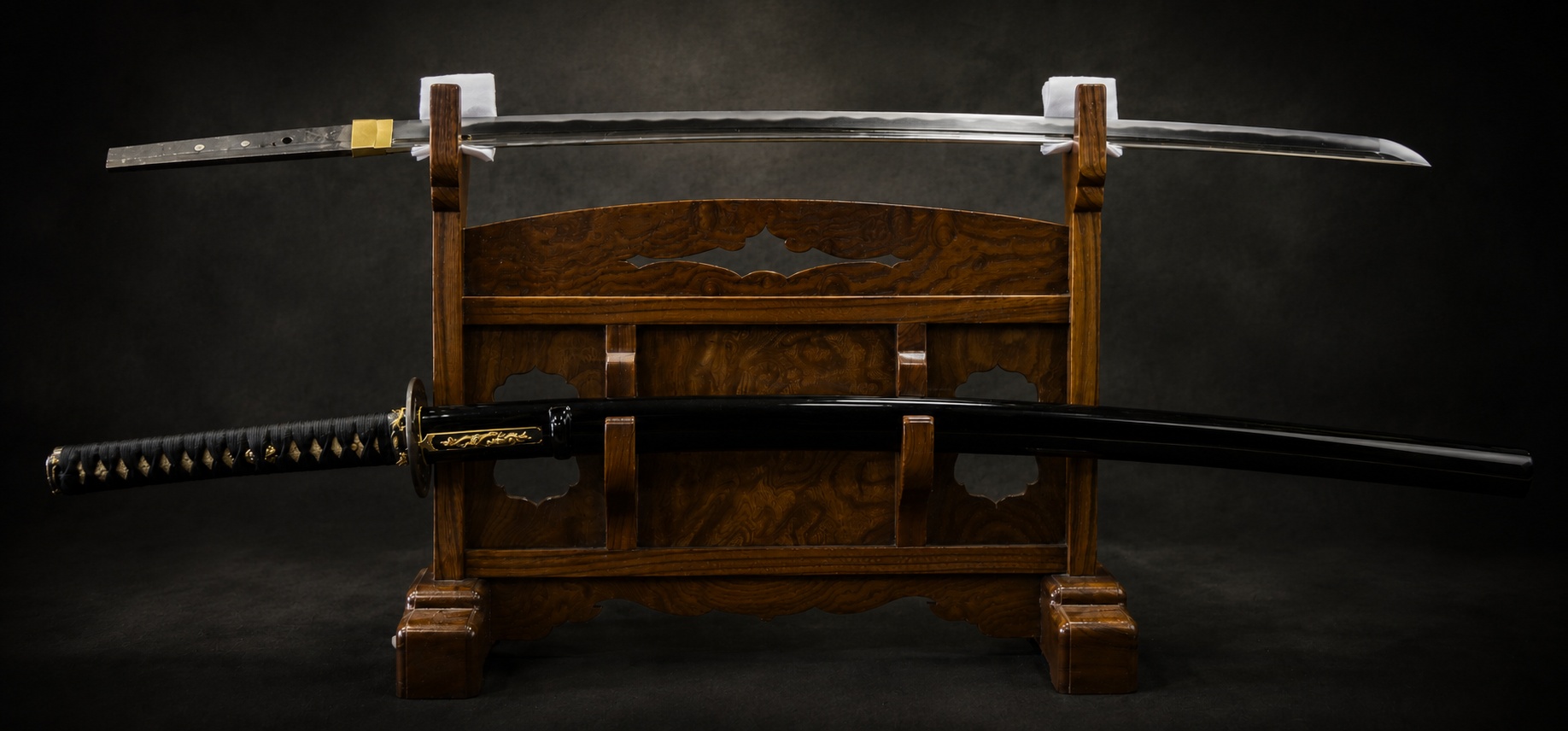
The Japanese sword is a curved, single-edged blade forged in Japan from tamahagane steel, in forms that include the tachi and the later katana. Its curve appeared around the Heian period, roughly the tenth century, and five regional traditions, the Gokaden, shaped its golden age up to about 1596. The craft survived a ban on wearing swords in public in 1876 and confiscations after 1945, and licensed smiths still forge blades today.
| Steel | Tamahagane, made from iron sand and charcoal at the Nittōho Tatara in Okuizumo, Shimane |
|---|---|
| Tachi | About 60 cm or longer, slung from the hip, edge down. Late Heian to early Muromachi |
| Katana | About 60 cm or longer, worn at the waist, edge up. Early Muromachi to the end of Edo |
| Public wearing banned | March 28, 1876, Haitōrei edict. Exempt: court dress, uniformed soldiers, police, officials |
| Preservation society | NBTHK, founded February 24, 1948, to save swords from postwar confiscation |
| Rules today | Swords of artistic value may be owned once registered. New smiths train 5 years or more |
Checked in October 2026 against touken.or.jp, city.setouchi.lg.jp, archives.go.jp, bunka.go.jp.
Few objects carry a nation the way the Japanese sword carries Japan. It has been a weapon, of course, but also a sacred treasure kept in a shrine, a symbol of imperial legitimacy, the declared “soul” of a warrior class, and, in the end, one of the most refined art forms the country ever produced. To follow the sword through a thousand years is to follow Japan itself: its myths, its wars, its craftsmen, and its near-losses.
This is that story: where the blade came from, who shaped it, how it is actually made, and how it survived being all but destroyed twice over.
A blade born from myth
Long before any swordsmith signed his name, the sword already sat at the centre of Japan’s founding myths. In the tales recorded in the Kojiki and Nihon Shoki, the storm god Susanoo slays the eight-headed serpent Yamata-no-Orochi and finds, buried in its tail, a marvellous blade. He offers it up to the sun goddess Amaterasu, and it passes down through the gods to become one of the Three Sacred Treasures: the mirror, the jewel, and the sword, that legitimise the imperial line to this day. That blade, Kusanagi-no-Tsurugi, is enshrined at Atsuta Shrine in Nagoya; by tradition no one, not even the emperor, may look upon it.
There is a quiet coincidence worth holding onto. The myth places Susanoo’s deed in Okuizumo, in what is now Shimane, and Okuizumo is the very place where Japan’s only furnace for traditional sword steel still burns today. The country’s oldest sword story and its living craft share the same ground.
From straight to curved: the sword takes its shape
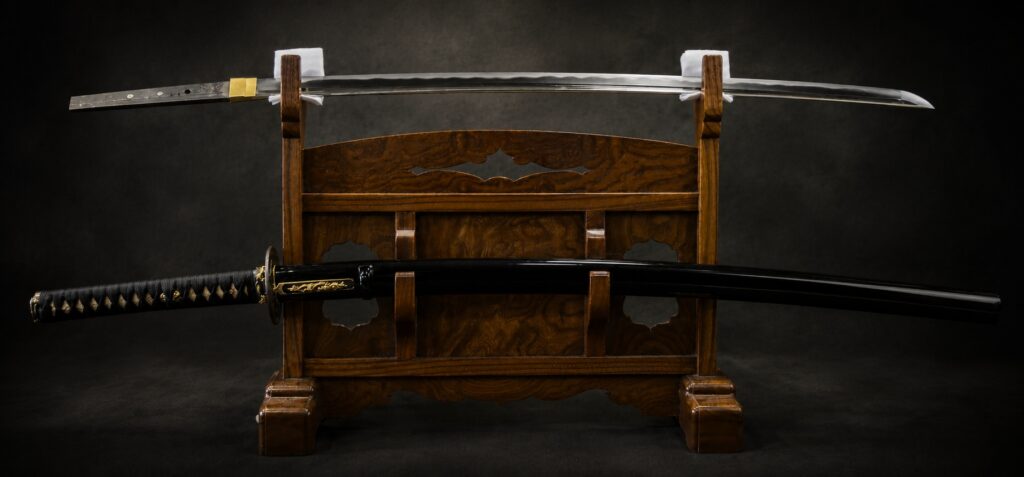
The sword of myth was not yet the sword we picture. For centuries, Japan’s blades were straight (chokutō), following swords brought from the Asian continent. The silhouette everyone now recognises, that long, elegant curve, did not appear until around the Heian period (roughly the tenth century).
The curve was not decoration; it was function. As mounted, armoured warfare rose, a curved blade could be drawn and could cut in a single sweeping motion from horseback in a way a straight blade never could. Legend credits a Yamato smith named Amakuni with forging the first curved single-edged blade, but nothing of his survives, so he remains more myth than man. What is certain is that by the late Heian era the tachi: a long, deeply curved sword worn edge-down, slung from the hip, had become the weapon of the rising warrior class. The Japanese sword, as an idea and a shape, had been born.
The golden age: five traditions, five characters
The centuries that followed: the kotō or “old sword” era, running to around 1596, are considered the sword’s golden age. Blades from this period have never been surpassed, and much about how the very best were made is still not fully understood.
What makes the era so rich is that it was regional. Different provinces developed distinct styles, or den, and five of them came to be regarded as supreme, the Gokaden, the “Five Traditions.” (The neat five-part scheme, it’s worth noting, was largely codified much later, after the Meiji era, by the Hon’ami family of hereditary sword appraisers.) Each tradition had its own home, its own masters, and its own personality.
Yamato (present-day Nara), the oldest, grew up around the great temples, forging austere, unshowy blades for their warrior-monks. Yamashiro (Kyoto), in the shadow of the imperial court, produced the most refined and graceful swords of all, the work of smiths like Sanjō Munechika, whose “Mikazuki” blade is counted among the most beautiful ever made.
Bizen (eastern Okayama) was the powerhouse. Centred on the workshops of Osafune along the Yoshii River, it was by far the most prolific tradition, historical counts record more Bizen smiths than any other by a wide margin, and its flamboyant, clove-shaped chōji temper lines made “Bizen” almost a synonym for the sword itself. Its dominance ended abruptly: a catastrophic flood in 1590 devastated Osafune, and the tradition never fully recovered.
Sōshū (Kamakura) was born of crisis. The Mongol invasions of the late thirteenth century exposed the limits of existing blades, and the shogunate’s smiths answered with a bold new method, fiercely hot forging and dramatic quenching that produced blades of startling power and beauty. Its supreme master, Masamune, is the most celebrated swordsmith in Japanese history, and his style was so demanding that only around 140 smiths ever worked in it across three centuries; the full technique was eventually lost.
Mino (southern Gifu, centred on Seki) came last, and it came for war. Where the older traditions prized refinement, Mino optimised for blades that could be made in numbers and survive relentless combat, swords said not to break, not to bend, and to cut well. It was shaped in part by pupils of Masamune who migrated to the province, and it produced famed masters such as Kanemoto and Kanesada. When the 1590 flood ended Bizen’s reign, Mino, Seki, became the largest sword-producing region in the country, a status its blade-making heritage still trades on some eight centuries later.
How a Japanese sword is actually made
The mystique is real, but the engineering beneath it is more interesting than the myth. A sword must solve a contradiction: hard steel holds an edge but shatters, while soft steel survives but goes blunt. Japanese smiths refused to choose.
It begins with a special steel. Sword-making starts with tamahagane, smelted from iron sand and charcoal over several days in a clay furnace called a tatara. The smith then sorts the raw steel by hand, because its carbon content decides how hard the finished blade will be.
Folding, and the myth around it. The signature move is fold-forging: heat, hammer flat, fold, weld, repeat. You may have heard a blade was “folded a thousand times.” It wasn’t, and couldn’t be, folding doubles the layers each time, so the number climbs fast:
| Times folded | Steel layers |
|---|---|
| 8 | 256 |
| 10 | 1,024 |
| 13 | 8,192 |
| 15 | 32,768 |
A smith folds on the order of 8 to 13 times, producing hundreds to thousands of layers. The aim was never a big number; it was to drive out impurities, even out the carbon, and create the fine grain (jihada) a trained eye can still read on an antique blade.
A soft heart in a hard shell. The real solution to the contradiction is structural: a soft, low-carbon core is wrapped inside a harder, higher-carbon skin. The skin takes and holds the edge; the core absorbs shock so the blade won’t snap.
Fire, clay, and water. Finally, the smith paints the blade with clay, thin along the edge, thick along the spine, heats it to a precise glow judged by eye, and quenches it in water. The edge cools instantly and turns glass-hard; the spine stays tough. The two zones contract differently, and the blade curves itself into its final shape. The boundary between them appears as the hamon, the wavy temper line collectors prize, not decoration, but the blade’s own structure made visible.
And the sword was never one person’s work. A finished blade passed through a chain of specialists, the smith, then the polisher (togishi) who could take weeks to reveal the steel, and the makers of the scabbard, hilt, and fittings. The metal guard (tsuba) alone became a canvas for goldsmiths and is collected as art in its own right. The Japanese sword is, in the end, a collaboration.
The soul of the samurai
As warfare moved from horseback to foot, the sword changed with it. The slung tachi gave way to the uchigatana: the katana, worn edge-up, thrust through the sash, ready to be drawn and to strike in one motion. (That single detail is the seed of iaido, the art of drawing.) By the Edo period the sword had become the unmistakable badge of the samurai: the daishō, a matched long-and-short pair worn only by the warrior class.
It was more than a tool. A sword was called the very soul of the samurai: carried with ritual, handled with strict etiquette, passed down as a family’s honour. Great blades were named and treasured; the shogunate even commissioned a catalogue of the most famous swords in the land. Around the celebrated names grew legends: where Masamune’s blades stood for a kind of serene perfection, folklore later cast the swords of the smith Muramasa as cursed and hungry for blood: a story with little basis in fact, but one that shows how deeply the sword had entered the Japanese imagination.
With the long peace of the Edo period, the sword’s role shifted again. Fine steel became standardised, blades grew more decorative than the wild variety of the old traditions, and the sword settled into life as a symbol of status and a work of art, admired as much for the beauty of its grain and temper line as for anything it could cut.
Nearly lost: twice
The sword’s story almost ended, and not once but twice.
The first blow was the Meiji Restoration. The samurai class was dissolved, and in 1876 the Haitōrei edict banned the wearing of swords in public. Overnight, the blade lost its world; smiths lost their livelihood, and countless swords were sold off cheaply. In a strange twist, this scattering is what launched the serious study of the sword: the research that eventually produced the very idea of the “five traditions.”
The second blow was far worse. After 1945, Occupation authorities ordered the confiscation of weapons, swords included, and terrified owners destroyed their own heirlooms. Blades were burned, dumped in the sea, and cut up for scrap; it is remembered as the greatest catastrophe in the sword’s history. More than two hundred thousand swords were gathered at a single army depot, later nicknamed the “Akabane swords”, and their fate hung in the balance.
They were saved by an argument. The scholars Honma Junji and Satō Kanzan insisted that the sword was not a weapon but a work of art, and persuaded the authorities to let Japan judge which blades had artistic value. In 1948 they helped found the Society for the Preservation of Japanese Art Swords (NBTHK): its first president a member of the Hosokawa family, the same lineage that had once treasured a Kanesada blade centuries before. Of the rescued swords, many were later entrusted to public museums; fittingly, the town of Seki received more than any other. The moment the sword was reclassified from weapon to art is the moment it survived.
A living craft, fiercely protected
Today the Japanese sword endures as one of the most tightly guarded crafts on earth, and that scarcity is deliberate. There is no official cap on how many blades a smith may forge, but each blade must take a minimum number of working days set for its type. Every art sword in Japan must carry a registration certificate, and making one at all requires official approval, which comes from the Agency for Cultural Affairs for a smith’s first application and from the prefectural board of education after that. The raw tamahagane comes from a single revived furnace, the Nittōho Tatara in Okuizumo, Shimane, the mythic ground of Susanoo’s serpent, and is distributed to the nation’s smiths just once a year.
The craft’s summit is the annual Contemporary Swordsmith Exhibition, where today’s makers compete for honours; its highest-ranked living masters are titled mukansa, and a rare few are named Living National Treasures. A weapon that was twice condemned to death now survives as art, made by hand, by a small number of people, exactly as it was a thousand years ago.
See the tradition for yourself
The sword is not only history. It is still forged today, including in Seki, heart of the old Mino tradition and the town that received the most rescued blades. If this story has drawn you in, you can stand in the heat and watch it happen.
At Blacksmith Japan in Seki, you can watch the swordsmith Masaya forge a blade by hand, or begin with a lump of tamahagane and, guided by him, forge your own and set your own hamon. Masaya is a licensed swordsmith and a winner of the Kanzan Prize: the honour named for Satō Kanzan, one of the very men who saved the Japanese sword from destruction. A fitting way, perhaps, to meet a thousand-year-old craft: beside someone still keeping it alive.
Forge a blade with Masaya in Seki
Watch a licensed swordsmith at work, or start from a lump of tamahagane and forge your own under his guidance. Private, with English guidance, and we reply in English within 24 hours.
Enquire about this experience →And if you want to understand what the blade was for: how it was drawn, moved, and mastered, that lives on in the martial arts of iaido and battodo → Iaido vs Battodo: Japanese Sword Arts Explained.
FAQ
Why is the Japanese sword curved?
The curve appeared around the Heian period (roughly the tenth century), when mounted warfare rewarded a blade that could be drawn and cut in one motion from horseback. Earlier Japanese blades were straight.
What are the five traditions (Gokaden)?
They are the five great regional schools of sword-making from the “old sword” era: Yamato (Nara), Yamashiro (Kyoto), Bizen (Okayama), Sōshū (Kamakura), and Mino (Gifu/Seki). Each had its own masters and style.
Who was the greatest Japanese swordsmith?
Masamune, of the Sōshū tradition, is the most celebrated. His technique was so demanding that few smiths ever mastered it, and it was eventually lost.
How is a Japanese sword made?
A smith forges tamahagane steel (smelted from iron sand in a tatara furnace), fold-welds it to refine the grain, wraps a soft core in a harder skin, and hardens the edge with a clay coating and a water quench, which creates both the curve and the hamon (temper line).
Are Japanese swords still made today?
Yes, but the craft is strictly limited. Each sword must take a minimum number of working days set for its type, every sword must be registered, and the raw steel comes from a single traditional furnace in Shimane.
Where can I see a Japanese sword being made?
In Seki, Gifu: long a centre of sword-making. You can watch a swordsmith forge a blade by hand, and even forge your own from tamahagane under a smith’s guidance.
Who invented the katana?
The katana has no confirmed inventor. Legend credits a Yamato smith named Amakuni with forging the first curved single-edged blade, but nothing of his work survives. Curved swords appeared around the Heian period, and the katana (uchigatana) later replaced the slung tachi as fighting moved from horseback to foot.
How many times is a Japanese sword folded?
The steel for a Japanese sword is folded about 8 to 13 times, not a thousand. Each fold doubles the layers, so 10 folds produce 1,024 layers and 13 folds produce 8,192. Smiths fold the steel to drive out impurities, even out the carbon and create the fine grain called jihada.
Sources & further reading
This article draws on primary and institutional Japanese sources, including:
- Atsuta Shrine (Atsuta Jingū): on the sacred sword Kusanagi, the myth of Susanoo, and the Three Sacred Treasures: atsutajingu.or.jp
- Bizen Osafune Japanese Sword Museum, Setouchi City: on the Bizen tradition and the Osafune smiths: city.setouchi.lg.jp
- Society for the Preservation of Japanese Art Swords (NBTHK): on tamahagane and the Nittōho Tatara, Japan’s sole traditional steel furnace: touken.or.jp
- Agency for Cultural Affairs (Bunka-chō): on swordsmith approval and Japan’s sword-registration law: bunka.go.jp
Share