
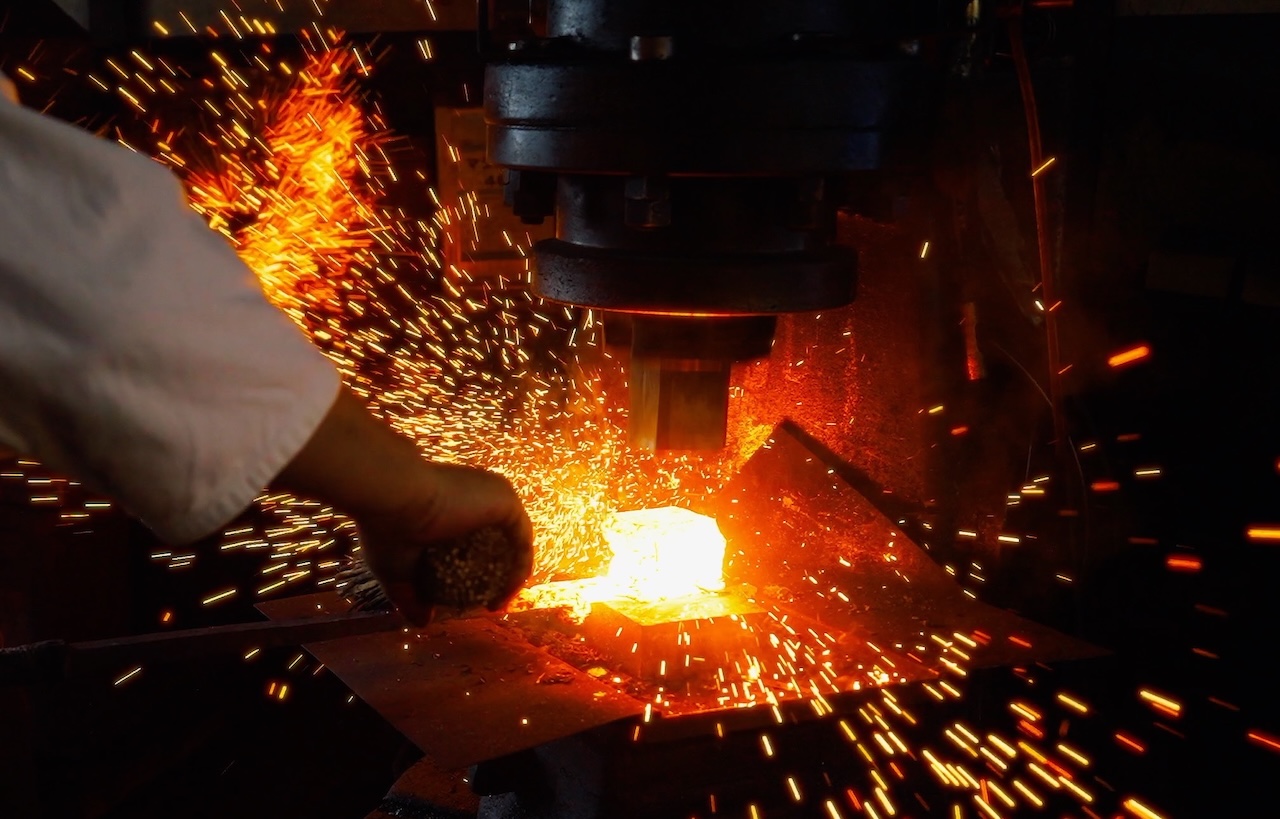
Tamahagane is the high-grade steel that the tatara, a traditional Japanese clay furnace, smelts from iron sand and charcoal, and it is the raw material of the Japanese sword. The Society for Preservation of Japanese Art Swords (NBTHK, known in Japan as Nittoho) calls it indispensable to sword making. The tamahagane that Japan’s swordsmiths work with comes from a single furnace, the Nittoho Tatara in Okuizumo, Shimane, and in principle only swordsmiths can obtain it.
| What it is | Steel smelted from iron sand and charcoal in a clay tatara furnace (NBTHK) |
|---|---|
| Carbon content | Grades 1 and 2: 0.5 to 1.2%, with an almost uniform fracture surface (NBTHK) |
| Where it is made | Nittoho Tatara, Okuizumo Town, Shimane, run by NBTHK with cooperation from Proterial (Japanese Sword Museum) |
| One smelt | Three days and three nights, giving a bloom (kera) of about 2.5 tons (NBTHK) |
| Who can buy it | In principle only swordsmiths, distributed about once a year (NBTHK) |
| Steel per sword | About 4 kg of tamahagane for a finished blade of about 1 kg (Japan Tourism Agency) |
| Can you visit | The Nittoho Tatara is not open to the public (JNTO). The nearby Okuizumo Tatara and Sword Museum closes for renovation from December 1, 2026 (Okuizumo Town tourism guide) |
What is tamahagane steel?
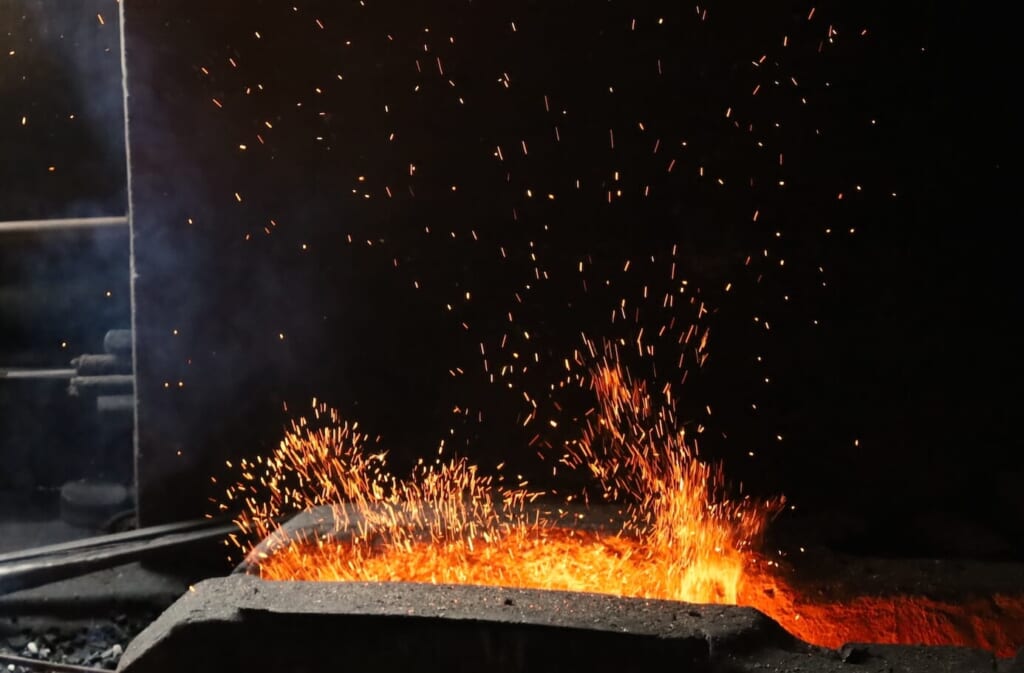
Tamahagane is the best steel taken from the kera, the multi-ton mass of iron, slag and steel left in the furnace after a tatara smelt. The Japan Tourism Agency states that tatara smelting is the only way to produce tamahagane, and that its strength and ductility have made it an irreplaceable sword material since the Edo period (1603 to 1867).
The Japanese Sword Museum in Tokyo, which NBTHK runs, sorts tatara iron into three classes by carbon content: tetsu (0 to 0.03%), hagane or steel (0.03 to 1.7%) and zuku or pig iron (1.7% and above). Tamahagane is the hagane with an especially even, sound fracture surface, and it goes straight into a sword as it is. NBTHK sorts what comes out of each smelt like this:
| Material | Carbon content | How smiths use it |
|---|---|---|
| Tamahagane, grades 1 and 2 | 0.5 to 1.2%, fracture surface almost uniform | Sword steel, used directly (Japanese Sword Museum) |
| Oroshigane material | Varies widely | Mainly the soft core steel, shingane (NBTHK) |
| Zuku (pig iron) | 1.7% and above, more fully melted | Too much carbon, so it must be decarburized before use (Japanese Sword Museum) |
How does the tatara furnace make tamahagane?
A tatara smelt runs for three days and three nights. The crew charges iron sand and charcoal into the clay furnace in turns, then breaks the furnace apart to drag out a kera of about 2.5 tons. NBTHK calls this step, kera-dashi, the most tense and powerful moment of the whole operation. Because the furnace is destroyed to remove the steel, a new clay furnace is built for every smelt.
Historic figures show the scale. At the Sugaya tatara in Unnan, one three-day cycle used about 12 tons of iron sand and 13 tons of charcoal to make roughly 3 tons of kera, and the flame had to stay at 1,300 to 1,500°C. The iron sand came from kanna-nagashi, a method that washed hillside soil down channels so the heavy sand settled out. Japan’s Agency for Cultural Affairs notes that the mined land was turned into rice terraces afterwards.
A short history of tatara steel
- Late 6th century: the tatara method dates to this period, according to the Japan Tourism Agency.
- 733: the Izumo Fudoki gazetteer already praises local iron as hard and suited to many tools (Japan Heritage).
- Late Edo to Meiji periods: about 80% of Japan’s iron was made at the foot of the Chugoku Mountains around Izumo (Japan Heritage).
- 1920s: tatara works closed down, unable to compete with modern furnaces.
- 1933 to 1945: a small operation made tamahagane for military sabers and stopped when the war ended. Only 5 to 6 metric tons of tamahagane remained afterwards.
- 1976 to 1977: NBTHK rebuilt the furnace at the old Yasukuni tatara site in Okuizumo on June 24, 1976, and lit it on November 8, 1977.
Why do Japanese swordsmiths use tamahagane?
Japanese swordsmiths use tamahagane because traditional forging is built around it. Shimane Prefecture’s announcement of the national designation explains that only a sword made from tamahagane gains its outstanding performance and its artistic qualities: a graceful shape, a refined steel surface (jihada) and the hamon, or temper line. The same text warns that switching to other iron would mean abandoning traditional forging methods.
The blade’s design explains the rest. The Japanese Sword Museum describes the goal as a sword that does not break, does not bend and cuts well. A blade must be hard to cut and resist bending, yet soft to avoid snapping. Smiths resolve this by wrapping a soft, low-carbon core in hard, high-carbon skin steel, and tamahagane supplies that skin steel. For how this design developed over a thousand years, read our history of the Japanese sword.
How is tamahagane graded and folded?
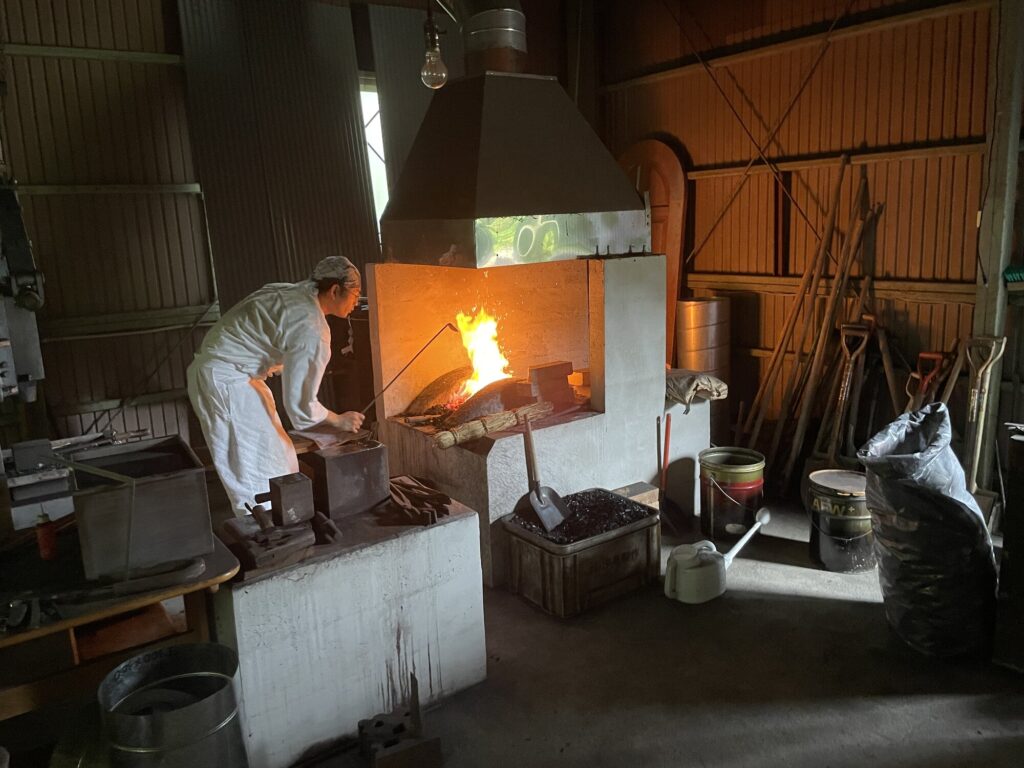
Every winter the Nittoho Tatara smelts its steel, and each year around May the tamahagane is sorted, graded and sold to swordsmiths throughout the country. NBTHK’s classification lists tamahagane in grades 1 and 2 and sets aside pieces with uneven carbon, mainly for core steel. In the workshop, about 4 kg of tamahagane becomes a blade of about 1 kg. The Japanese Sword Museum describes the general process like this:
| Step | What the smith does |
|---|---|
| 1. Mizuheshi and kowari | Heats the tamahagane, hammers it to about 5 mm thick, breaks it into 2 to 2.5 cm pieces and picks the best 3 to 4 kg |
| 2. Tsumiwakashi | Stacks the pieces on a holder called a teko and heats them in the hearth until they fuse into one block |
| 3. Tanren (folding) | Hammers the block flat and folds it in two, about 15 times, to adjust the carbon and drive out impurities. This makes the hard skin steel, kawagane |
| 4. Shingane and assembly | Wraps a soft core (shingane) in the skin steel. Methods such as kobuse, honsanmai and shihozume vary by school and smith |
| 5. Sunobe and hizukuri | Draws the steel into a flat bar, then shapes the blade with a small hammer and a file |
| 6. Tsuchioki and yaki-ire | Coats the blade with clay mixed with charcoal and whetstone powder, thin where the edge will harden, heats it to about 800°C and quenches it |
| 7. Finishing and signature | Corrects bends, rough-polishes, files the tang, drills the peg hole and signs the tang |
About 15 folds give roughly 33,000 layers by the museum’s own calculation, which it names as one reason the Japanese sword is so tough. The Japan Tourism Agency adds that before folding, the stacked pieces are covered with muddy water and ash, and that after hardening a specialist polisher takes over the blade.
Who makes tamahagane today?
NBTHK makes it. The society runs the Nittoho Tatara directly, with cooperation from Proterial and Torikami Mokutansen Kojo, and supplies the tamahagane to swordsmiths nationwide. Proterial is the steel company that changed its name from Hitachi Metals in January 2023. Shimane Prefecture describes the furnace as kept alight with Proterial’s technical cooperation.
The head of each smelt is the murage. Horio Kaoru, born in Okuizumo, trained under the late murage Kihara Akira and became murage in July 2024. In an interview with Shimane’s governor, he said 12 trainee murage hold appointments from NBTHK.
The work has national protection. “Tamahagane production (tatara-buki)” was first chosen as a Selected Conservation Technique under Japan’s cultural properties law on May 11, 1977, and in July 2024 Japan’s Council for Cultural Affairs recommended selecting it again, with Horio as its holder. The surrounding landscape is recognized too. Tatara sites in Yasugi, Unnan and Okuizumo became Japan Heritage sites in 2016, and in August 2025 the UN Food and Agriculture Organization recognized Okuizumo’s farming system, built on terraces and channels left by iron sand mining, as a Globally Important Agricultural Heritage System.
Is tamahagane used for kitchen knives?
Tamahagane is seldom used for kitchen knives. NBTHK distributes it about once a year, and in principle only swordsmiths can obtain it. So a genuine tamahagane kitchen knife normally comes from a swordsmith’s forge rather than a knife factory. If a shop sells a knife as tamahagane, ask who forged it and where the steel came from.
Everyday knife steel from the tatara was historically a different product. In Unnan’s account, the lower-grade zuku and bukera were decarburized into flat bars called wari-tetsu, also known as hocho-tetsu, or “kitchen-knife iron”, which smiths used for knives, farm tools and carpentry tools.
Knives sold as Yasugi steel are another case. Proterial makes Yasugi Specialty Steel at its Yasugi Works and presents it as heir to the tradition of tatara iron-making. The Japan Tourism Agency describes it as a new variety of steel that came from twentieth-century steelmaking. It is a modern steel, not tamahagane. For more on Japanese kitchen knives, see our guide to Seki knives.
To hold a tamahagane blade you made yourself, Japan Documented Visits arranges a private tamahagane knife forging workshop in Seki, Gifu. You work a raw block of tamahagane with a licensed swordsmith, heat and hammer it, apply the clay and set your own hamon, then grind, sharpen and fit the handle. It takes 4 hours, costs 154,000 yen per knife, is guided in English and is open to adults 18 and over.
Where can you see a tatara furnace or a swordsmith at work?
You cannot watch the Nittoho Tatara itself, which is not open to the public. These places show the furnace, the steel or the forging.
| Place | What you can see | Visitor notes |
|---|---|---|
| Okuizumo Tatara and Sword Museum, Okuizumo, Shimane | A life-size cross-section model of a tatara furnace, bellows you can try, and sword forging demonstrations by swordsmith Kobayashi on the second Sunday and fourth Saturday of each month at 10:00 AM and 1:00 PM (Okuizumo tourism guide) | Closed for renovation from December 1, 2026 until further notice. Before that: 9:30 AM to 5:00 PM, closed Tuesdays, adults 530 yen or 1,270 yen on demonstration days |
| Sugaya Tatara Sannai, Unnan, Shimane | An ironworking village that ran for 130 years until 1921, with the only takadono furnace building in Japan still in its original state (Unnan City Tatara Project Council) | Open to the public. Designated an Important Tangible Folk Cultural Property in 1967 |
| Wako Museum, Yasugi, Shimane | Full-size dioramas and a 15-minute film of a Nittoho Tatara smelt, with English subtitles on request (Japan Tourism Agency) | Confirm current hours and fees with the museum before you go |
| Bizen Osafune Sword Museum, Setouchi, Okayama | A resident swordsmith who works in view of visitors on most days, though he may be away (Setouchi City) | 9:00 AM to 5:00 PM, last entry 4:30 PM, closed Mondays. Adults 500 yen, which can change during special exhibitions (Setouchi City) |
| Japanese Sword Museum, Ryogoku, Tokyo | NBTHK’s own museum of finished swords, a 7-minute walk from the West Exit of JR Ryogoku Station (museum site) | 9:30 AM to 5:00 PM, last entry 4:30 PM, closed Mondays. Adults 1,000 yen, or 1,500 yen during the special exhibition from October 24 to December 20, 2026 (admission page) |
| Seki, Gifu (Japan Documented Visits) | A private demonstration in which a licensed swordsmith forges tamahagane through the tanren and hizukuri stages, narrated in English | About 1.5 to 2 hours with transfer from Seki Station, 121,000 yen per private group of up to 6 |
To reach Okuizumo, JNTO suggests flying from Haneda to Izumo Airport, about 1 hour, then driving about 1 hour to the tatara area. The Okuizumo museum is a 15-minute walk from Izumo-Yokota Station on the JR Kisuki Line. Because of the renovation closure, call the museum on 0854-52-2770 before planning a trip around it.
To handle a sword rather than watch one being made, compare the two cutting arts in our guide to iaido vs battodo, or read about our samurai sword-cutting experience in Tokyo.
Frequently Asked Questions
What is tamahagane made from?
Tamahagane is made from iron sand and charcoal, smelted together for three days and three nights in a clay tatara furnace. NBTHK describes the tatara as an ancient Japanese method that produces high-purity iron from these two materials. Tamahagane is the best steel sorted from the resulting bloom, which weighs about 2.5 tons.
Can tourists buy tamahagane in Japan?
Tamahagane is not sold to tourists in the normal way. NBTHK, which runs the only furnace supplying Japan’s swordsmiths, states that in principle only swordsmiths can obtain tamahagane, and it distributes the steel about once a year. The practical way to work with it is a swordsmith-led workshop.
Can you visit the Nittoho Tatara in Okuizumo?
The Nittoho Tatara is not open to the public. The nearby Okuizumo Tatara and Sword Museum explains the furnace with a life-size model and holds forging demonstrations, but it closes for renovation from December 1, 2026, with no reopening date announced yet.
How much tamahagane does one Japanese sword need?
One Japanese sword uses about 4 kg of tamahagane, and the finished blade weighs about 1 kg, according to the Japan Tourism Agency. The Japanese Sword Museum says the smith starts by selecting the best 3 to 4 kg of broken tamahagane pieces.
How many times is tamahagane folded?
Tamahagane is folded about 15 times when making the skin steel of a Japanese sword. The Japanese Sword Museum calculates that this gives roughly 33,000 layers. Folding adjusts the carbon content and removes impurities, and the museum names it as one reason the sword is so tough.
Last checked: October 2026. Museum hours, closures, prices and demonstration days change, so confirm with the official sources linked above before you travel.
Share