
Japan’s power bank rules changed on April 24, 2026, and they now shape how you fly, ride the shinkansen, and charge devices in your hotel. On flights you may carry up to two power banks per person, each rated 160Wh or less, in your cabin bag only, with no charging of the power bank onboard and no using it to charge devices during the flight. On trains and in hotels there is no legal limit, so you can use a 20,000mAh charger freely from your seat or your room. This guide covers the airline limits, the mAh-to-Wh math, and the train and hotel questions travelers actually ask.
For many travelers in Japan, a smartphone is more than just a convenience. It is a map, translation tool, train guide, payment method, camera, and emergency contact device. That is why power banks, also known as portable chargers or mobile batteries, have become an essential travel item.
However, Japan introduced stricter rules for carrying and using power banks on aircraft from April 24, 2026. The new rules limit the number of power banks passengers can bring, prohibit charging power banks onboard, and restrict the use of power banks to charge smartphones and other devices during flights. These changes are based on updated international aviation safety standards and guidance from Japan’s Ministry of Land, Infrastructure, Transport and Tourism.
Reference:モバイルバッテリーの機内持込みの新たなルールについて
This guide explains the current rules in plain English, including how many power banks you can carry, whether they can go in checked baggage, how to check the Wh rating, and what travelers should do before flying to, from, or within Japan.
Quick Answer: What Changed from April 24, 2026?
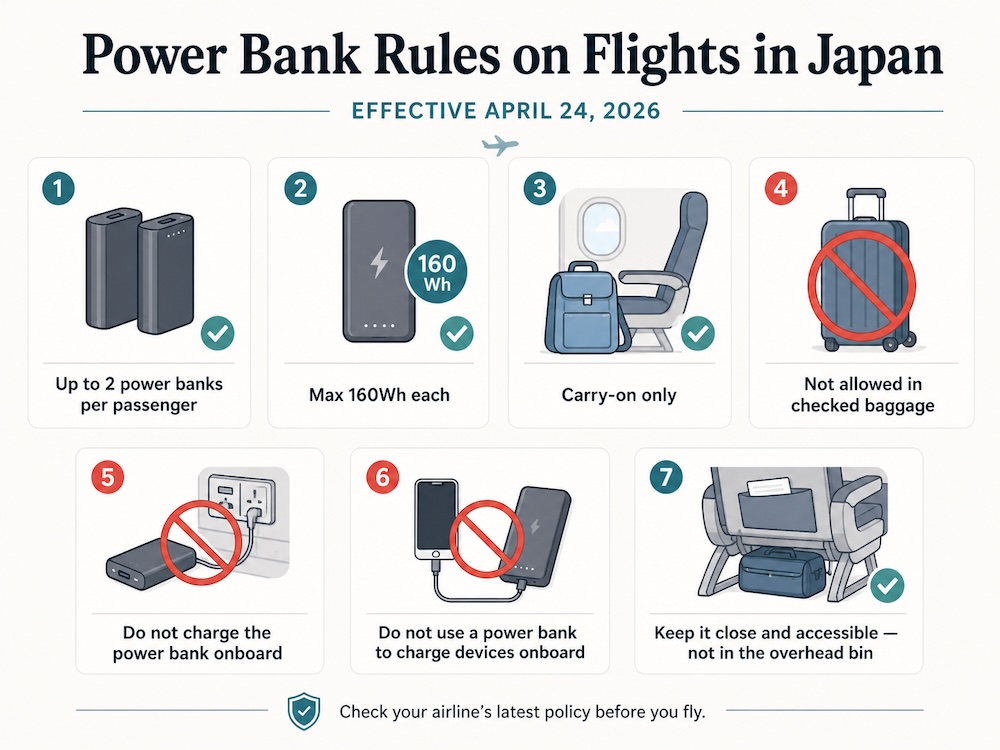
As of April 24, 2026, passengers should follow these basic rules when bringing power banks on flights in Japan:
| Item | Current Rule |
|---|---|
| Number of power banks | Up to 2 per passenger |
| Capacity limit | 160Wh or less per power bank |
| Checked baggage | Not allowed |
| Carry-on baggage | Required |
| Charging the power bank onboard | Prohibited |
| Charging devices from a power bank onboard | Prohibited |
| Storage during flight | Keep it close and accessible, not in overhead storage |
Japan Airlines states that passengers may bring no more than two power banks per person, each rated at 160Wh or less. JAL also prohibits charging power banks through in-seat power outlets or USB ports and prohibits using power banks to charge other electronic devices while onboard.
Reference: JAL Regulation
Power Bank Rules by Airline: JAL, ANA, Peach, ZIPAIR and More
JAL, ANA, Peach, ZIPAIR, Jetstar Japan, Skymark and Spring Japan all follow the same national rule from April 24, 2026: up to two power banks per person, each 160Wh or less, in your cabin bag only, with no charging the power bank and no charging devices from it during the flight. What differs is the wording and how much detail each airline gives on batteries between 100Wh and 160Wh.
How many power banks each airline allows
| Airline | Power banks allowed | Items over 100Wh (up to 160Wh) |
|---|---|---|
| Japan national rule (MLIT) | 2, max 160Wh each | 2 in total, spare batteries included |
| JAL | 2, max 160Wh each | 2 in total, spare batteries included |
| ANA | 2, max 160Wh each | 2 in total, spare batteries included |
| Peach | 2, max 160Wh each | 2 in total, spare batteries included |
| ZIPAIR | 2, max 160Wh each | Not detailed; national rule applies |
| Jetstar Japan | 2, max 160Wh each | Not detailed; national rule applies |
| Skymark | 2, max 160Wh each | Spare batteries: up to 2; national rule applies |
| Spring Japan | 2, max 160Wh each | Not detailed; national rule applies |
In-flight charging and where to keep it
| Airline | Charging the bank or your devices from it | Where to keep it |
|---|---|---|
| Japan national rule | Both banned | At hand or in the seat pocket, not the overhead bin |
| JAL | Both banned | Not the overhead bin |
| ANA | Charging the bank banned; asks you to “refrain” from charging devices | Not stated* |
| Peach | Both banned | Not stated* |
| ZIPAIR | Both banned | Not stated* |
| Jetstar Japan | Both banned | At hand or in the seat pocket, not the overhead bin |
| Skymark | Both banned | At hand or in the seat pocket, not the overhead bin |
| Spring Japan | Both banned; no charging points onboard | Not stated* |
*Not on the airline’s own page, but the joint rules of the Scheduled Airlines Association of Japan, which all seven airlines belong to, bar power banks from overhead compartments. Last verified: September 2026. The Jetstar Japan, Skymark and Spring Japan links go to Japanese-language notices.
How the over-100Wh count works. Japan’s rule puts no count limit on spare batteries of 100Wh or less (ANA caps them at 20), but power banks and spares between 100Wh and 160Wh share a cap of two. Two power banks of 100Wh or less leave room for two such spares, one power bank over 100Wh cuts that to one, and two over 100Wh leave none. None of these airline pages asks for advance approval in this range, but JAL and Peach say a battery whose Wh rating cannot be confirmed may be refused.
Wording differences. ANA’s own notice only asks passengers to “refrain” from charging devices from a power bank, but the joint airline rules ANA follows list it as prohibited, so treat it as banned on every airline here. Spring Japan has no charging points on its aircraft, so board fully charged. Spring Japan also repeats JAL’s warning that the 160Wh cap may drop to 100Wh from January 2027.
Flying a non-Japanese airline? Japan’s national tourism organization tells passengers on foreign airlines’ international routes to check that airline’s own page, and the transport ministry notes that some airlines may set stricter rules.
Can You Bring a Power Bank on a Plane in Japan?
Yes. You can bring a power bank on a plane in Japan, but it must be carried in your cabin baggage. You cannot place power banks in checked luggage.
This is because power banks contain lithium-ion batteries, which can overheat, emit smoke, or catch fire if damaged, short-circuited, or improperly handled. Keeping them in the cabin allows passengers and crew to notice problems quickly and respond if something goes wrong.
Japan’s transport ministry states that power banks must not be placed in checked baggage and should be brought into the cabin. The same guidance also states that power banks over 160Wh are not allowed.
How Many Power Banks Can You Carry?
The current limit is two power banks per passenger.
Each power bank must be 160Wh or less. This limit applies to power banks carried onboard the aircraft, and airlines may also consider how power banks are combined with other spare lithium-ion batteries. ANA, for example, explains that the number of power banks you can carry depends on how they are combined with lithium-ion spare batteries rated between 100Wh and 160Wh.
For most travelers, this will not be a problem. Common power banks used for smartphones are usually far below 160Wh. A typical 10,000mAh power bank is often around 37Wh, and a 20,000mAh model is often around 74Wh, depending on its voltage.
Still, you should check the printed label on your device before flying. If the Wh rating is missing, airport staff or airline staff may not be able to confirm that your power bank is allowed.
Can You Put Power Banks in Checked Baggage?
No. Power banks cannot be placed in checked baggage.
They must be carried in cabin baggage. This is not a new idea in aviation safety, but the 2026 update makes the handling of power banks stricter and clearer for passengers.
ANA’s baggage guidance states that power banks can be carried onboard but are not permitted in checked baggage. Japan’s transport ministry also states that passengers must not place mobile batteries in checked baggage.
In practical terms, this means you should not pack your power bank deep inside your suitcase before checking it in. Keep it in your carry-on bag, personal item, or another accessible place.
Can You Use a Power Bank During the Flight?
No. Under the updated rules, you should not use a power bank to charge your smartphone, tablet, headphones, camera, or other electronic devices during the flight.
You also cannot charge the power bank itself using the aircraft’s USB port, in-seat power outlet, or other onboard charging equipment.
This is one of the biggest changes for travelers. In the past, many passengers used power banks freely during flights. Under the new rules, the safer approach is to fully charge your phone, tablet, camera, and other devices before boarding.
JAL states that both charging power banks through in-seat power outlets or USB ports and using power banks to charge other electronic devices onboard are prohibited. Skymark gives the same guidance for passengers from April 24, 2026.
Where Should You Keep Your Power Bank During the Flight?
Keep your power bank somewhere close and accessible.
Japan’s transport ministry advises passengers not to store power banks in overhead compartments. Instead, they should be kept nearby, such as in a seat pocket or another place within reach.
This matters because lithium-ion battery problems need to be noticed quickly. If a battery starts to overheat or emit smoke inside an overhead bin, it may take longer for passengers or crew to identify the source.
A good rule of thumb is simple: keep your power bank in your personal bag under the seat or somewhere you can immediately access it if needed.
How to Check Your Power Bank’s Wh Rating
Airlines use watt-hours, written as Wh, to determine whether a lithium-ion battery is allowed.
Some power banks clearly show the Wh rating on the product label. Others only show mAh and voltage. If your power bank does not show Wh, you can calculate it with this formula:
Wh = mAh × V ÷ 1000
Japan’s transport ministry uses the same calculation method in its official guidance.
Here are common examples:
| Power Bank Capacity | Typical Voltage | Approximate Wh |
|---|---|---|
| 5,000mAh | 3.7V | 18.5Wh |
| 10,000mAh | 3.7V | 37Wh |
| 20,000mAh | 3.7V | 74Wh |
| 27,000mAh | 3.7V | 99.9Wh |
These examples are only rough calculations. Always check the actual label on your device.
If the Wh rating is over 160Wh, the power bank is not allowed. If the rating is unclear, contact your airline before departure.
What About Spare Batteries for Cameras, Drones, or Laptops?
Spare lithium-ion batteries are handled separately from regular electronic devices, but they still require care.
ANA states that spare batteries cannot be checked in and must be carried onboard. It also explains that up to two lithium-ion spare batteries rated over 100Wh and up to 160Wh can be carried onboard, and that short-circuit prevention measures are required.
This is especially relevant for photographers, videographers, drone users, and business travelers carrying multiple device batteries.
Before flying, make sure spare batteries are individually protected. You can do this by:
- Keeping them in their original packaging
- Covering exposed terminals with tape
- Placing each battery in a separate plastic bag or protective pouch
- Avoiding contact with metal objects such as keys, coins, or cables
Japan’s transport ministry also recommends protecting terminals and avoiding storage with other batteries or metal objects to prevent short circuits.
Why Japan Tightened the Rules
The stricter rules are not just bureaucratic. They reflect a real safety concern.
Lithium-ion batteries are widely used because they are compact, rechargeable, and efficient. But if they are damaged, exposed to heat, poorly manufactured, or short-circuited, they can overheat and cause fires.
The International Civil Aviation Organization introduced new specifications for lithium battery-powered power banks on March 27, 2026. ICAO stated that power banks would be limited to two per passenger and that passengers would be prohibited from recharging them during flights.
In Japan, the National Institute of Technology and Evaluation reported 1,860 accidents involving lithium-ion battery-powered products between 2020 and 2024. About 85% of those accidents, or 1,587 cases, developed into fire-related incidents.
For travelers, the practical lesson is straightforward: power banks are useful, but they need to be treated as battery devices with real fire risk, not just casual accessories.
Will the Rules Change Again?
Possibly.
JAL notes that due to anticipated changes to International Air Transport Association regulations, the capacity limit may be reduced to 100Wh from January 2027.
That does not mean every traveler needs to panic. Most smartphone power banks are already below 100Wh. However, travelers with larger power banks, high-capacity laptop chargers, camera batteries, or professional filming equipment should pay close attention to future updates.
Before flying, always check your airline’s official baggage page. Airline-specific rules may be stricter than the general standard.
Traveler Checklist Before Flying in Japan
Before your flight, use this checklist:
- Check the Wh rating printed on your power bank.
- Make sure each power bank is 160Wh or less.
- Bring no more than two power banks.
- Do not pack power banks in checked baggage.
- Keep power banks in your carry-on baggage.
- Protect terminals from short circuits.
- Do not charge the power bank onboard.
- Do not use the power bank to charge your phone or other devices onboard.
- Keep the power bank close and accessible during the flight.
- Check your airline’s latest rules before departure.
The safest strategy is to charge your phone, camera, headphones, and other devices before boarding. If your aircraft has seat power or USB charging, use it directly for your device if the airline allows it, but do not use it to charge your power bank.
FAQ
Can I bring a 20,000mAh power bank on a plane in Japan?
In most cases, yes. A typical 20,000mAh power bank using 3.7V is about 74Wh, which is below the 160Wh limit. However, you should check the actual Wh rating printed on the device.
Can I bring two power banks?
Yes. The current rule allows up to two power banks per passenger, each rated at 160Wh or less.
Can I put a power bank in checked luggage?
No. Power banks must be carried in cabin baggage and cannot be placed in checked baggage.
Can I charge my phone with a power bank during the flight?
No. Under the updated rules, using a power bank to charge smartphones, tablets, or other electronic devices during the flight is prohibited.
Can I charge my power bank using the seat USB port?
No. Charging a power bank through an aircraft’s USB port or in-seat power outlet is prohibited.
What happens if my power bank does not show Wh?
If the Wh rating is not printed, use the formula Wh = mAh × V ÷ 1000. If you still cannot confirm the rating, contact your airline before departure. Airport staff may refuse items that cannot be verified.
Are the rules the same for every airline?
Not always. The basic rules are aligned with Japanese and international aviation safety standards, but individual airlines may apply stricter rules. Always check your airline’s official baggage guidance before flying. For JAL, ANA, Peach, ZIPAIR, Jetstar Japan, Skymark and Spring Japan, the core limits match; see the airline table above.
Final Thoughts
Power banks are still allowed on flights in Japan, but the rules are now stricter than before.
For most travelers, the impact is manageable. A normal smartphone power bank is usually well below the 160Wh limit, and bringing one or two power banks in carry-on baggage should be acceptable. The biggest change is behavior during the flight: do not charge your power bank onboard, and do not use it to charge your phone or other devices while in the air.
If you are traveling to Japan, flying domestically within Japan, or leaving Japan by air, check your power bank before departure, keep it in your carry-on baggage, and make sure it stays close and accessible during the flight.
Official Sources and References
This article is based on official guidance and public safety information from the following sources:
- Japan Ministry of Land, Infrastructure, Transport and Tourism: New rules for carrying mobile batteries onboard aircraft.
- Japan National Tourism Organization: New carry-on power bank regulations effective from April 24, 2026.
- Japan Airlines: Updates to the handling of power banks onboard aircraft from April 24, 2026.
- All Nippon Airways: Conditions for carry-on and check-in items, including power banks and lithium-ion batteries.
- International Civil Aviation Organization: New power bank specifications effective March 27, 2026.
- National Institute of Technology and Evaluation: Lithium-ion battery accident data from 2020 to 2024.
Power Bank Rules on Japanese Trains and the Shinkansen
Japan’s aviation limits stop at the aircraft door. There is no legal cap on power bank size or quantity on JR trains, the shinkansen, subways, or city buses. You can carry a 20,000mAh charger and use it freely from your seat.
A few practical notes for rail travelers:
- Green Cars and most reserved shinkansen seats now have a personal AC outlet at your seat or under the window, so on long rides you often will not need the power bank at all.
- Older local trains and some rapid services have no outlets. This is where a power bank earns its place.
- Keep the charger in your bag or on the tray table, not wedged into a seat gap where it can be crushed. A damaged lithium cell is the real hazard, on a train just as on a plane.
- If you are building your trip around a rail pass, our complete guide to the JR Pass explains how to reserve seats that have power outlets.
Using Power Banks in Japanese Hotels and Ryokan
Hotels and ryokan place no restrictions on power banks. You can charge your devices and recharge the power bank itself overnight in your room.
Two things are worth knowing:
- Japanese outlets are Type A, 100V, the same plug shape as North America. Most power banks and chargers are dual voltage, but check the small print on your charger before you plug in.
- Traditional ryokan rooms sometimes have very few accessible sockets, often just one near the tea set. A power bank keeps your phone topped up overnight without hunting for an outlet. For more on what to expect, read our essential tips for a ryokan stay.
Capacity Limits: How to Read mAh and Wh
The airline limit is written in watt-hours (Wh), but most power banks are labeled in milliamp-hours (mAh). Convert with this formula:
Wh = (mAh ÷ 1000) × voltage
Most power banks run at 3.7V, which gives these common figures:
- 10,000mAh is about 37Wh (allowed)
- 20,000mAh is about 74Wh (allowed)
- 27,000mAh is about 100Wh (allowed, and the practical ceiling for hassle-free travel)
- Above roughly 43,000mAh you approach the 160Wh line, which is the absolute cabin maximum in Japan
Anything at or under 100Wh is accepted without airline approval. Between 100Wh and 160Wh you may still carry it, but airlines combine the count with your other spare lithium batteries, so confirm with your carrier before you fly.
2026 Status: What Is Current Right Now
As of 2026, the rules introduced on April 24, 2026 are the ones in force: two power banks per person, 160Wh maximum, cabin baggage only, no recharging the power bank onboard, and no using it to charge devices during the flight on carriers such as JAL and ANA. Train and hotel rules are unchanged. Before you fly home, it is also worth checking what you cannot pack at all. Our guide to medications you can’t bring into Japan covers the other customs surprise that catches visitors off guard.
More Power Bank Questions
Can I use a power bank on the shinkansen or a JR train?
Yes. Japan’s airline limits do not apply on the ground. There is no cap on power bank size or number on the shinkansen, JR trains, subways, or buses, and you can use one freely from your seat. Many shinkansen seats already have a personal AC outlet, so on long rides you may not need it at all.
Are power banks allowed in Japanese hotels and ryokan?
Yes. Hotels and ryokan set no restrictions on carrying, using, or recharging power banks in your room. Japanese outlets are Type A, 100V, the same shape as North American plugs, and most chargers are dual voltage. Traditional ryokan rooms can have very few accessible sockets, so a power bank is handy for keeping your phone charged overnight.
How do I convert my power bank’s mAh to Wh?
Multiply the mAh by the voltage (usually 3.7V) and divide by 1,000. A 20,000mAh battery is about 74Wh, and a 27,000mAh battery is about 100Wh. Anything at or under 100Wh flies without airline approval, and 160Wh is the absolute cabin maximum in Japan.
Can I buy a power bank in Japan if mine is too big to fly home?
Yes. Power banks are sold at electronics stores like Bic Camera and Yodobashi, at Don Quijote, and in many convenience stores. Choose a model rated at or under 100Wh (roughly 27,000mAh or less) so it clears every airline without special approval on your flight home.
How do I dispose of a power bank in Japan?
Do not put lithium power banks in regular household trash. Large electronics retailers and home centers have battery recycling collection boxes, often marked with the JBRC recycling logo. Tape over the terminals before you drop it off, and ask staff if you cannot find a bin.
Share