
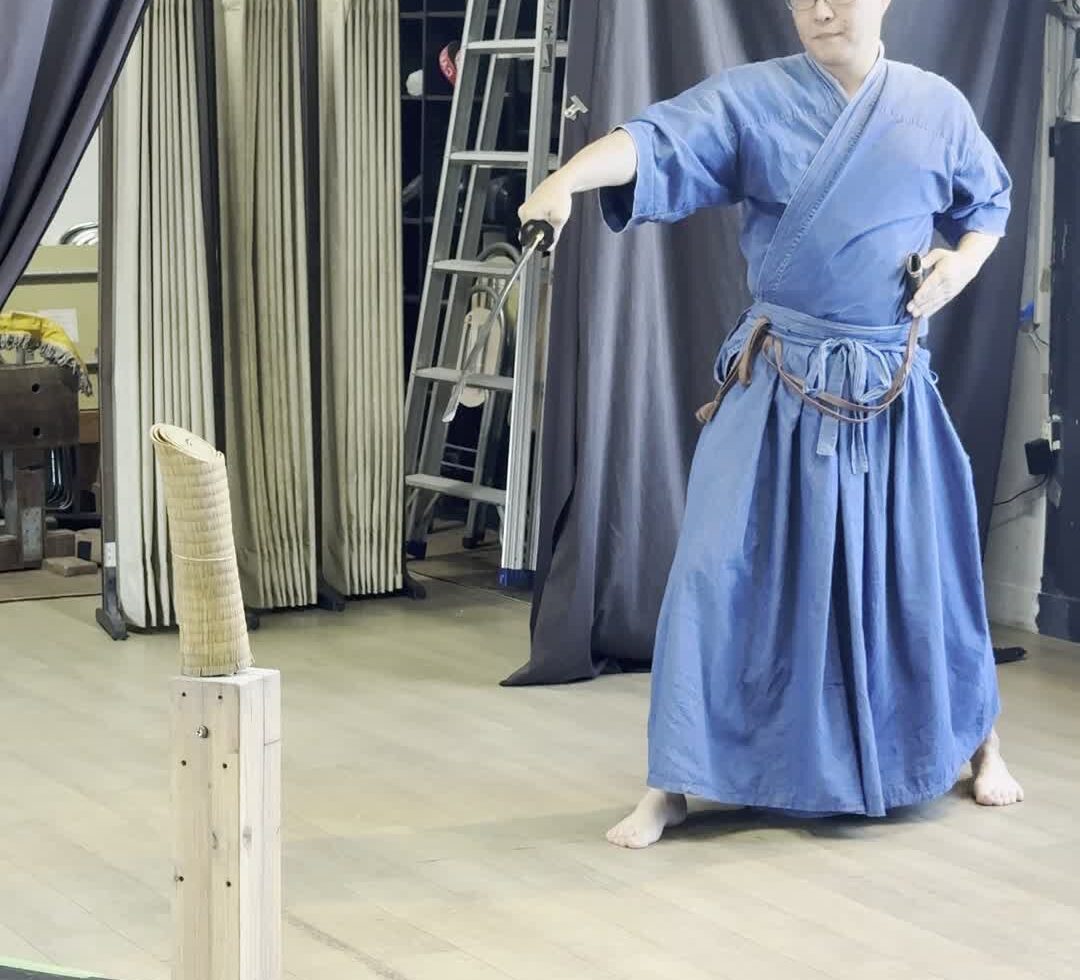
A samurai sword-cutting experience in Tokyo taught me two things fast. A real katana is heavier than it looks, and cutting the target is only half of it: you also have to stop the blade safely afterwards. I tried it at a dojo in Tokyo with Kamiide-san, an experienced Japanese sword instructor, and the thing that stayed with me wasn’t the cut itself. It was how much control a real katana demands.
I had seen Japanese swords plenty of times before, whether in museums, in films, or behind glass, but holding one myself changed my impression in a second. On screen a katana looks quick and almost weightless. In your hands it has real mass, and once the blade is moving, staying in control of it is the whole game. That became very real the moment it was my turn to cut.
This is a first-hand account. Everything below happened during our own session in Tokyo, and every photo and video here was filmed on the day.
What a beginner samurai sword-cutting session looks like
The experience did not begin with cutting. Before we picked up anything sharp, the session moved through clear stages, and that structure turned out to be the point:
- Reihō (etiquette): how to bow and carry yourself in the dojo.
- Bokutō practice: learning the swing with a wooden sword.
- Handling a shinken: drawing and holding a real, sharpened blade.
- Tameshigiri: the actual cut through rolled tatami.
For a proper explanation of how battōdō differs from iaidō and battojutsu, we cover that separately in our guide to the difference between iaido and battodo. Here, I want to stick to what it actually felt like.
It starts and ends with a bow
The first thing Kamiide-san taught us was reihō, or etiquette. We bowed before we began, and we bowed again at the end. There’s a well-worn phrase in Japanese martial arts, “budō begins and ends with respect,” and it can sound like a slogan until you actually go through the sequence inside a dojo.
You don’t wander in, grab a sword, and start swinging. There’s a deliberate line between everyday movement and training: you stand properly, you listen, you bow, and you pay attention to the instructor, to the sword, and to the space around you. For anyone coming to Japan because of an interest in samurai or katana culture, this part matters. The sword is never treated as a tourist prop. It’s a weapon, and the room feels like it.
Learning the swing with a wooden sword
Before anyone touched a real blade, we practised with a bokutō, a wooden sword. Kamiide-san, barefoot on the wooden floor in an indigo keikogi and hakama, demonstrated the basic sequence: how to hold the sword, how to set the body, how to raise it, and how to bring it down.
Watching it, the movement looked straightforward. Doing it correctly was another matter. My first instinct was to muscle the sword with my arms, but it isn’t meant to be a wild swing. The position of the hands, the shoulders, the feet, and the angle of the blade all feed into the cut. So we repeated it: raise, cut, stop, reset, and again. That repetition mattered more than I realised at the time. A mistake with a wooden sword is forgiving; the same mistake with a sharp one is not, which is exactly why Kamiide-san built the movement up slowly instead of handing a beginner a live blade.
Holding a real katana
Eventually we moved from the bokutō to a shinken, a real sharpened Japanese sword. Kamiide-san showed us how to draw and hold it first.
The atmosphere shifted straight away. Part of it was in my head, because I knew the blade was sharp, but a lot of it was physical. Up close, a real-katana experience is nothing like looking at a sword behind glass. The steel has real mass, and holding it out in front of you, you feel that weight immediately. There was something oddly concrete about all of it, too: the fittings, the wrapped handle in my hands, the cool steel, the faint metallic smell when I leaned in close. Most of all, I became aware of exactly where the edge was at every moment. That sounds obvious. It wasn’t.
Tameshigiri: cutting rolled tatami
The centrepiece of the experience was tameshigiri, cutting a rolled tatami target. The target was more substantial than I’d pictured: dense and slightly damp-looking, the tightly packed layers visible around the edges. (Rolled tatami is used because, soaked and bound, it’s often compared to the resistance of a real limb, which tells you why technique matters.) Before I tried, Kamiide-san demonstrated.
The whole thing was quick: a short sound as the blade moved through the air, then almost immediately the sound of the cut, and the top of the roll sliding cleanly off. Watching an experienced practitioner, it looked effortless. It was not effortless when I tried.
Stopping the blade was harder than cutting
Beforehand, I was only thinking about whether I’d get through the tatami at all. With the sword actually in my hands, a second concern arrived: what happens after the blade passes through the target? A katana carries momentum. If I just threw all my strength into the downward swing, the sword wasn’t going to politely stop once the tatami was cut. If I lost control, I could picture the blade carrying on toward the floor, or toward my own leg.
That possibility was not theoretical with a live blade in my grip, and it made me concentrate far harder than I expected. It was also the moment all that bokutō repetition suddenly made sense. I needed enough commitment for the sword to travel through the target, and enough control to keep it from travelling anywhere else.
When my turn came, I set my grip, fixed my stance, raised the sword, locked onto the target, and cut. There was a brief resistance as the edge met the tatami, then a sudden sense of release as it passed through, cleaner than I’d imagined, with no dramatic jolt up my arms. And then, immediately, the part I’d been worrying about: bringing the blade back under control before anything else. Only once it was safely stopped could I look down and actually see the cut, a clean diagonal cross-section through the packed layers of the roll.
A real blade changes how you move
The bokutō and the real sword were technically the same lesson, but mentally they were nothing alike. With the wooden sword I was asking myself, “Am I doing the movement right?” With the real one, the only question was, “Where exactly is the edge?” That single shift changed my posture and my focus, and it made even small corrections from Kamiide-san land differently. The angle of the blade mattered. The position of my feet mattered. The direction the sword would travel after the cut mattered, and stopping safely mattered as much as making contact.
That’s why I came away appreciating how gradually the lesson was taught. At no point was I simply handed a dangerous object and left to work it out. We practised first, watched the demonstrations, took corrections, and only then moved to the live blade. It felt controlled without feeling staged.
Is a samurai sword-cutting experience in Tokyo worth it?
For anyone drawn to samurai history or Japanese swords, the value of a samurai sword-cutting experience is that it turns something abstract into something physical. You can stand in front of a hundred katana in a museum and still have no idea what holding one feels like. You can watch a thousand on-screen sword fights and never once think about what the blade does after the strike. Trying it yourself gives you a completely different reference point.
Three things stayed with me:
- A real Japanese sword is heavier than it looks.
- A clean cut is about control and technique, not swinging hard.
- Handling a sharp blade is what finally makes the etiquette and the caution make sense.
This isn’t dressing up in samurai costume for a photo. The interesting part is learning a small slice of how the weapon is genuinely handled. For travellers who want to try samurai sword cutting in Japan, it was one of the most direct ways I’ve found to actually feel Japanese sword culture rather than just look at it.
Want to try this yourself?
We run this exact session with Kamiide-san as a private, English-friendly experience in Tokyo. Free consultation, and we reply in English within 24 hours.
Enquire about this experience →FAQ: samurai sword-cutting & tameshigiri in Tokyo
Is a samurai sword-cutting experience dangerous?
A real Japanese sword is obviously dangerous if it’s handled badly. In our session, though, the training built up in stages: we learned the movement with a wooden sword first, watched Kamiide-san demonstrate, and got corrections before ever handling a sharp blade. I still felt nervous, and some nervousness is honestly appropriate, but the experience itself was closely supervised throughout.
Can beginners actually use a real katana?
In our case, yes. Using a real sword was part of the supervised experience. That doesn’t mean beginners are free to wave one around: the instructor teaches the basic movement first and decides how the session progresses. Exact rules can differ by dojo and provider.
Do I need any martial arts or sword experience?
No. I had no prior sword training. The lesson was built for beginners, starting with etiquette and basic movements before progressing to tameshigiri. If you’ve never held a sword before, that’s completely normal here.
Can children try tameshigiri?
Age requirements vary by dojo, instructor, and program. Because a real blade may be involved, families should check the minimum age and participation rules directly when booking.
What should I wear?
Clothes you can move and stand securely in. You’ll be raising your arms, shifting your stance, and handling a sword, so anything restrictive is a bad idea. Follow any specific clothing or footwear instructions the dojo gives you when you reserve.
What’s the difference between battōdō and tameshigiri?
In simple terms, tameshigiri was the actual cutting practice I did within the wider battōdō experience. For how battōdō, iaidō, and related sword arts relate to one another, see our full guide to the difference between iaido and battodo.
How do I book a tameshigiri experience in Tokyo?
Book in advance rather than treating the dojo as a drop-in attraction. You can check availability and send an enquiry from our Iaido & Battodo experience page, and we reply in English within 24 hours.
Final thoughts
Before this, I mostly thought about a katana in terms of how sharp it is. Afterwards, I thought far more about its weight. A sword doesn’t stop just because the target has been cut. You have to control the blade before, during, and after the strike, and that’s the part photos and videos had never conveyed to me.
The cut itself lasted a moment. What stayed with me was everything around it: the bow before training, the repetition with the bokutō, the weight of the steel in my hands, the sound of the blade splitting the air, and the immediate need to bring it safely under control the instant the tatami fell away. I didn’t leave the dojo feeling like a swordsman. I left with a much clearer sense of how demanding it is just to handle a real Japanese sword with control. For me, that’s exactly what made it worth doing.
Try a samurai sword-cutting experience in Tokyo
Private, beginner-friendly, and led in English by Kamiide-san. Tell us your dates and we’ll build the session around you, then reply within 24 hours.
Enquire now →Share