
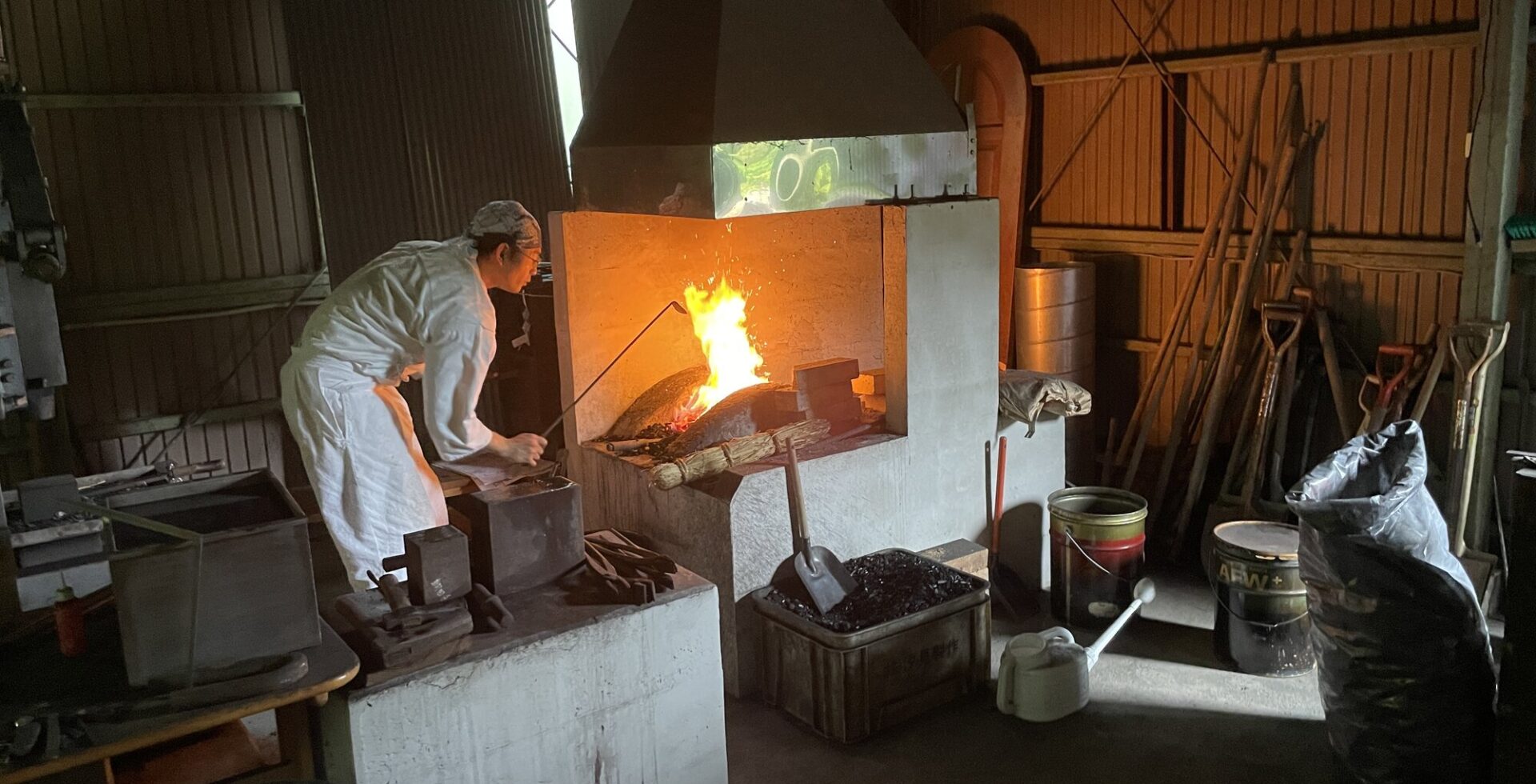
The first thing you notice at a working sword forge is not the sword. It is the noise. A power hammer strikes, sparks fly from the steel, and the person at the center of it all simply keeps talking to you in English, as if this were just another ordinary day.
Tucked away in Gifu Prefecture, the small city of Seki has been making blades since the Kamakura period. Here, you can stand just a few steps away while a licensed swordsmith heats and hammers a real Japanese sword. This guide covers what to expect from the demonstration, why Seki is the place to see it, and what two people who live and work with blades there told us about the craft you will be watching.
The sword forging demonstration at a glance
This private demonstration takes place at a working forge in Seki and focuses on the stages where a sword actually takes shape.
- What you see: a licensed swordsmith heating and hammering tamahagane (the traditional steel used for Japanese swords) through the forging (tanren) and fire-forming (hizukuri) stages
- How long: about 1.5 to 2 hours in total, including the short ride from the station
- Language: the swordsmith narrates the entire process in English
- Who can join: private groups, with no age, height or build restrictions
- Getting there: free pickup and drop-off at Seki Station, about 10 minutes by car from the workshop
- What it is not: a hands-on class. You can watch, ask questions and take photos, but you will not make or take home a sword
Full details, current pricing and the inquiry form are on the Japanese Master Swordsmith Demonstration with Pickup page.
Why Seki, of all places
Ask people in Seki why their town makes blades, and you will usually hear the same three words: earth, water and wood.
Koji Inohara, a former chef who now runs Blacksmith Japan Inc., a knife and sword shop in Seki, put it this way when we interviewed him in 2024:
“Swordsmiths moved to the Seki area because the soil, the water and the hō wood used for scabbards were all easy to find here. They have been making swords ever since.”
He traces these roots back roughly seven hundred years. Official histories place the arrival of the first smiths in the Kamakura period, some eight centuries ago. By the feudal era, more than three hundred swordsmiths worked in the town. Two of them, Kanemoto and Kanesada, became some of the most celebrated names in the Mino school of sword making.
Then the work nearly stopped. The 1876 edict that ended the public wearing of swords, and the years after the Second World War when sword making was barred under the Allied occupation, left the smiths without their main trade. “There were times when swords could not be made,” Inohara said, “and in those times they made kitchen knives instead.” That turn is how Seki became one of the best known knife towns in the world.
The swords did not disappear, though. A small number of licensed smiths still forge them in Seki today, and this demonstration lets you stand inside one of their workshops.
What happens at the forge
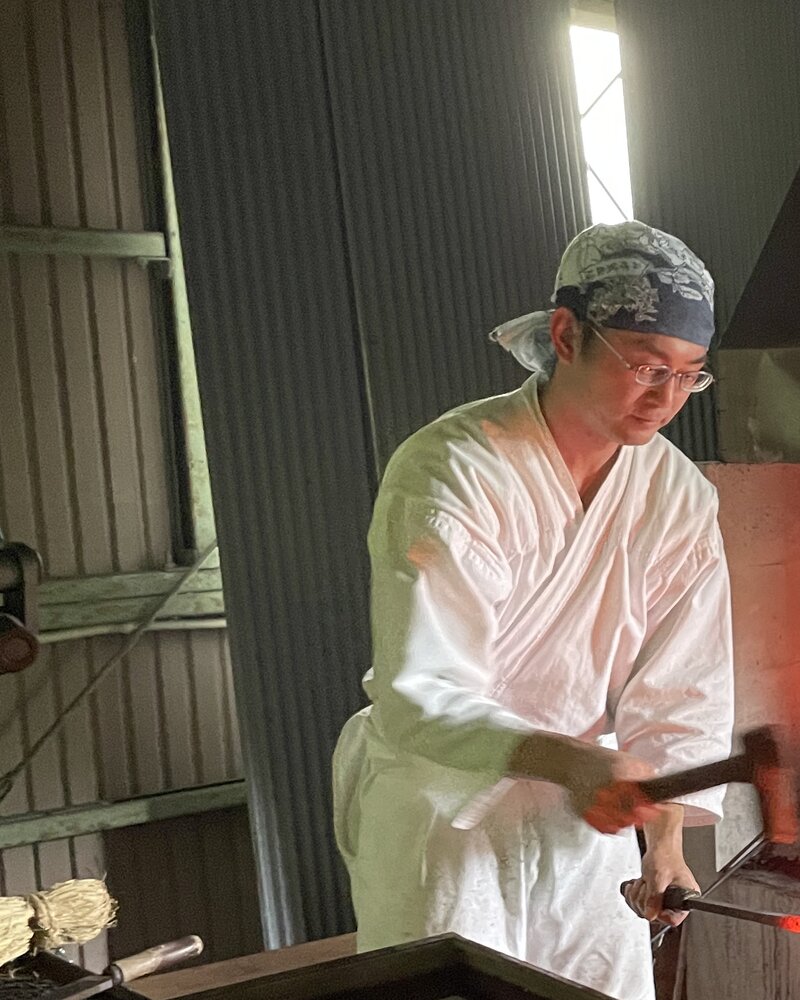
Your host is a young licensed swordsmith based in Seki. The demonstration focuses on two stages:
- Forging (tanren). The steel is heated until it glows, then hammered, folded and hammered again. This is the loud part, and the moment most visitors come to see.
- Fire-forming (hizukuri). The forged bar is drawn out and shaped into the rough form of a blade.
The raw material is tamahagane, steel smelted in a traditional clay furnace called a tatara. It is the same material used for samurai swords, and it is difficult to work. That difficulty is exactly what makes the next section of this guide matter.
Want to see this up close?
We arrange this demonstration as a private, English-narrated visit in Seki with pickup from Seki Station. Send us your dates and we reply in English within 24 hours.
Enquire about this demonstration →What you are really watching
To understand what is at stake with every hammer blow, it helps to hear from a smith directly. Kanetoki Kojima is a swordsmith in Seki whom we interviewed in 2024, when he had been forging for twenty-six years. He is not the host of this demonstration, but the craft he describes is the one you will see.
When we asked what goes through his mind while he works, his answer depended on the stage. At the grinding wheel, it was this:
“Mushin. No mind. At this stage, no mind at all.”
Earlier in the process, while the steel is still being worked down, it is the opposite.
“When I’m taking the weight down, I’m praying that no flaw comes out. Praying the whole time. ‘Don’t come out, don’t come out.’”
The reason he prays is simple. A single flaw in the steel can end a blade.
“If a flaw comes out, everything I’ve done for the past month is gone. More than a month, probably. The iron that melted away doesn’t come back. It’s a minus start.”
Kojima told us this happens to him two or three times a year. Japan limits licensed smiths to registering twenty-four swords a year, so each lost blade is a real share of a year’s work.
Keep that in mind while you stand at the forge. The sparks are spectacular, but the smith in front of you is also watching for something you cannot see, and hoping it never appears.
Why no two swords are alike
Over the years, Inohara has handled a great many swords. The thing he finds most fascinating is how impossible they are to repeat.
“Even from the same maker, the shape, the curvature, the length and the hamon are all different. There is not a single identical sword in the world.”
The hamon is the temper line along the edge, formed when the clay-coated blade is quenched in water. You will not see a hamon appear during this demonstration, because it comes much later in the process. But what you are watching at the forge is the start of an object that will never exist twice.
He also explained why the work matters to him, in a way that stayed with us.
“However much a human being achieves, we only live a hundred years. A sword lasts hundreds of years. It stays behind after the person is gone.”
Is the demonstration worth it?
That depends on what you want out of your day.
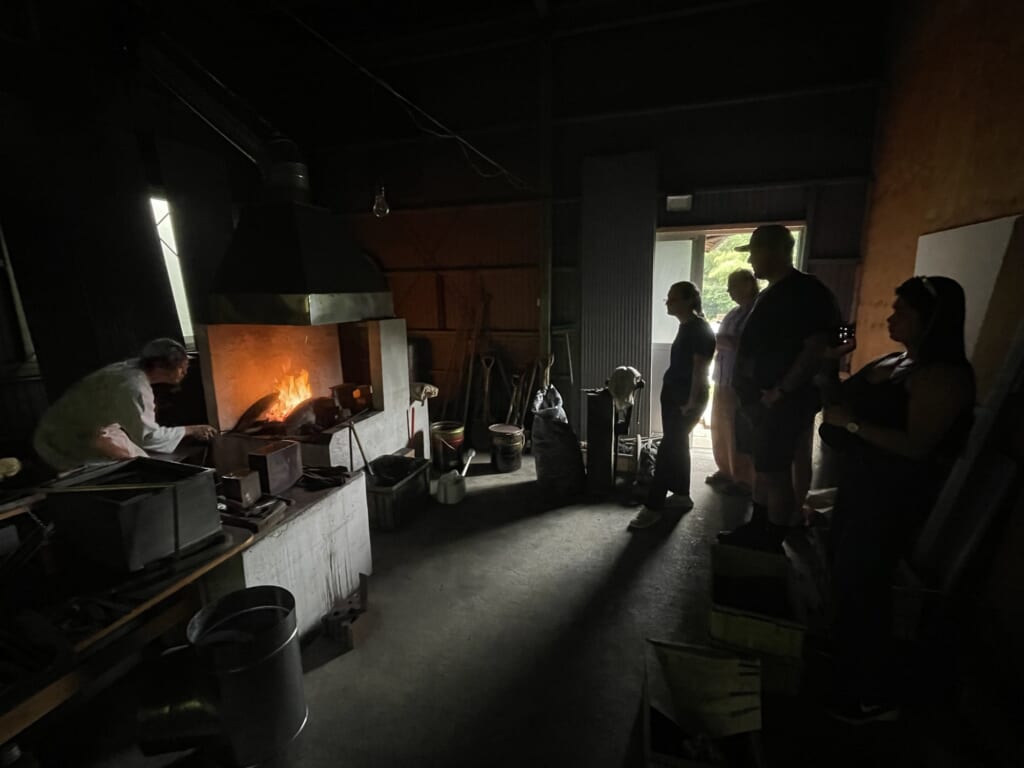
Choose the demonstration if you want to see a real Japanese sword being forged at close range, you are traveling with children or older family members, or you would rather watch, film and ask questions than work the steel yourself. There are no age restrictions, and photos and video are welcome throughout.
Choose a hands-on workshop instead if you want to hammer steel yourself and leave with something you made. Seki also offers a hands-on knife forging workshop where you forge your own kitchen knife from tamahagane with a licensed swordsmith.
A few honest cautions:
- It is loud. The hammering and the power hammer are constant, so this is not recommended for anyone sensitive to noise.
- Sparks fly. Very rarely they can cause a minor burn or mark clothing, so wear clothes you do not mind getting dirty, ideally flame resistant.
- You do not take a sword home. This is an observation experience.
Practical tips for visiting Seki
- Getting to Seki: Seki Station is the meeting point, and pickup and drop-off there are included. Transfers from Gifu or Nagoya Station are available for a surcharge.
- Timing: the demonstration runs year round, including in light rain. It is closed from December 31 to January 4.
- Make a day of it: the Seki Traditional Swordsmith Museum in the city introduces the history of Seki’s blades and is an easy addition before or after your visit.
- Ask questions: the smith narrates in English and answers questions directly. For many visitors, this is the part they remember most.
FAQ: watching katana forging in Seki
Can I watch a Japanese sword being forged in Japan?
Yes. In Seki, Gifu, a licensed swordsmith offers a private demonstration in English. You watch tamahagane being forged and fire-formed into the rough shape of a blade, standing a few steps from the forge.
Do I make a sword myself?
No. The demonstration is observation only. If you want to forge something yourself, a separate knife making workshop in Seki lets you make your own kitchen knife from tamahagane.
Is the demonstration suitable for children?
There are no age, height or build restrictions. It is loud and involves fire and sparks, so consider whether your children are comfortable with sudden, loud noise.
Is it in English?
Yes. The swordsmith narrates the whole demonstration in English.
How do I get to Seki?
Seki is in Gifu Prefecture in central Japan. The demonstration includes free pickup and drop-off at Seki Station, and transfers from Gifu or Nagoya Station can be arranged for a surcharge.
Why are Japanese swords so rare?
Only a small number of smiths in Japan are licensed to forge traditional swords, and each licensed smith may register up to twenty-four swords a year. Add the weeks of work behind each blade and the risk of a single flaw destroying it, and genuine Japanese swords remain scarce.
Final thoughts
At the end of our interview, we asked Kojima what the most enjoyable part of his twenty-six years at the forge had been. He told us there was none.
“There’s no end to it. There’s no such thing as mastering it.”
He did not say it as a complaint. It was simply how the work looks from the inside. An hour in a Seki forge will not show you all of that, but it will show you the heat, the noise and the attention a single blade demands. And it will change how you look at every Japanese sword you see afterwards.
Watch a swordsmith forge a katana in Seki
Private, English-narrated, with free pickup from Seki Station. Tell us your dates and we reply within 24 hours.
Enquire now →Share