
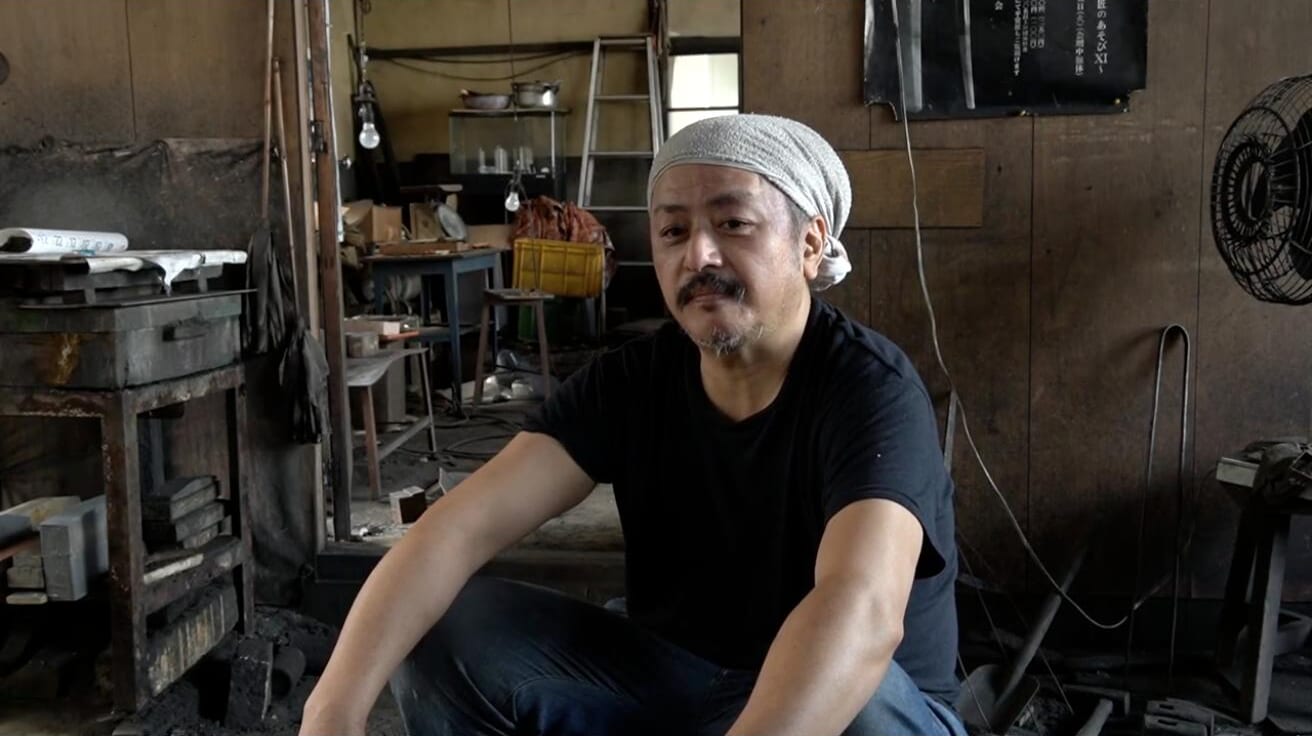
When I am taking the weight down, I am praying that no flaw comes out. Praying the whole time.
Kanetoki Kojima can tell whether a blade is straight by looking at it. No jig, no gauge, just his eye and twenty-six years of them. But the part of his work he talks about most is not the looking. It is the praying. In Seki, a small city in Gifu Prefecture that has been making blades for roughly seven hundred years, two men sit on either side of the same steel: the one who forges it, and the one who puts it in your hands.
“Don’t Come Out, Don’t Come Out”
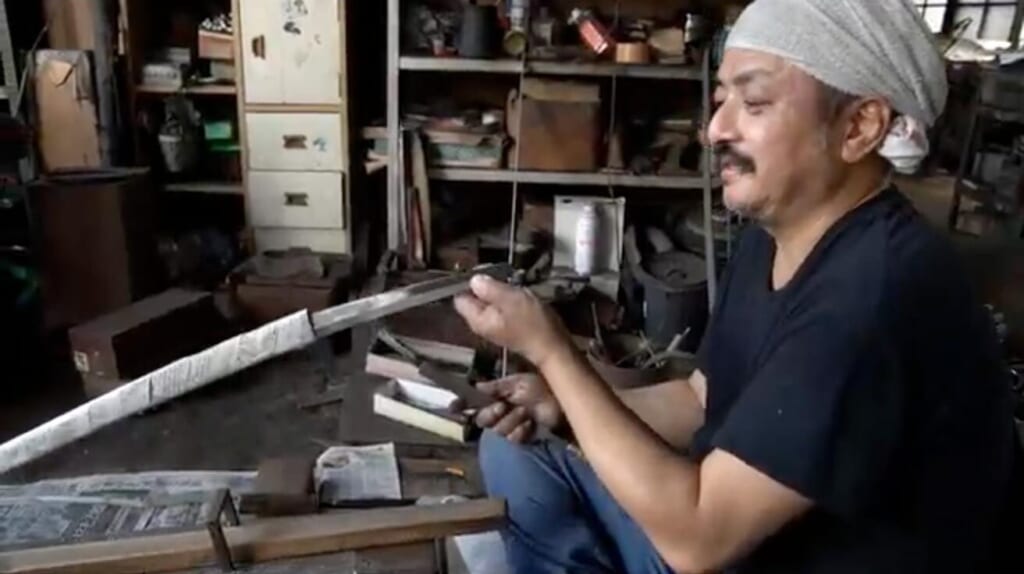
Watch Kanetoki Kojima at the grinding wheel and the first thing you notice is how little he measures. He marks the steel, bites into it, checks the line against his eye, and marks it again.
How do you tell if it’s straight? Is it purely by eye?
By eye.
And what are you thinking about while you do this?
Mushin. No mind. At this stage, no mind at all.
That answer is easy to romanticize, so it is worth pausing on what he says next, because it is the opposite of serene.
You’re not in that state at the earlier stage?
When I’m taking the weight down, I’m praying that no flaw comes out. Praying the whole time. “Don’t come out, don’t come out.”
And if one does?
If a flaw comes out, everything I’ve done for the past month is gone.
A month?
More than a month, probably. All of it gone.
Back to the beginning?
Not the beginning, exactly. It doesn’t come back. The iron that melted away is gone.
So you start from minus.
That’s right. A minus start. Once a flaw shows, you’re already in the negative.
How often does that happen?
Two or three a year.
There is no undo in this work. Steel that has been burned off in the fire does not return, so a failed blade does not put a smith back where he started. It puts him behind. Kojima says this in the flat, unbothered voice of a man describing the weather, and then goes back to grinding.
When I’m taking the weight down, I’m praying that no flaw comes out. Praying the whole time. “Don’t come out, don’t come out.”
Kanetoki Kojima, swordsmith
Twenty-Four Blades a Year
Japan limits how many swords a licensed smith may register in a year. “The country allows up to twenty-four a year as swords,” Kojima says. “Making them, you can make as many as you like.” The cap is a legal ceiling on registered blades, not on practice, and it is one reason a genuine Japanese sword is a scarce object rather than a manufactured one.
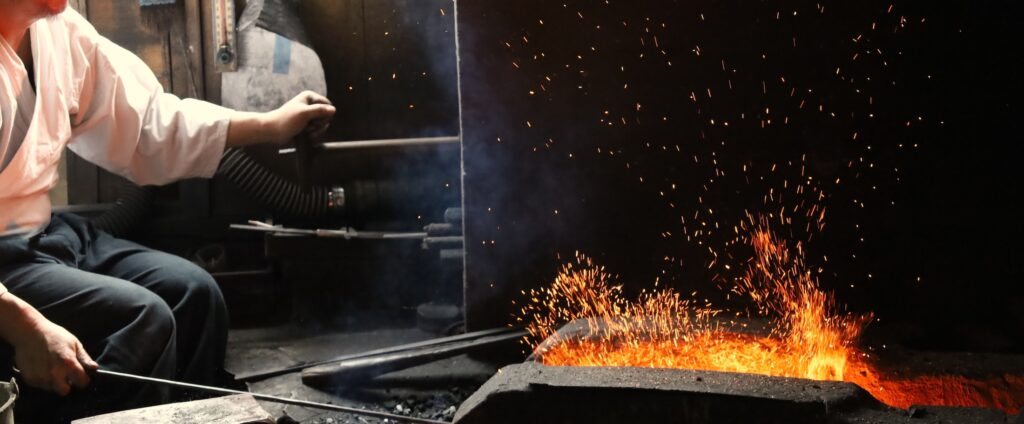
Kojima had been forging for twenty-six years when we visited him in 2024. The first five of those were his apprenticeship, which is the standard road into the trade: you train under a licensed smith for roughly five years before you can sit the certifying examination. He is the fourth generation of his family to do this work, counting back to his great-grandfather, whose photograph hangs in the workshop.
Kanetoki is his swordsmith name, the name he signs. The kane character has run through Seki’s smiths for centuries, in names like Kanemoto and Kanesada, the two masters who made the region’s reputation.
Asked about the hardest part of the job, he does not reach for anything lofty.
Has there been anything really tough?
Injuries, mostly. And bumping heads with people. That happens constantly. Arguments.
What’s the worst thing anyone’s said to you?
The worst thing? I don’t remember. There have been too many.
What’s the most dangerous part of making a sword?
Grinding debris in the eye. That’s the one I hate. That one hurts. Burns are nothing.
That does sound dangerous.
My eyesight dropped off all at once because of that. It took about a month to heal.
The Chef Who Came for the Steel
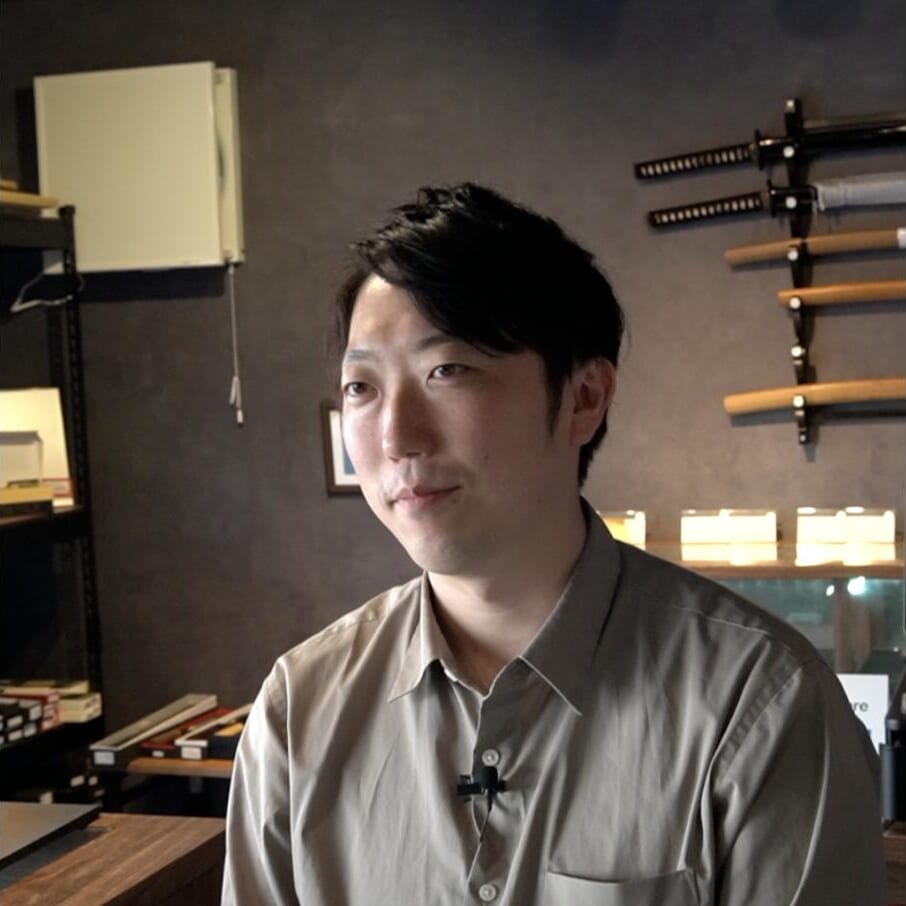
Elsewhere in the same town, Koji Inohara does something a swordsmith rarely does: he explains all of this in the language of a working kitchen.
Inohara is the CEO of Blacksmith Japan Inc., a shop in Seki that sells kitchen knives and Japanese swords. He is not from here. He grew up in Numazu, in Shizuoka Prefecture, and he came to blades through food.
How did you start working with blades?
I used to be a chef overseas. Japanese knives were incredibly well known there, and it was obvious how much people outside Japan wanted them. So when I came back to Japan and had to decide what to do next, I wanted to do something connected to knives. That’s why I moved to Seki.
Where did you cook?
Canada and Australia.
Why those two?
Those were the working holiday visas I could get.
Were Japanese knives a big deal there?
Enormously. The chefs there, and I know I’m Japanese so I would say this, but they were always telling me how good Japanese knives are.
He had been in Seki about five and a half years when we spoke. He now sells the work of the people who make it, including smiths like Kojima, whose blades pass through his shop.
What a Chef’s Hand Knows
Ask Inohara why a chef abroad reaches for a Japanese knife and you get an answer with a cutting board under it.
What actually makes a Japanese knife different?
It cuts well, and delicate work is easier with it. The edge is simply sharper.
On what, specifically?
Honestly, anything, but fish is one, and slicing meat after it’s been cooked is another. It’s really good for that. Basically, when you’re cutting something fine, or you have to cut something thin, a sharper edge makes it easier.
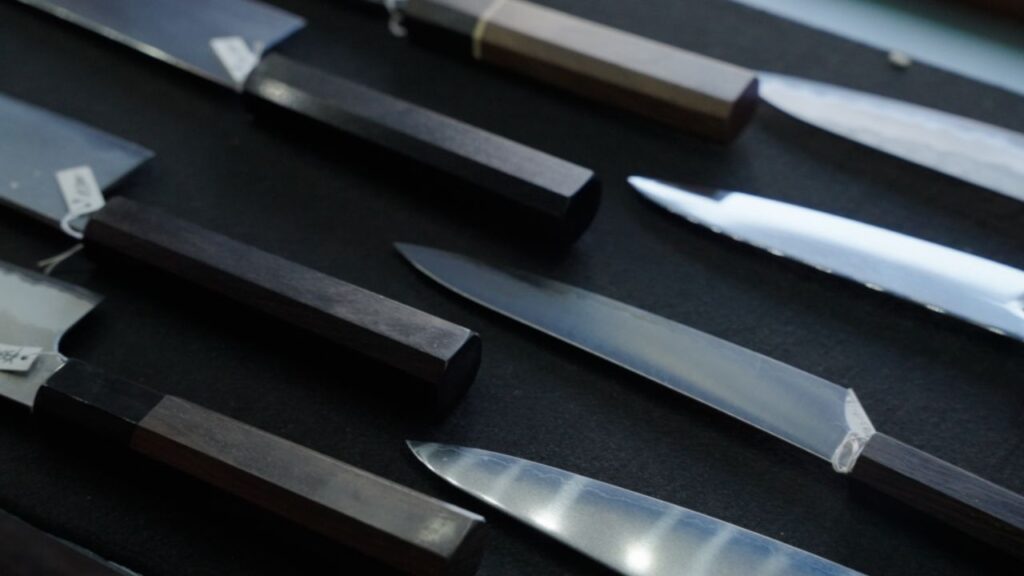
He is equally direct about the alternative.
Compared to the other great blade regions, Germany for instance, is the knife itself different?
German knives are thick, so my impression is that you can knock them around and treat them fairly roughly without breaking them. Japanese knives, and Seki knives specifically, were made to slice thinly, as I said. They’ve been built around pursuing the edge above everything. That’s the difference.
That is a buying guide compressed into two sentences. A thick European blade forgives a heavy hand. A Japanese blade rewards a careful one and asks for care in return. Which you should own depends less on prestige than on what you actually do at the counter.
Every Blade Is a Different Blade
For all his practicality, the thing Inohara lights up about is not a kitchen knife.
What’s the single greatest appeal of the sword, for you?
The greatest appeal? That every single one is different. Even from the same maker, the shape, the curvature, the length, the hamon, all of it is different. There is not a single identical sword in the world. That’s what I find fascinating.
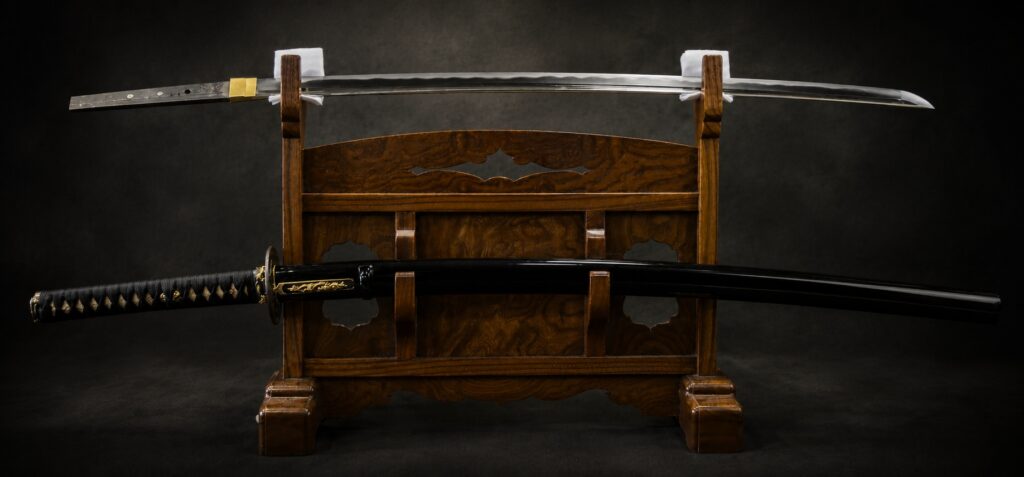
Hamon is the temper line, the cloudy border left along the edge when the clay-coated blade meets the water. It is the closest thing a sword has to a fingerprint, and no smith can repeat one exactly, which is why Kojima’s month of praying matters. Each blade is the only one of itself that will ever exist.
He returns often to a line he heard from a swordsmith years ago, in a previous job at a company that made swords.
Is there something someone said that stayed with you?
An old swordsmith once told me that the swords we make today are imitations of the old ones, so how close you can get to them is the whole contest. The reason the great old blades survive is that they were made superbly and then looked after, which is why they’re still here centuries later. He said he wanted to make something as close to that as he could, a sword that would still be here after he was gone. That stayed with me.
Why do swords, specifically?
However well a human being does, we only live a hundred years. A sword lasts hundreds. I always thought that was a wonderful thing. It stays behind after the person is gone.
“I Was Happy When Someone Held It”
Kojima, asked for the best moment in twenty-six years, does not name a prize or a commission.
What’s the happiest thing that’s happened in this work?
When someone picked one up and was happy with it, and posted that on social media. That made me happy.
It is a small answer and an unexpectedly modern one. The reward is not the making. It is the moment the object reaches a person who wanted it.
Inohara thinks about where those people are, and his answer has no border in it.
How should swords be passed on?
They should go to people who will genuinely take care of them. It has nothing to do with whether that’s inside Japan or outside it. If someone overseas understands how to handle one and maintains it properly, it will survive hundreds of years over there too. I just want them to end up with people who can look after them properly.
What about the culture itself?
I want the appeal of the sword to reach as many people as possible, and I feel strongly about carrying this culture and tradition through to the next generation. So I think constantly about training craftspeople and how to spread the culture of the sword among younger people.
It has nothing to do with whether that’s inside Japan or outside it. If someone overseas understands how to handle one and maintains it properly, it will survive hundreds of years over there too.
Koji Inohara, CEO of Blacksmith Japan Inc.
Standing in the Workshop
None of this reads the same from a screen. The forge is loud, the sparks travel, and the rhythm of the hammer is the part no photograph carries.
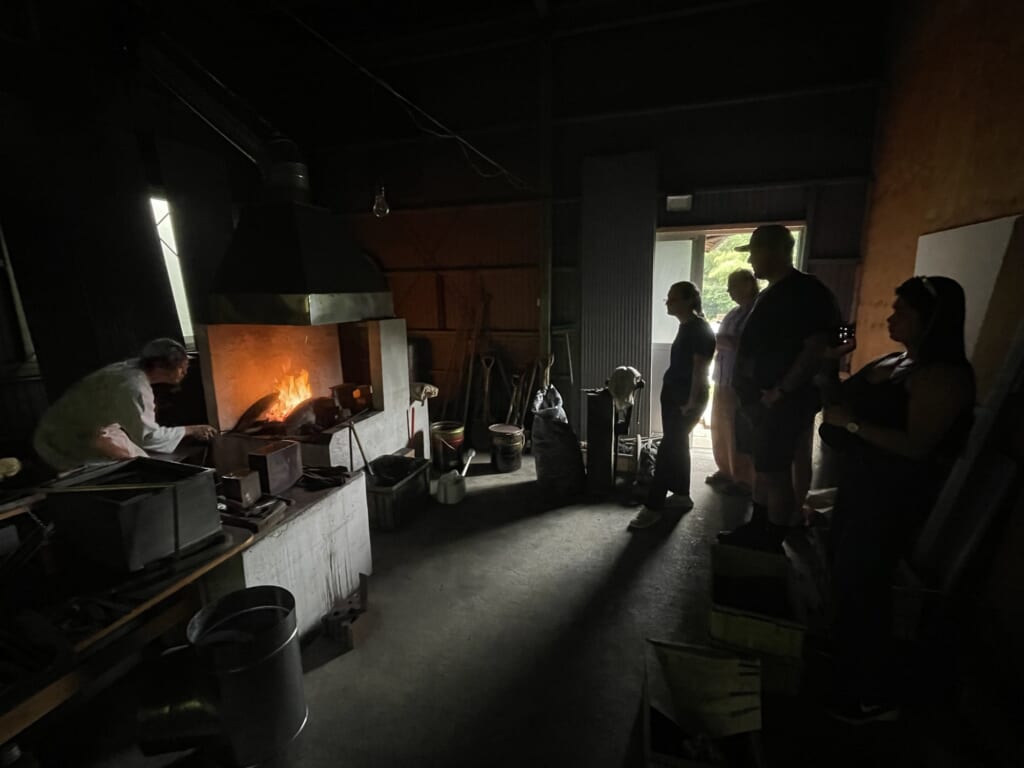
Two experiences in Seki put visitors inside that room, both narrated in English by the swordsmith.
Watch a sword being forged
A 1.5-hour experience built around roughly an hour at the forge, standing steps away as tamahagane is heated and hammered through the tanren (forging) and hizukuri (fire-forming) stages. Free pick-up and drop-off at Seki Station, private groups of up to six, and no age restriction. Photography is welcome throughout with no restricted areas. It is an observation experience: you do not take a blade home. 154,000 yen per private group of up to six.
Forge your own kitchen knife
A 4-hour private workshop in which you work a raw block of tamahagane, the same steel used for samurai swords, into a kitchen knife: heating and hammering it to shape, applying the clay and setting your own hamon, then grinding, sharpening, and fitting the handle. You keep the knife. Adults 18 and over, all materials and tools included, English instruction throughout, free pick-up from Mino-Ota Station. 132,000 yen per knife.
Both run year round, closed from 31 December to 4 January. Wear clothes you do not mind ruining.
If you would rather start with your hands on a finished edge, Blacksmith Japan’s shop in Seki lets you test-cut with the knives before you choose one, which is the fastest way to understand what Inohara means about a Japanese edge.
“There Is No End to It”
We asked Kojima one last question, expecting a warm note to close on.
And the most enjoyable thing?
Enjoyable. That’s the one thing I don’t think exists. I don’t think it will exist in the future either.
Why is that?
Because there’s no end to it. There’s no such thing as mastering it. I’ll go on struggling with it, and I don’t think there will be much I’d call fun.
He said it without a trace of self-pity, then turned back to the wheel.
That is the sentence to keep when you pick up a Seki blade. Somewhere behind it is a man who has decided that finishing is not on offer, and who went to work anyway, twenty-four times a year at most, praying each time that the steel holds.
Frequently Asked Questions
Where is Seki, and how do I get there?
Seki is in Gifu Prefecture, in central Japan. The two blade experiences include free pick-up and drop-off at Seki Station and Mino-Ota Station respectively, and pick-up from Gifu or Nagoya Station is available for a surcharge.
Can I actually make a knife myself, or only watch?
Both. The 1.5-hour demonstration is observation only. The 4-hour workshop is hands-on from start to finish and you take home the kitchen knife you forged.
Is English available?
Yes. Both experiences are narrated and instructed in English by the swordsmith. There are no printed English materials.
Is it suitable for children?
The demonstration has no age restriction, though it is loud and involves sparks. The hands-on forging workshop is adults only, 18 and over.
What is tamahagane?
Tamahagane is the traditional Japanese steel smelted in a clay tatara furnace and used for Japanese swords. The hands-on workshop uses the same material for the kitchen knife you make.
Why are Japanese swords so scarce?
A licensed smith in Japan may register up to twenty-four swords a year. Combined with the months of work behind each blade and the risk of a single flaw destroying it, that keeps genuine Japanese swords rare.
Plan Your Visit
Ready to stand in the forge yourself? Enquire about the sword-forging demonstration or the tamahagane kitchen knife workshop in Seki. We reply in English within 24 hours.
Want more stories from the people shaping contemporary Japan? Read the rest of our Humans of Japan series.
Read Next
Share