

What is a Typhoon?
A typhoon is a powerful tropical storm that originates over the warm waters of the western Pacific Ocean. Similar to hurricanes in the Atlantic and cyclones in the Indian Ocean, typhoons are characterized by strong winds and heavy rain, and often cause significant disruptions. The typhoon season in Japan typically runs from June to October, with the most active months being August and September. During this time, travelers should be prepared for possible delays, cancellations, and other impacts on their travel plans.
| Typhoon season | Typically June to October, most active in August and September |
|---|---|
| Typhoons per year | 25.1 form, 11.7 approach Japan and 3.0 make landfall (1991 to 2020 average) |
| Most and least affected | Okinawa averages 7.7 typhoon approaches a year, Hokkaido 1.9 |
| Official forecasts | Japan Meteorological Agency. Position every 3 hours, track forecast up to 5 days ahead |
| Weekly forecast reliability | JMA grades rain forecasts from day 3 as A, B or C. A is as accurate as a next-day forecast |
| Help line for visitors | JNTO Japan Visitor Hotline, 050-3816-2787, 24 hours, English, Chinese and Korean |
Checked in October 2026 against data.jma.go.jp, jma.go.jp, japan.travel.

Tips for Traveling During a Typhoon
1. Choose Your Destination Wisely
If you plan to visit Japan during typhoon season, consider focusing on areas less affected by these storms, such as Hokkaido, Tohoku, and Hokuriku. These regions are generally safer options as they tend to experience fewer and less intense typhoons compared to southern parts of Japan like Okinawa or Kyushu.
2. Build Flexibility into Your Schedule
To avoid unnecessary stress, plan your trip with some buffer days, especially around your departure date. This will help mitigate the impact if your return flight or other travel plans are delayed due to a typhoon.
3. Book Flexible Tickets
When purchasing flight or train tickets, opt for options that allow date changes without hefty penalties. This is particularly important for flights to and from regions like Okinawa, which are more frequently affected by typhoons. Having the flexibility to adjust your travel dates can save you from potential headaches.
4. Be Ready to Change Plans
If a typhoon is forecasted to make a direct hit on your planned destination, don’t hesitate to cancel your trip or switch to a safer location. For example, if you have plans to visit Okinawa and a typhoon is approaching, consider rerouting to a less affected area.
Stay Informed About the Weather
1. Trustworthy Weather Sources
The Japan Meteorological Agency (JMA) provides reliable weather forecasts and updates on its website. Pay close attention to areas marked with an ‘A’ rating, which indicates a high level of forecast accuracy. While the JMA is a trustworthy source, keep in mind that typhoon paths can be unpredictable, so it’s important to check the updates daily.
If the weather forecast seems uncertain, it’s wise to change your plans early.
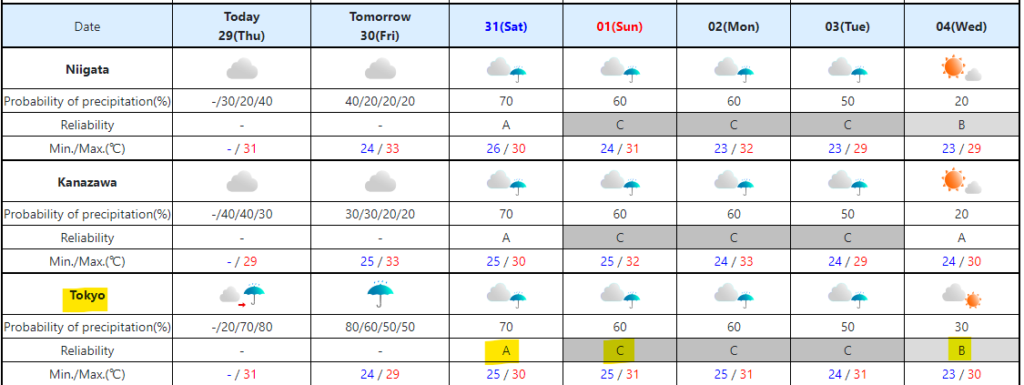
Reference: Forecast: Japan Meteorological Agency
2. Monitor Typhoon Progress
Typhoon updates are refreshed every few hours, and significant changes can occur. Therefore, it’s essential to check the typhoon information daily throughout your stay.
Additional Tips
- Emergency Kit: Even if you’re staying in a hotel, it’s wise to prepare a small emergency kit with essentials like bottled water, snacks, a flashlight, and a portable phone charger, as power outages can still occur. While this is less likely in major cities like Tokyo, it’s a real possibility in regions like Kyushu or Okinawa.
- Stay Indoors During the Storm: If you find yourself in an area where a typhoon is passing through, follow local advice and stay indoors. Many hotels are well-equipped to handle typhoons, and it’s safest to stay put until the storm passes.
- Be Prepared for Low Pressure: It’s not widely known, but the pressure changes that come with a typhoon can affect some people’s health, leading to symptoms like migraines or discomfort. If you’re prone to headaches or sensitive to pressure changes, it’s a good idea to keep headache medication or any other necessary remedies on hand.
By following these tips and staying informed, you can still enjoy your trip to Japan even during typhoon season. Safety should always be your top priority, so plan accordingly and be ready to adapt as needed.
Frequently Asked Questions
When is typhoon season in Japan?
Typhoon season in Japan typically runs from June to October, and August and September are the most active months. Japan Meteorological Agency averages for 1991 to 2020 show about 25 typhoons forming each year, about 12 coming within 300 km of Japan and about 3 making landfall. The agency records the highest numbers from July to October.
Is September typhoon season in Japan?
September is one of the two peak months of typhoon season in Japan, along with August. Japan Meteorological Agency averages for 1991 to 2020 record 3.3 typhoons approaching Japan in September and 1.0 making landfall, the highest landfall figure of any month. October is quieter, with 1.7 approaches and 0.3 landfalls on average.
Which parts of Japan get the fewest typhoons?
Hokkaido gets the fewest typhoons of any region in Japan, with an average of 1.9 approaching each year in Japan Meteorological Agency data for 1991 to 2020. Tohoku averages 2.7 and Hokuriku 2.8. Okinawa is the most exposed region at 7.7 a year, and southern Kyushu averages 3.9.
Where can travelers check typhoon information in Japan?
Typhoon information for Japan is published by the Japan Meteorological Agency (JMA) on its website, which has an English version. JMA updates each typhoon’s position every 3 hours, or every hour when a typhoon is approaching Japan, and forecasts its track up to 5 days ahead. The Safety tips app for foreign tourists sends push alerts for weather warnings in 15 languages, including English.
Does Japan have hurricanes?
Japan has typhoons, which are the same weather phenomenon as hurricanes under a different regional name. NOAA explains that the same type of storm is called a hurricane in the North Atlantic and the central and eastern North Pacific, and a typhoon in the Northwest Pacific.
Share