
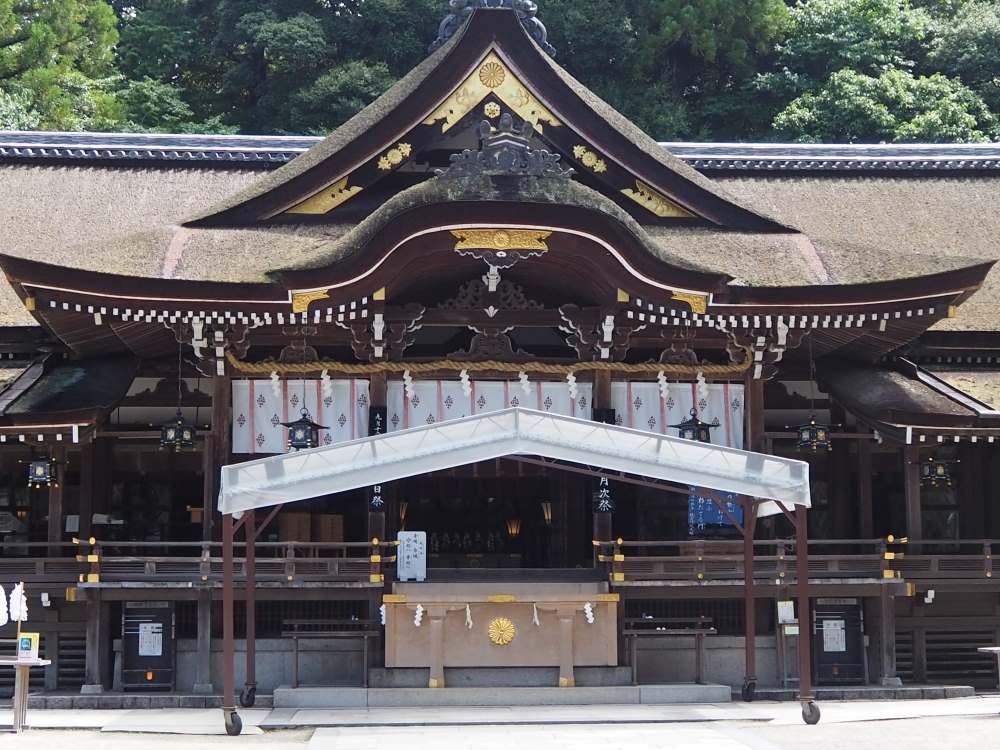
Omiwa Shrine (Ōmiwa-jinja) is a Shinto shrine in Sakurai City, Nara Prefecture, that has no main hall (honden) because its object of worship is Mount Miwa itself. The deity Ōmononushi-no-Ōkami is said to dwell in the 467-metre mountain behind the worship hall. The present worship hall was rebuilt in 1664.
| Location | 1422 Miwa, Sakurai City, Nara Prefecture |
|---|---|
| Nearest station | Miwa Station on the JR Sakurai Line, 5 minutes on foot |
| Amulet counter hours | 9:00 AM to 5:00 PM (to 4:30 PM from December to February) |
| Admission | Free to enter the grounds |
| Main deity | Ōmononushi-no-Ōkami |
| Mount Miwa climb | Registration at Sai Shrine 9:00 AM to 10:30 AM, descent report by 1:30 PM. 300 yen each |
Checked in October 2026 against oomiwa.or.jp, visitnara.jp.
If you have ever wondered what a Shinto shrine looked like before Shinto had buildings, Omiwa Shrine (大神神社, Ōmiwa-jinja) is the answer. Tucked into the foot of Mount Miwa, Omiwa Shrine is widely regarded as the oldest Shinto sanctuary in Japan: a place mentioned by name in both the Kojiki (712) and the Nihon Shoki (720), and where worshippers still pray today exactly as their ancestors did fifteen hundred years ago: facing the mountain itself as the body of the god.
It is also a shrine you can feel the moment you step inside the forest. The air drops a few degrees. The cicadas hush. And the long path of stone lanterns and ancient cedars begins to feel less like a tourist site and more like a doorway.
This guide is a walking record of a recent visit, what to see, what each space actually means, the practical rules most travel guides get wrong (including the strict 10:30 AM cut-off for climbing Mount Miwa), and the small details locals notice and visitors usually miss.
Why Omiwa Shrine Is the Oldest Shrine in Japan
At nearly every Shinto shrine in Japan, the god lives inside a small inner sanctuary called the honden (本殿). At Omiwa Shrine, there is no honden. There never has been.
Instead, the entire Mount Miwa (467 m), rising directly behind the worship hall, is the shintai: the physical body in which the deity dwells. This is the oldest known form of Shinto worship, called shintai-zan (神体山, “the mountain as the kami-body”), and it predates the building of shrine halls altogether. Omiwa Shrine therefore preserves, almost untouched, what Japanese religion looked like before it built temples, before it carved statues, before it wrote anything down.
For this reason the shrine has been called “the shrine of all shrines”: and its principal deity, Ōmononushi-no-Ōkami (大物主大神), has been worshipped here continuously since at least the early Kofun period (3rd, 4th century). In the year 859, the imperial court granted the shrine the highest divine rank of Shō-Ichi-i (正一位); under the Engi-shiki it was designated a Kanpei-taisha of the highest class; and it was eventually named the ichi-no-miya (first-ranked shrine) of the ancient Yamato Province.
In other words: long before Kyoto existed, this was already the most important shrine in Japan.
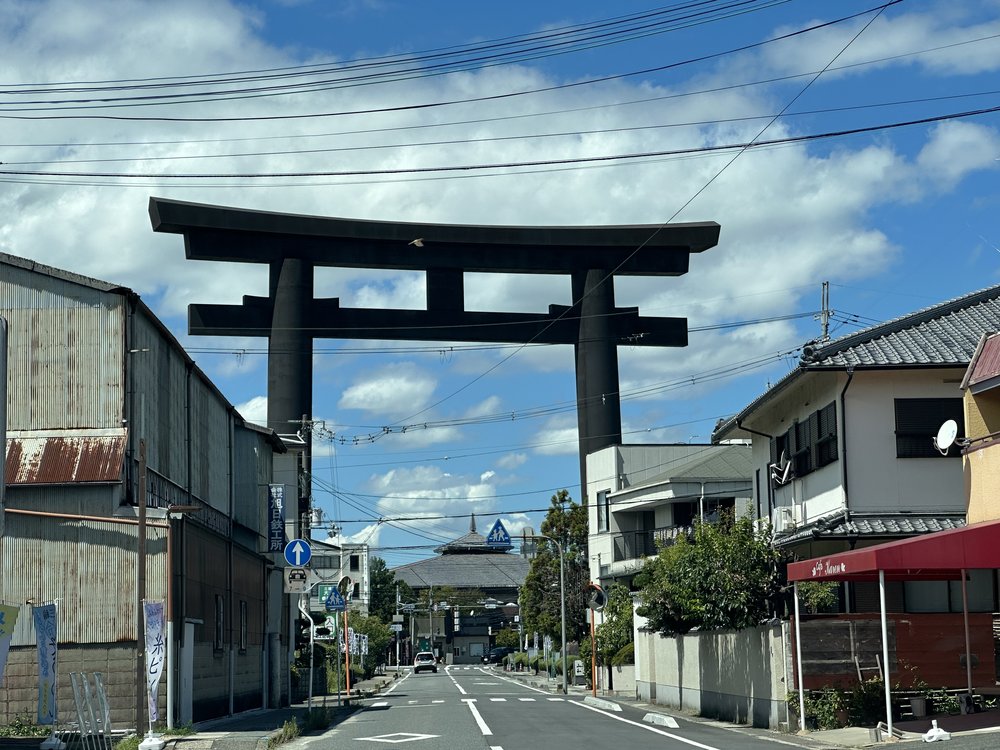
The First Sight: The Giant Otorii (32 m of Sacred Steel)
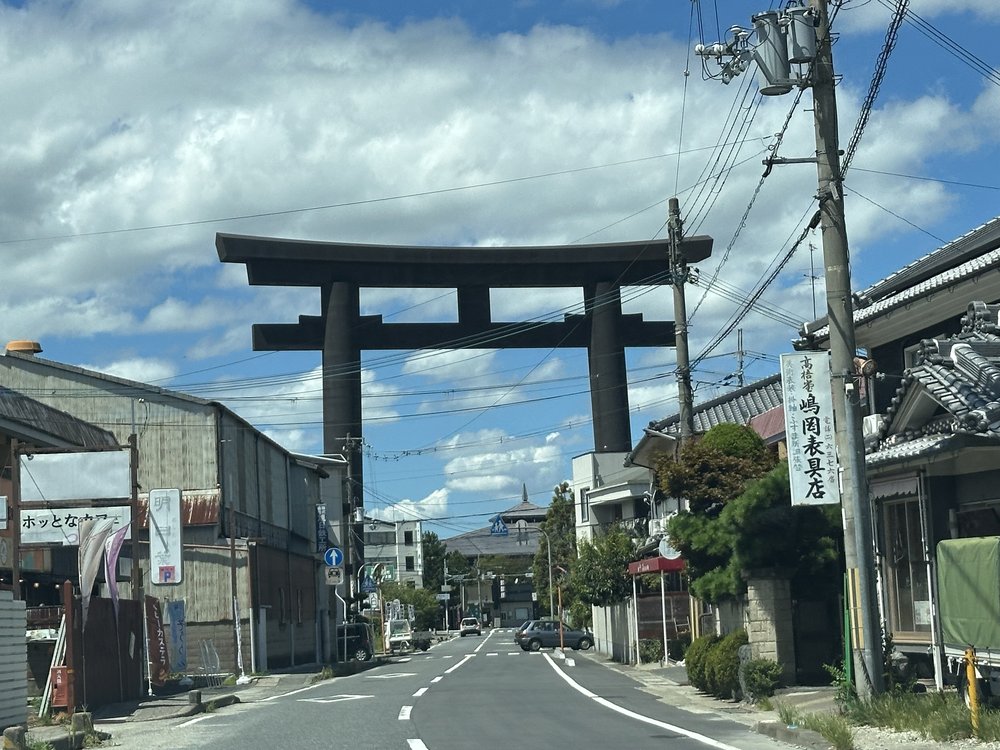
Long before you arrive at the shrine grounds, you will see the Otorii (大鳥居): and you will see it from kilometres away. Erected in 1986, this enormous steel gate stands 32.2 metres tall with 23 metres between its pillars, making it the second-tallest torii in Japan (the tallest, at Kumano Hongū Taisha in Wakayama, edges it by less than two metres).
It looks especially surreal standing astride a normal residential street, dwarfing the houses, telephone poles and convenience stores around it. There is something quietly powerful about seeing a small Japanese town simply living its life under a 32-metre gate to a god.
The Approach: Walking the Sandō Forest Path
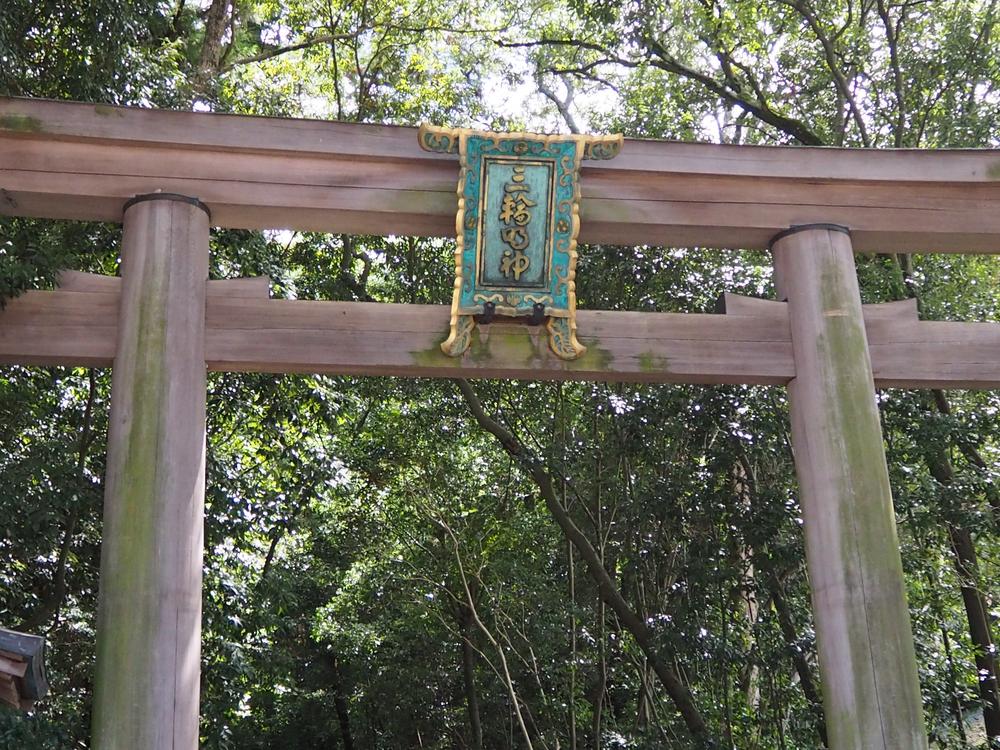
From the Otorii, the real approach begins. The Ninotorii (the “second torii”) is a much smaller, weathered wooden gate flanked by two stone lanterns, and it marks the point where the town ends and the shrine forest begins.
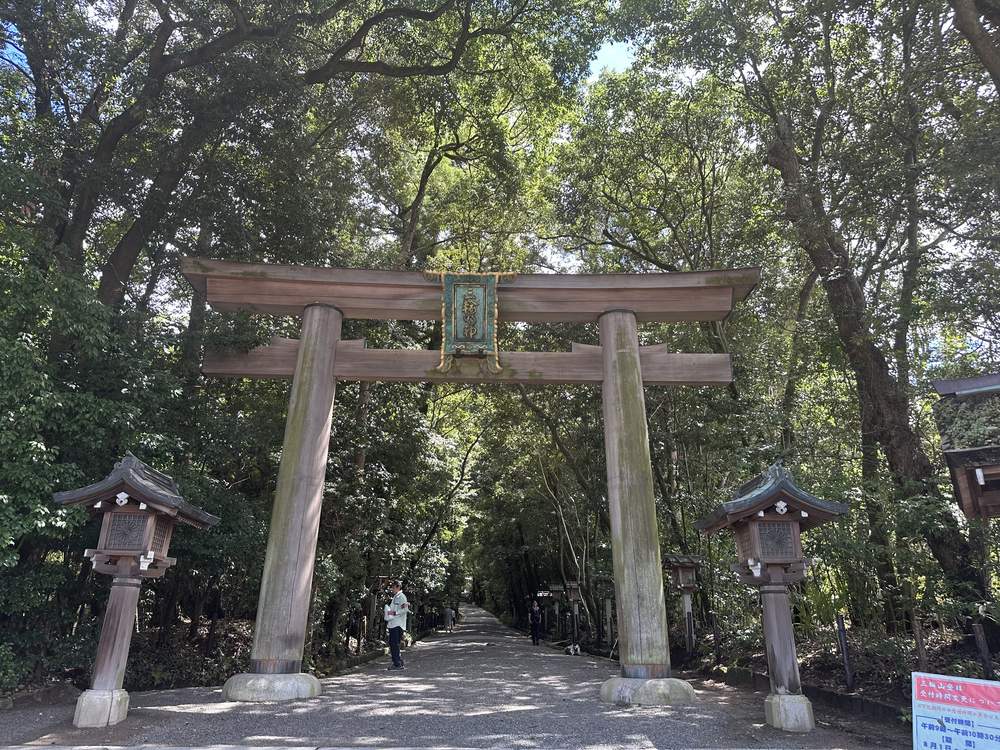
Above the gate hangs a green-and-gold lacquered plaque inscribed 「三輪明神」: Miwa Myōjin, the shrine’s older and still-affectionate name. Myōjin is an honorific reserved for the most powerful kami in the land, and you will hear locals refer to the shrine this way far more often than its official “Ōmiwa-jinja.”
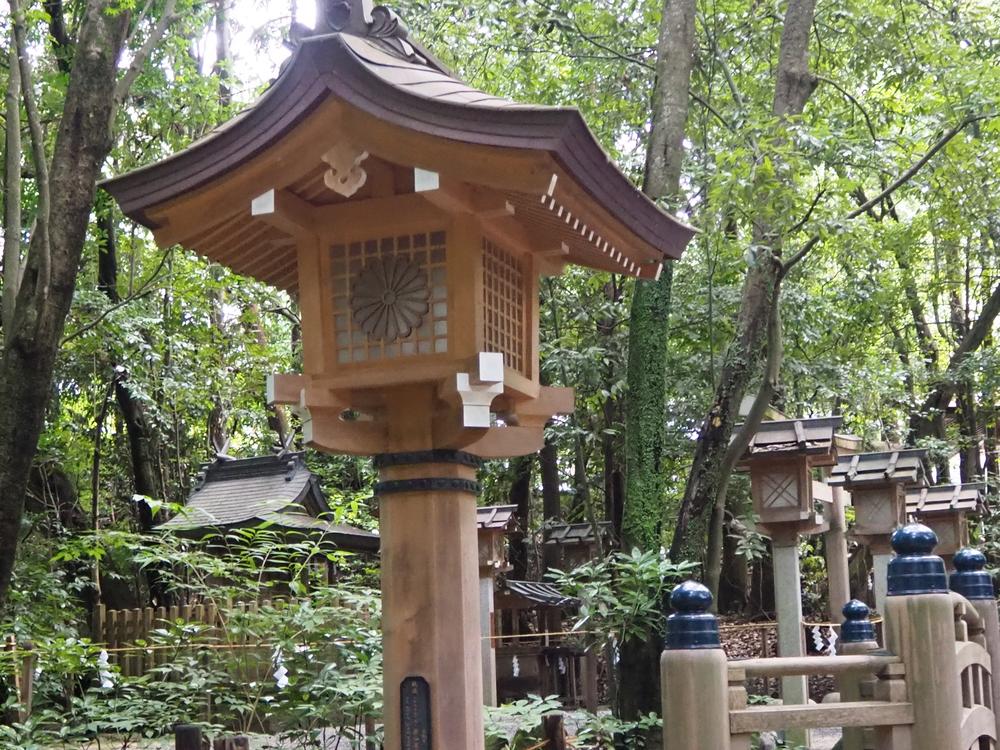
Pass under the gate and the sandō: the formal approach path, unfolds in a long, gently rising avenue beneath enormous Cryptomeria cedars. Carved-wood lanterns line both sides; many of them are decorated with the imperial chrysanthemum, a quiet reminder of the shrine’s centuries of imperial patronage.
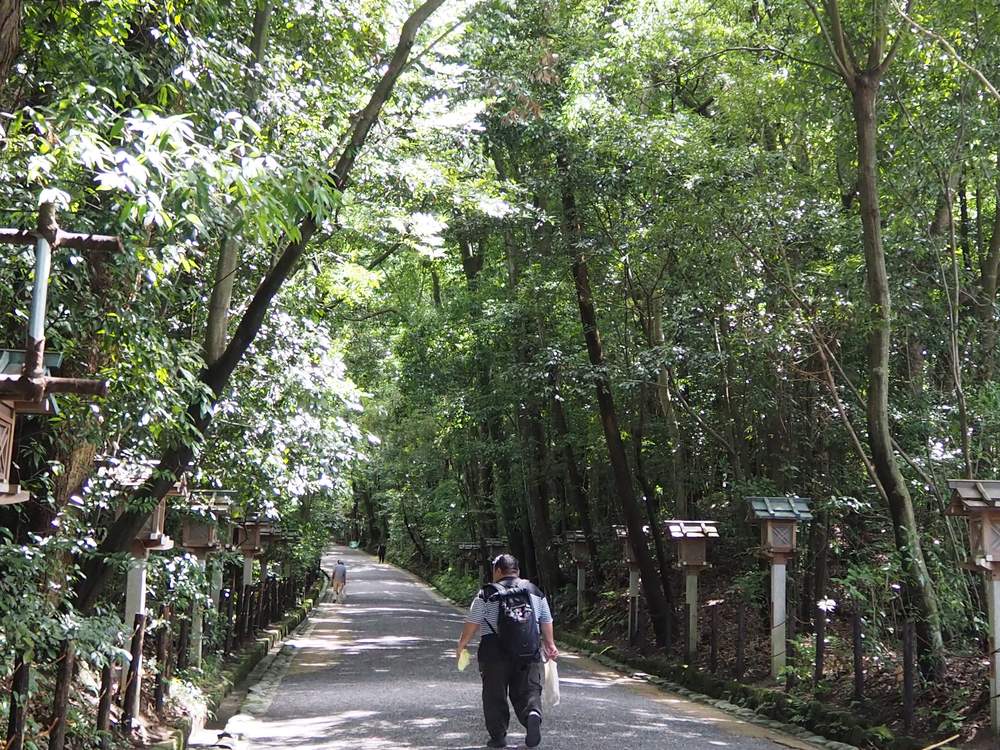
Even on a warm Nara summer day this corridor is cool and dim. The cedars are old enough that some are themselves considered shinboku: “sacred trees”, and tied with thin shimenawa ropes to mark them as dwellings of kami.
The Temizuya, the Bronze Snake, and the 500-Year-Old Sacred Cedar
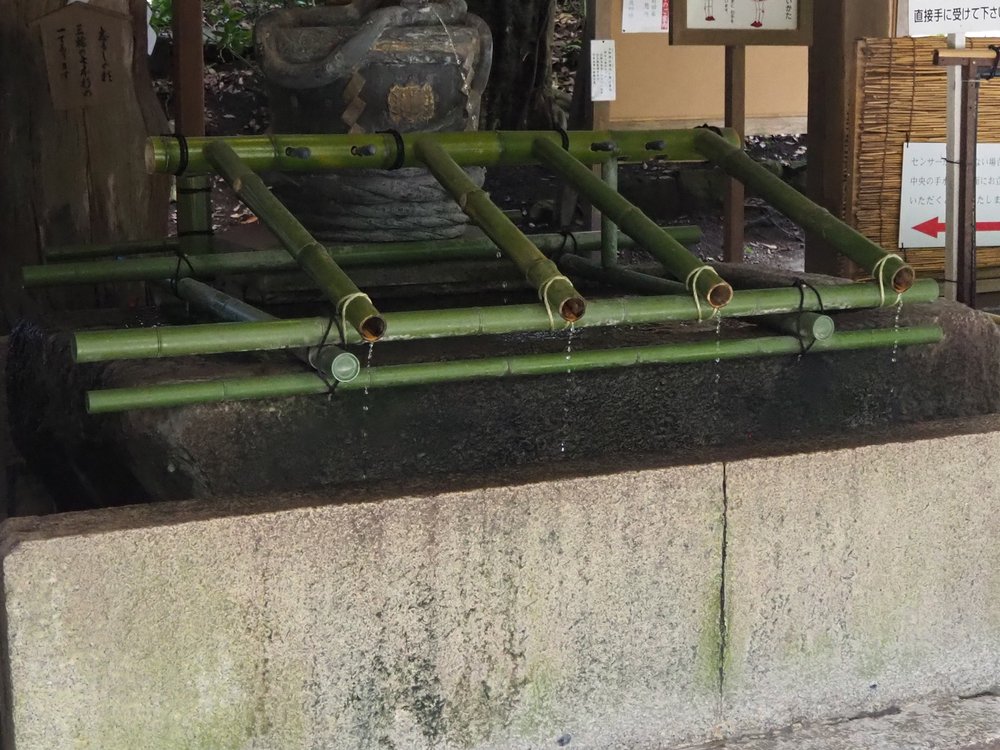
About halfway up the sandō, a wooden roof shelters the temizuya (手水舎): the purification fountain where visitors rinse their hands and mouths before approaching the deity. At most shrines this is a quiet but ordinary stop. At Omiwa Shrine it is anything but.
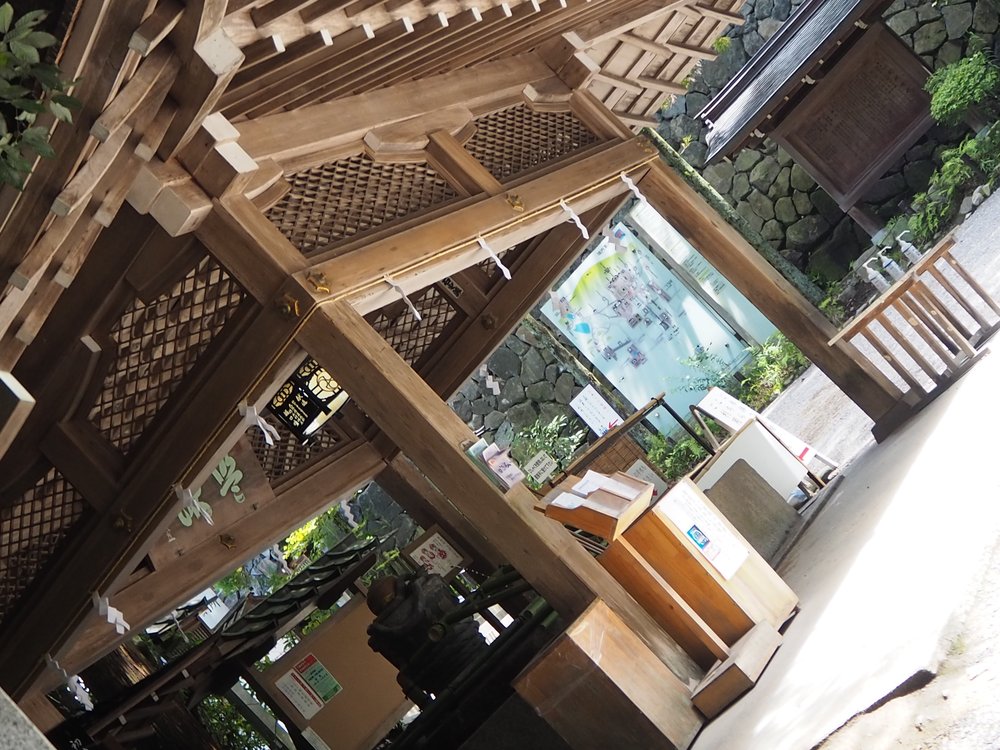
Water here flows not from a traditional dragon but from the mouth of a bronze snake coiled around a sake jar.
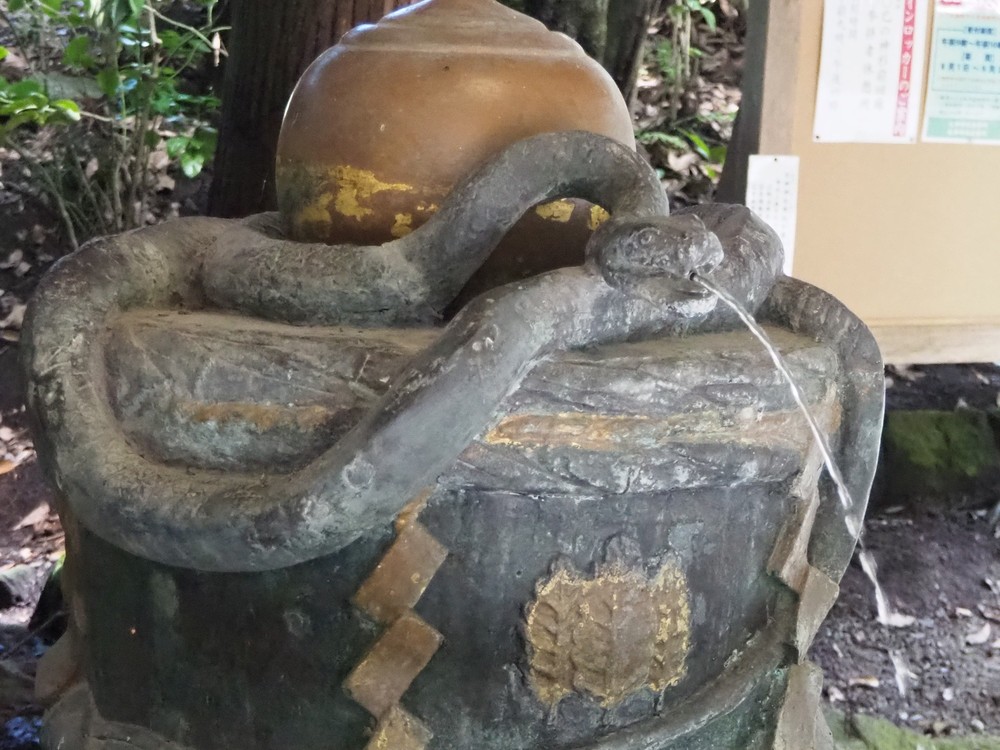
This is not ornament. In the Kojiki and Nihon Shoki myths, Ōmononushi-no-Ōkami occasionally appears in the form of a white snake. That belief is still very much alive, and it is most visible a few paces further along, at the Mi-no-Kami-sugi (巳の神杉, “the Snake-God Cedar”), a massive Cryptomeria believed to be roughly 500 years old. Look closely into the hollow at its base and you will almost always see fresh raw eggs and small cups of unrefined sake left by locals at first light: the traditional favourites of the serpent deity.
Pro-Tip, Don’t miss the Ōmiwa-no-Mori Observation Deck. A short ten-minute detour from the haiden brings you to the 大美和の杜展望台 (Ōmiwa-no-Mori Tenbōdai), an open clearing where the entire Yamato plain spreads out below you, with the giant Otorii floating above the rooftops and Mount Nijō on the far western horizon. It is one of the best free viewpoints in Nara and almost every tour group skips it.
The Worship Hall (Haiden) and the Mysterious Mitsu Torii
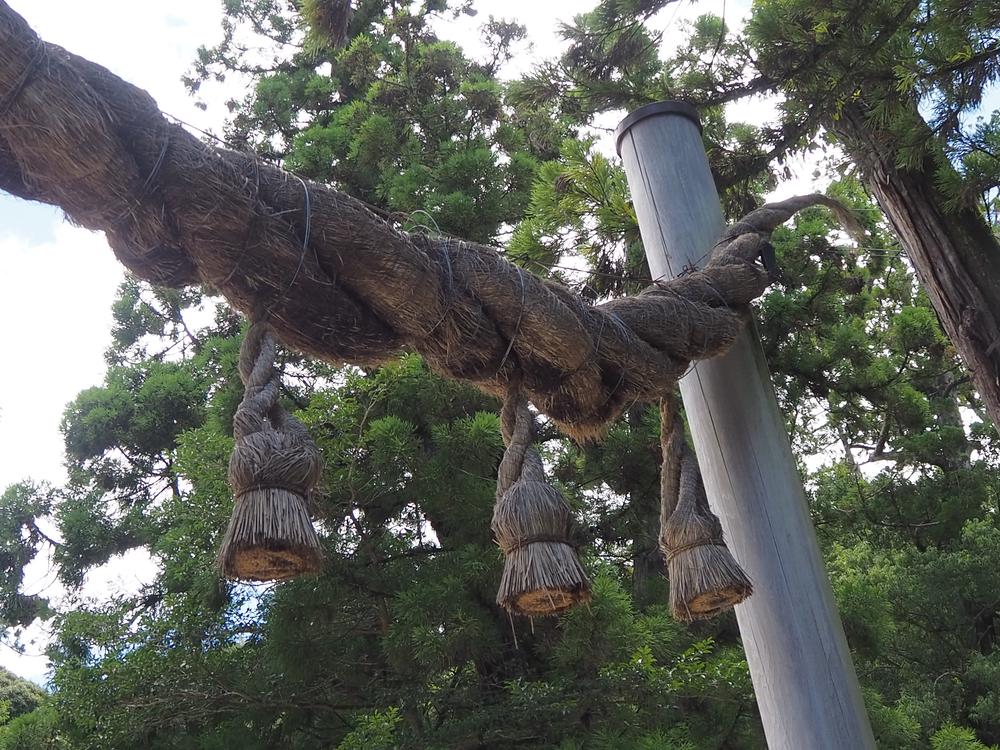
The path widens, climbs a final flight of stone steps, and passes beneath the most photographed feature of the shrine: an immense shimenawa rope, thick as a tree trunk and woven with rice straw, hung horizontally across the entrance to the inner precinct. The five large shide tassels swing slowly in the mountain breeze.
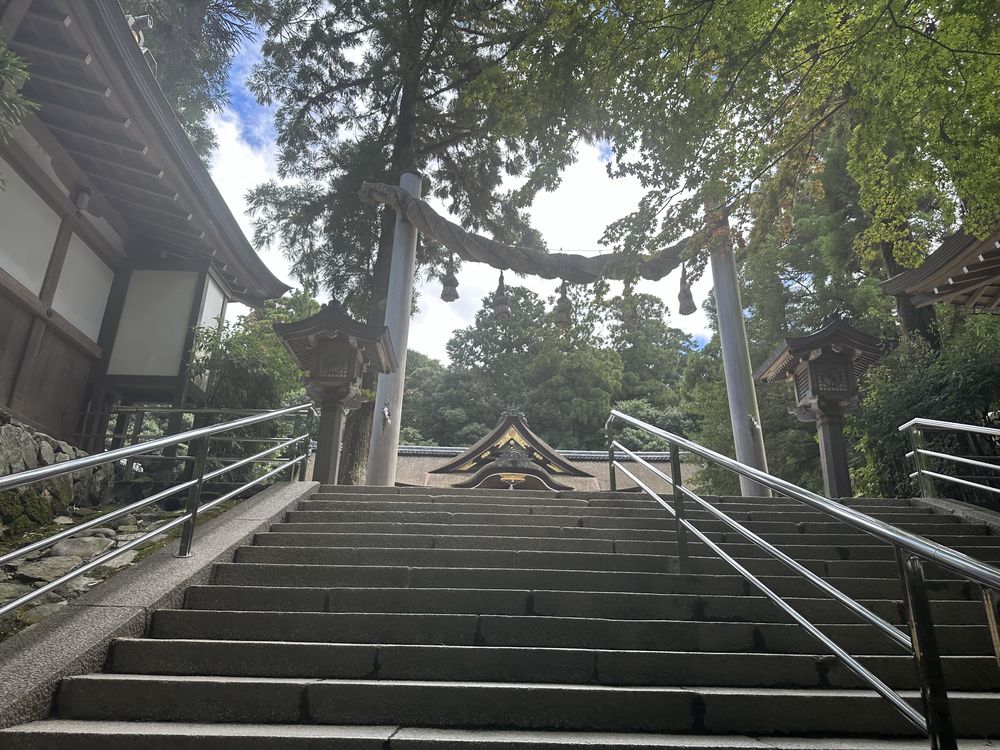
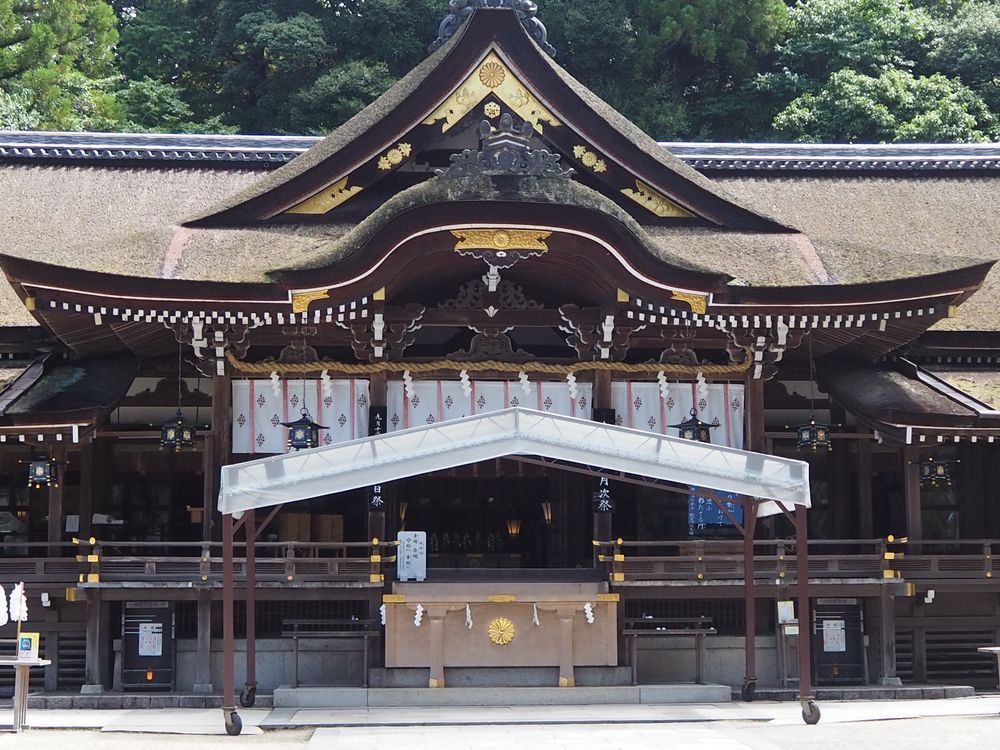
At the top stands the haiden (拝殿), the worship hall. The current structure was rebuilt in 1664 by the fourth Tokugawa shōgun Ietsuna, and is designated an Important Cultural Property of Japan. Its long cypress-bark roof, sweeping eaves, and gold-leafed pediment glow quietly against the dark green of Mount Miwa rising directly behind it.
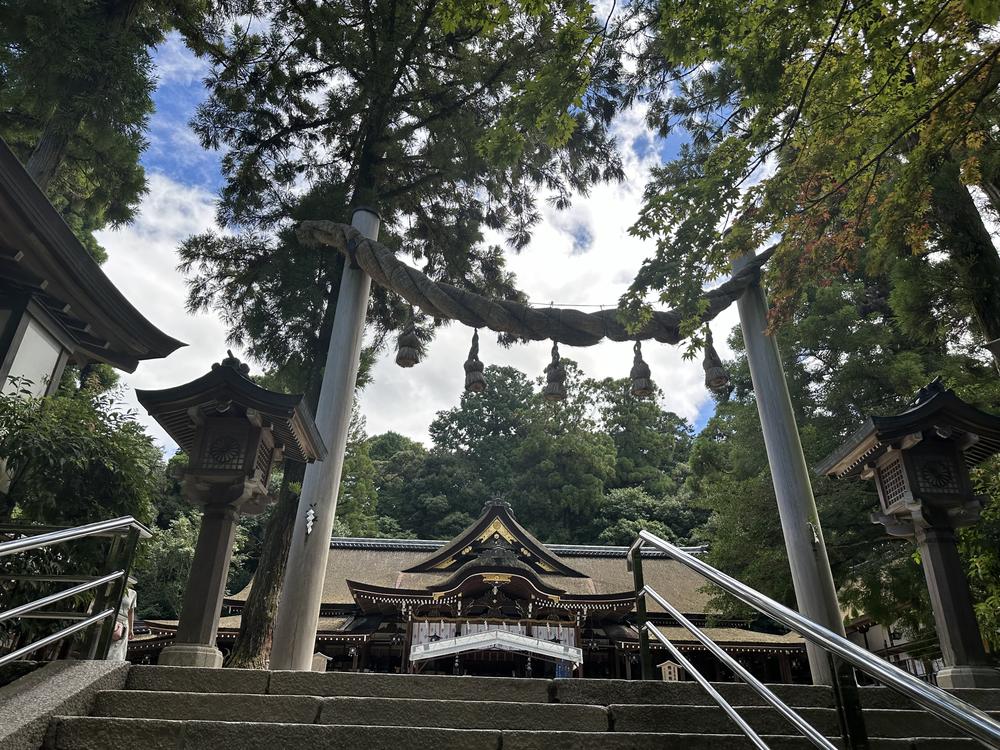
Stand at the centre of the offering platform, bow twice, clap twice, bow once: and you will notice something subtly unusual: you are not facing a building. You are facing the mountain. Behind the haiden, hidden from public view, stands the famous Mitsu Torii (三ツ鳥居, “three-part torii”): a unique gate composed of one central torii flanked by two smaller torii joined at the pillars. It has wooden doors, and it does not lead into a sanctuary. It leads to Mount Miwa itself.
The Mitsu Torii is one of the very few torii in Japan with closing doors, because what lies beyond them is too sacred to enter casually. The full structure can only be glimpsed during special ceremonies, but the principle is clear: between the worshipper and the god, there is no statue, no mirror, no shrine. There is only a gate, and the mountain.
The Deities of Omiwa Shrine
The shrine enshrines three closely related deities:
- Ōmononushi-no-Ōkami (大物主大神): the principal deity. His name literally means “the great master of all things,” and in the Nihon Shoki he is described as the saki-mitama and kushi-mitama (the “fortunate spirit” and “wondrous spirit”) of the better-known Ōkuninushi, the great nation-builder of Izumo mythology. According to the Kojiki, Ōmononushi himself asked to be enshrined at Miwa, saying: “Worship me upon the eastern mountains of Yamato’s blue-green hedge.”
- Ōnamuchi-no-kami (大己貴神): another name of Ōkuninushi, co-enshrined here.
- Sukunahikona-no-Mikoto (少彦名命): the tiny, brilliant god of medicine and healing.
Together, these three are the gods of nation-building, agriculture, industry, commerce, healing, brewing, safe travel, and en-musubi (the forming of good ties and marriages). It is hard to think of a single area of human life that Omiwa Shrine is not believed to govern.
Living Rituals: The Snake, the Egg, the Sake, and the Cedar Ball
Sake brewing. Ōmononushi is the patron deity of every sake brewer in Japan. According to the Nihon Shoki, during the reign of Emperor Sujin (10th emperor), a man named Takahashi-no-Ikuhi-no-Mikoto was appointed as the shrine’s sake brewer. He is now enshrined as a sub-deity at Ikuhi Shrine (活日神社) on the grounds: Japan’s only shrine dedicated to the god of brewers. Every November 14th, the Jōzō Anzen Kigan-sai (“Festival to Pray for Safe Brewing”) is held at the haiden, and brewers from every prefecture in Japan come to receive a cedar ball (sugitama): a large green sphere of cedar twigs, which they hang from the eaves of their brewery. When the ball gradually turns brown, that year’s new sake is ready.
The white snake. Beyond the Mi-no-Kami-sugi mentioned above, a second snake-haunted tree stands near Sai Shrine. Both have small hollows where, locals say, a real white snake (the visible form of Ōmononushi) sometimes appears. Visitors leave eggs and small cups of sake at the base, a quietly moving, deeply old detail you will not find at a Tokyo shrine.
Healing and pharmacology. Sukunahikona’s presence here makes Omiwa Shrine one of Japan’s oldest sites for prayers of healing. The annual Chinka-sai (鎮花祭) on April 18th: also called the Hana-shizume-no-Matsuri, the “Festival to Calm the Falling Petals”, was held in the Heian period to ward off epidemics carried, it was believed, on falling cherry blossoms. It is still performed today, and major Japanese pharmaceutical companies attend in formal dress.
New Year’s fire. On the night of December 31st into January 1st, the Nyōdō-sai (繞道祭) carries the shrine’s sacred new-year flame on a long torch-lit procession around the foot of Mount Miwa, one of Kansai’s oldest fire festivals.
Climbing Mount Miwa: Rules, Registration, and the Strict 10:30 AM Cut-Off
For those who want to go further, Mount Miwa itself is open to climbers: but only as a religious act, not as a hike. To reach the trailhead, you will walk the Kusuri-michi (くすり道, “Medicine Path”), a tranquil avenue lined with medicinal plants and trees donated by Japanese pharmaceutical companies, a living tribute to the healing god Sukunahikona.
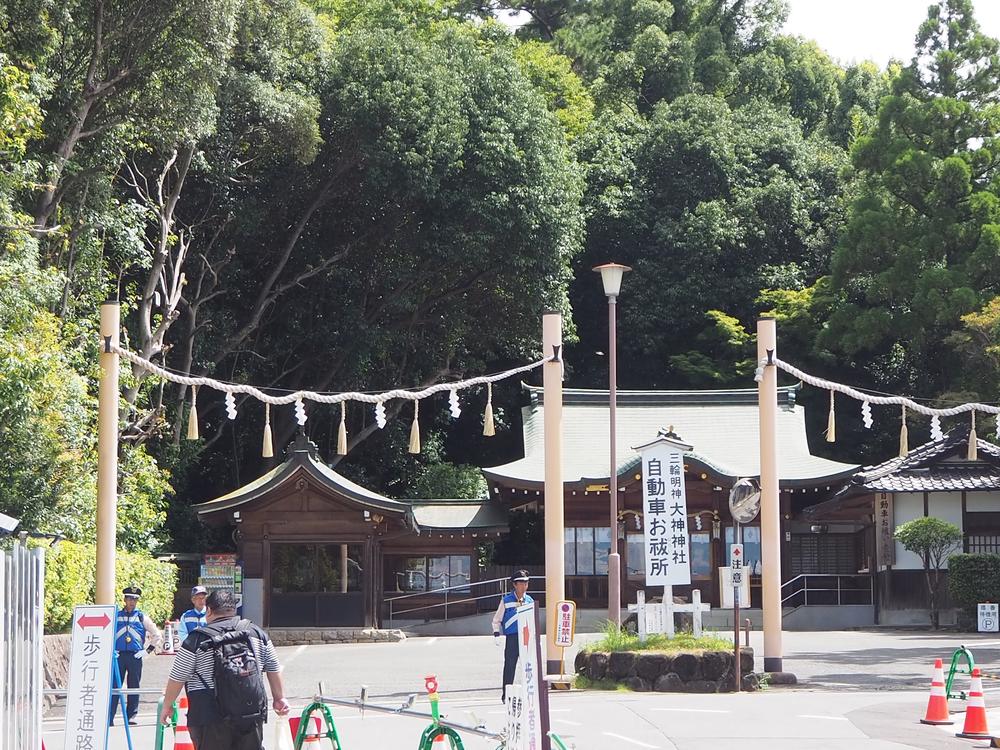
The climb itself begins at Sai Shrine (狭井神社), a sub-shrine about ten minutes’ walk north of the main haiden. This is a strict religious pilgrimage, not a casual hike. Climbers must register in person, pay a ¥300 offering, wear a white tasuki sash around the neck, and agree to a strict set of rules.
Climbing Mount Miwa, the rules at a glance:
- Registration hours: 9:00 AM to 10:30 AM only. No exceptions.
- Return reporting deadline: 1:30 PM. You must sign back in before this.
- Closed for the entire month of August (every year, due to extreme heat and risk of heatstroke).
- Closed during certain ceremonies and bad weather.
- No food, no smoking, no photography or video of any kind on the mountain.
- No taking anything from the mountain: not even a fallen leaf or pebble.
- Water only; hydration is strongly encouraged.
- The white tasuki must be worn for the entire ascent and returned afterwards.
- ID may be required at registration.
The route is steep and tangled with cedar roots; the round trip takes about two to three hours. Treat it as a participatory act of worship: the summit is the centre of the deity’s body. If you do go, go quietly, and go respectfully.
Just behind Sai Shrine, fill your bottle at the Kusuri-ido (薬井戸, “Medicine Well”): a sacred spring associated with Sukunahikona that locals drink for health.
Hibara Shrine: Where Amaterasu First Was Enshrined
A short walk further north along the foot of Mount Miwa stands Hibara Jinja (檜原神社), an auxiliary shrine of Omiwa. It is best known as the very first of the Moto-Ise (“Original Ise”) shrines: the place where, according to the Nihon Shoki, the sacred mirror Yata-no-Kagami was first removed from the imperial palace and enshrined before its centuries-long journey to its present home at Ise Grand Shrine.
Hibara has no honden either, only a Mitsu Torii looking directly into Mount Miwa. On a clear winter morning, you can see straight through the gate to Mount Nijō on the western horizon: and on the equinox, the sun is said to set exactly between its two peaks.
When to Visit Omiwa Shrine
- Early morning (7 to 9 AM): almost empty, the cedar avenues are filled with mist, and you may share the precinct with the shrine’s resident deer.
- Mid-April: the Chinka-sai festival; cherry blossoms still cling to the trees.
- November 14th: the brewers’ festival, when fresh cedar balls hang from the eaves.
- New Year’s: one of the most popular hatsumōde destinations in Kansai, drawing roughly half a million visitors over the first three days.
Avoid weekend afternoons in late autumn if you dislike crowds, the foliage at the foot of the mountain is locally famous.
Practical Tips & Etiquette
- Grounds are free to enter and open year-round; the office is staffed roughly 9:00 to 17:00.
- Mount Miwa climbing registers at Sai Shrine: 9:00 AM to 10:30 AM only, return by 1:30 PM, ¥300 fee, closed all of August.
- The shrine sells a beautiful white snake ema (votive plaque) and a sake cup engraved with the Miwa Myōjin crest: both popular souvenirs.
- A few minutes’ walk from the main shrine, the village of Miwa is the historic birthplace of sōmen noodles. Several centuries-old shops still serve Miwa Sōmen at lunch.
Not sure how to bow, clap, or make an offering once you arrive? Read our step-by-step guide on how to pray at a Japanese shrine, explained by a Shinto priest at Yushima Tenjin in Tokyo.
Access
Address: 1422 Miwa, Sakurai City, Nara Prefecture 633-8538
Phone: 0744-42-6633
Official website: oomiwa.or.jp
By train (recommended):
- JR Sakurai Line, “Miwa” Station: about 5 minutes on foot to the main shrine entrance. Trains run from JR Nara (≈30 min) and Kyoto (via Nara, ≈80 min).
- From Osaka, transfer at JR Tennōji or Takada, about 75 minutes total.
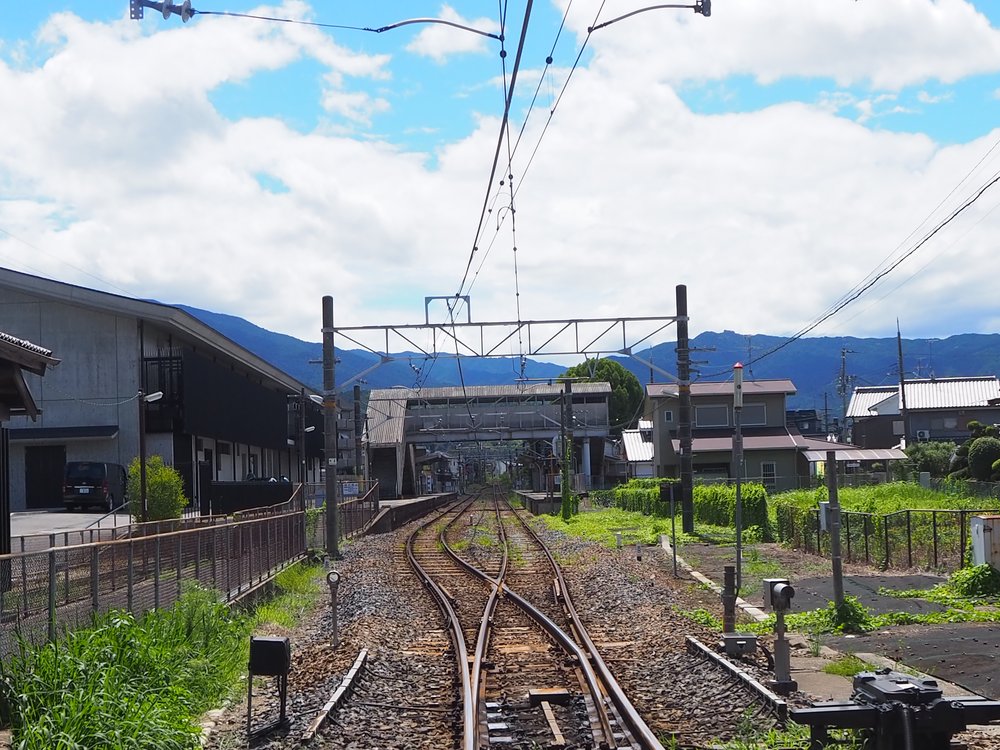
By car: Free parking (about 200 spaces) is available in the visitor lots west of the JR level crossing; it fills early during festivals and New Year’s.
Frequently Asked Questions
Is Omiwa Shrine the oldest shrine in Japan?
Yes: Omiwa Shrine is widely considered one of the oldest, and often the oldest, Shinto shrines in Japan. It is recorded by name in Japan’s two earliest histories, the Kojiki (712) and Nihon Shoki (720), and it preserves the most primitive form of Shinto worship: a mountain itself, rather than a building, is revered as the deity.
Can you climb Mount Miwa?
Yes: but it is treated as a religious pilgrimage, not a hike. You must register in person at Sai Shrine between 9:00 AM and 10:30 AM, follow strict rules (no photography, no eating, no removing anything from the mountain), and complete your descent by 1:30 PM. Climbing is completely closed throughout August every year.
How long does it take to climb Mount Miwa?
The ascent and descent take about two to three hours in total. The path is steep and covered with tree roots, so sturdy walking shoes are essential.
What is the mysterious gate behind the worship hall?
That is the Mitsu Torii (三ツ鳥居, “Triple Torii”), a rare gate style combining one central torii with two smaller ones at its sides. Unlike normal torii, it has physical wooden doors, and it does not lead to an inner sanctuary. It leads directly to Mount Miwa, the body of the deity.
What should I bring to Omiwa Shrine?
Comfortable walking shoes are essential: the grounds are large and the forest paths are uneven. If you plan to climb Mount Miwa, bring a water bottle (you can fill it from the sacred Kusuri-ido well), ID, and small change for the ¥300 climbing offering. Many local visitors also stop at the nearby shops to pick up a raw egg and a small cup of sake to leave at the base of the Snake-God Cedar.
Do you need to speak Japanese to climb Mount Miwa?
Foreign visitors may climb Mount Miwa only if they fully understand the shrine’s explanations in Japanese, either by themselves or with an interpreter. Omiwa Shrine lists this as one of three entry conditions. The other two are understanding Shinto and climbing with a devout heart, and having at least one phone in the group with a Japanese +81 number. Tour itineraries may not include the climb.
What are the amulet counter and prayer reception hours at Omiwa Shrine?
Omiwa Shrine’s amulet counter is open from 9:00 AM to 5:00 PM, closing at 4:30 PM from December to February. The reception hall (参集殿) gives out amulets from 7:00 AM to 5:30 PM. Prayer requests are accepted from 9:00 AM to 4:00 PM, or until 3:30 PM from December to February. Amulet hours can change at New Year, on the 1st of each month, and on Sundays and public holidays.
Final Thoughts
Most shrines in Japan are places of architecture: buildings to admire, gates to photograph, halls to enter. Omiwa Shrine is something older and stranger: a place where the architecture politely steps aside, and the mountain itself is the god.
Stand at the haiden, look past it, and you are looking at the same green slope that Emperor Sujin looked at; the same slope that priests faced fifteen hundred years before the first wooden building was raised here; the same slope that a snake-god is said to walk down at dusk.
There is no other place in Japan quite like it. And once you have stood there once, every other shrine you visit afterwards will look, very slightly, different.
Share