
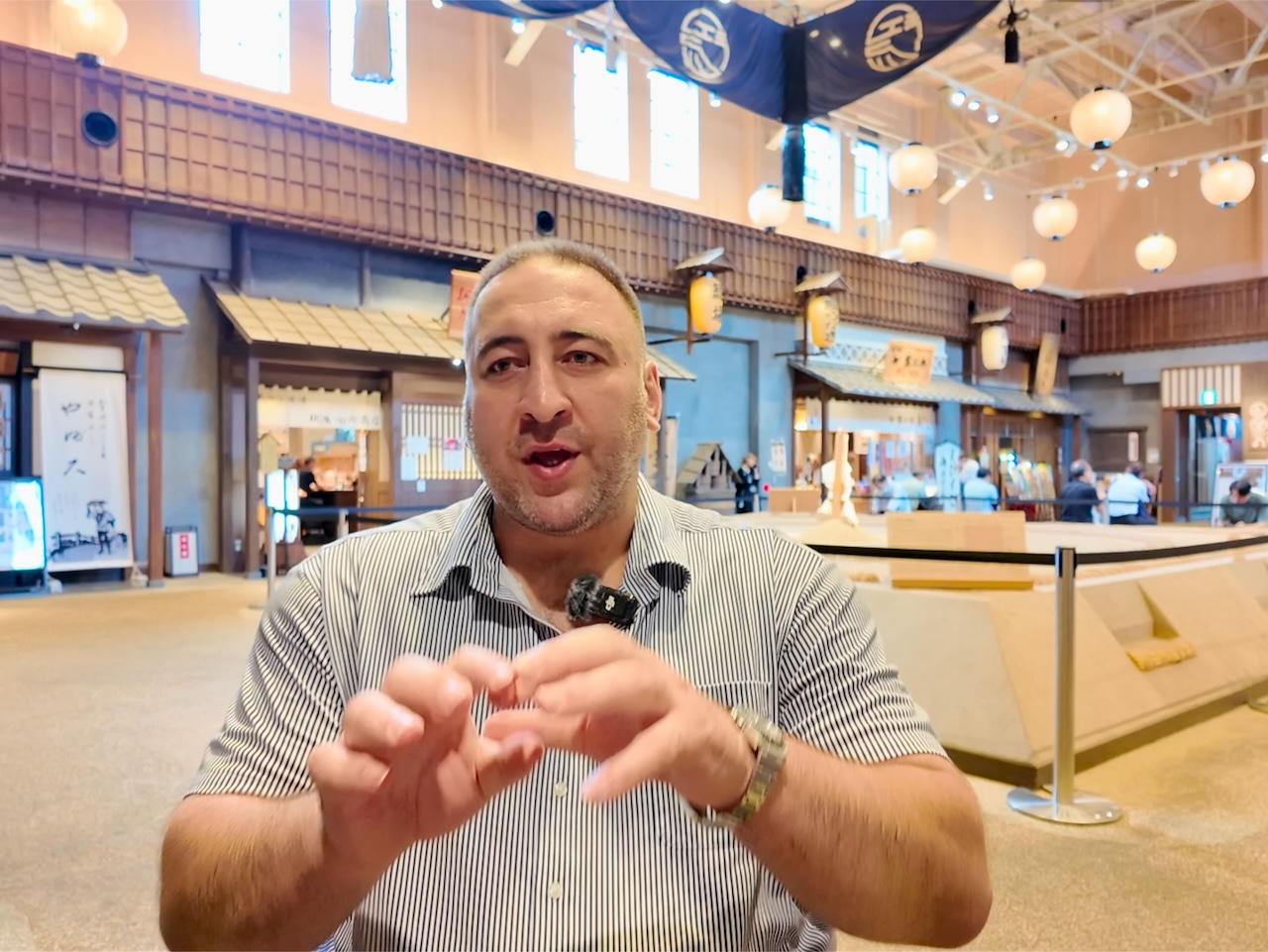
Levan Gorgadze came to Japan at sixteen knowing nothing about sumo. Almost twenty years later, he is still here — and still working to make his small country visible. The former ōzeki Tochinoshin on the silence of the stable, the discipline he inherited, and the country he still carries with him.

An Unplanned Path to the Sumo Ring
Q: Could you start by introducing yourself?
Levan: I’m Levan Gorgadze — the former ōzeki. People in sumo know me by my ring name (Tochinoshin), but a shikona belongs to that world, and I’ve left it now.
Some wrestlers keep being called by the ring name after they retire; some go back to their own name. Honestly, I’m happier when people just call me by my own name. Levan, or even Leo — either is fine.
Q: Where are you from?
Levan: I’m from Georgia. It’s a small country with both sea and mountains — almost all mountains, really. There aren’t many tall buildings like in Japan; it’s mostly small houses and countryside.
Q: You came to Japan for professional sumo very young. Had you done sumo in Georgia? How did you end up in it?
Levan: Georgia has its own wrestling — a sport called chidaoba. I started there, and then did sambo and judo too. It was judo that first made me interested in Japan.
Then in 2003, when I was sixteen, I heard there was an amateur junior world championship in Japan, and I was asked if I could enter. I didn’t know sumo at all — but I’d always wanted to get to Japan, so I thought, if it means I can go, then sumo or anything else is fine.
I came for that championship, in Osaka. That’s really where my life in sumo started.
Q: And you got results straight away?
Levan: In the team event we came second — we lost to Japan — and I came third individually. That was 2004. There was another world championship in 2005, and I came for that too.
It wasn’t that I was scouted. I had a three-month visa, and after the championship ended I stayed on at Nihon University, under a Professor Tanaka, to learn sumo. There was a senior Georgian wrestler there, and the idea came up — why not do this in Japan? Inside myself, I decided I’d give it a try.
Following a Small Georgian Lineage
Q: So the wrestlers who came before you mattered — Kokkai, for instance?
Levan: Kokkai was here, yes. And a few tournaments before me there was Gagamaru — a really big wrestler — who’d actually done judo with me back in Georgia. We came to the world championship together. He stayed in Japan right away, but I went home to Georgia first.
I talked it over with my parents and told them I wanted to try sumo. They were against it immediately. But I still wanted to do it myself, so I came back to Japan around September of 2005.
Q: For most Japanese people, Georgia isn’t very familiar. Is sumo the strongest connection between the two countries?
Levan: Sumo, and lately Georgia has slowly become a bit better known. When I first came, there was no embassy, and maybe only twelve Georgians in the whole country.
Since then the Georgians in sumo worked hard, an embassy was set up, and things like Georgian wine became known. We’re a small country, but we’re strong in combat sports — judo especially, and we won golds at the recent Olympics. Step by step, through sport and the embassy, Georgia has become more visible here.
Wine is my dream, so since retiring I’ve also been doing a little work with it — promoting Georgian products and wine.
The Hardest Part Was the Silence
Q: Georgian and Japanese are completely different languages. Was it hard at first?
Levan: The hardest part of all wasn’t the sumo — it was the Japanese. Not being able to have a conversation with people was really painful.
As a sumo wrestler you have to live in the stable, with everyone, and talk with everyone — and I couldn’t. But because there weren’t many people who spoke much to me, I actually learned to speak faster. Every day there was only Japanese. Within about a year I had greetings and simple words.
Foreign sumo wrestlers often get told their Japanese is good — it’s different from some other sports, where people can be here a long time and not pick it up. Sumo is special. You all live in the same stable, really together, so the language isn’t optional.
Q: In that first year, were there specific moments where communication broke down?
Levan: Every day was hard. When someone said something I didn’t understand at all, we’d use our hands — gesturing. At mealtimes it was like that. Looking back, there were all sorts of things.
But from the very start I learned the greetings — “ohayou gozaimasu,” little by little, every day. I didn’t know sumo either, so I learned sumo and Japanese at the same time.
Getting Through Each Day
Q: In a completely foreign country, where did your motivation come from?
Levan: I just had to get through each day. The stable I was in was old and strict. I didn’t even have a mobile phone. From morning to night, there was nothing but getting stronger.
Even eating was work. When I arrived I was only a little over 100 kilos — not even 110 — and the others were 160 or 170, so I had to force myself to eat every day. I couldn’t watch TV; even if I did, I couldn’t understand it. So all I had was training.
I think if an athlete does their sport while doing other things on the side, they get stronger more slowly. For me, there was no choice but to keep moving forward.
Q: Did you ever want to quit?
Levan: Many times. But I’m surprisingly patient — that was a good thing.
I wanted to go home many times, but going home and running away would have been embarrassing. I’d told my family, my fans, the people around me that I was going to Japan to make something of myself. To come back a few months later isn’t very manly, is it. My country still has that old sense of masculinity, and that’s how I was raised.
Of course, alone at night, it was hard. But I’m glad I endured. As they say — if a man decides to do something, he does it.
Q: That Georgian sense of values was a big part of it.
Levan: A big part. Georgia is tiny — there aren’t even four million of us — and yet we won seven Olympic medals. By the numbers, that’s quite something.
We’ve always been strong in combat sports. We’re a small country that’s had to fight throughout its history, so there have always been strong people. That’s how it held out against the bigger countries around it. In my country, once a man decides something, he has to follow through. My parents raised me that way.
Culture Shock, and a Sport With Its Own Rules

Q: At sixteen, arriving in Osaka — what was your biggest culture shock?
Levan: The quiet. So many people everywhere, and outside, no one was talking. Georgians are loud — we love to talk; two, three, five of us walking together will all be chatting. So a crowded Japanese street in near-silence genuinely amazed me.
And the suits. So many people in suits and dress shoes, all in black, with black bags, especially around the stations in the morning. Back home there’s no such rule — even politicians dress casually, except on really important days. It took me a while to understand the suit was just the uniform of going to work.
Masks, too. In my country I’d only ever seen them at a beauty salon, and here people wore them on the trains and outside — and this was well before COVID.
Q: You don’t look Japanese. Was there ever discrimination because of how you look?
Levan: No — if anything, the opposite. A lot of people are grateful that a foreigner would grow his hair out, take the chonmage, and give himself to the sport. There are occasional exceptions — it’s not zero — but mostly it comes down to the person.
My stablemaster always told me that being strong isn’t enough. You have to be good as a human being, with respect for those older and younger than you. My ring name has the character for “heart” in it — the idea was that they wanted me to become a wrestler with a Japanese heart. I don’t know how well I repaid that name, but I gave it everything.
Q: What’s your favorite part of Japanese culture?
Levan: New Year. At first I just ate the osechi food because it looked good, but once my Japanese improved I learned that each item has its own meaning. I’d ask about them one by one — that fascinated me.
And mochitsuki, the rice-cake pounding. I love it. It’s lively and fun, and everyone can join in — old, young, children. That’s my favorite.
Twenty Years On
Q: You’ve watched Japan for two decades. How has it changed?
Levan: Maybe this is just me, but nothing much has changed. I spent eighteen of those years inside the sumo world, so there’s a lot of ordinary life here I still don’t know. People say Japanese are lonely or isolated — I don’t really see that.
Q: There are far more first-time visitors now, though.
Levan: That’s the weak yen. It’s 160 to the dollar now — the older people around me remember 130 as the high — so Japan has simply become cheap to visit.
Lots of people coming isn’t a bad thing; it’s good for them to see what kind of country this is and go home having enjoyed it. But the weak yen itself — for the country, I’m not sure that’s such a good thing.
Q: Any advice for people coming to Japan for the first time?
Levan: The people who come from my country are mostly athletes, politicians, and tourists — rarely for work. With a smartphone they can look up most things themselves. Where they really get stuck is food.
Our cooking is heavily spiced, and a lot of my countrymen find Japanese food too mild — though I’ve come to love it precisely for that gentleness. So when they want something heartier, I tell them: yakiniku is best. And we go for yakiniku together.
The Country He Carries

Q: It’s been about a year since you retired. What do you want to do now?
Levan: I produce a wine from my country — wine is the dream. But really it’s part of something bigger. So many people have told me, “thanks to you, I learned where Georgia is.” I want to keep earning that.
I’ve stopped doing sumo, but I’m staying in Japan. What I want is to let people know what kind of country Georgia is, and to bring Georgia and Japan closer. We’re far apart on the map, but we can still be close. My country is small, but it has a very long history.
What I did in sumo is behind me — I’m an ordinary person now — but I’ll give whatever I do everything I’ve got.
Q: You’re very humble.
Levan: No, no — not at all.
・・・
Want to hear more stories from people living in Japan? Explore more interviews in our Humans of Japan series →
Share