
It’s fine to look clumsy. It’s fine to fail. Not a problem at all.
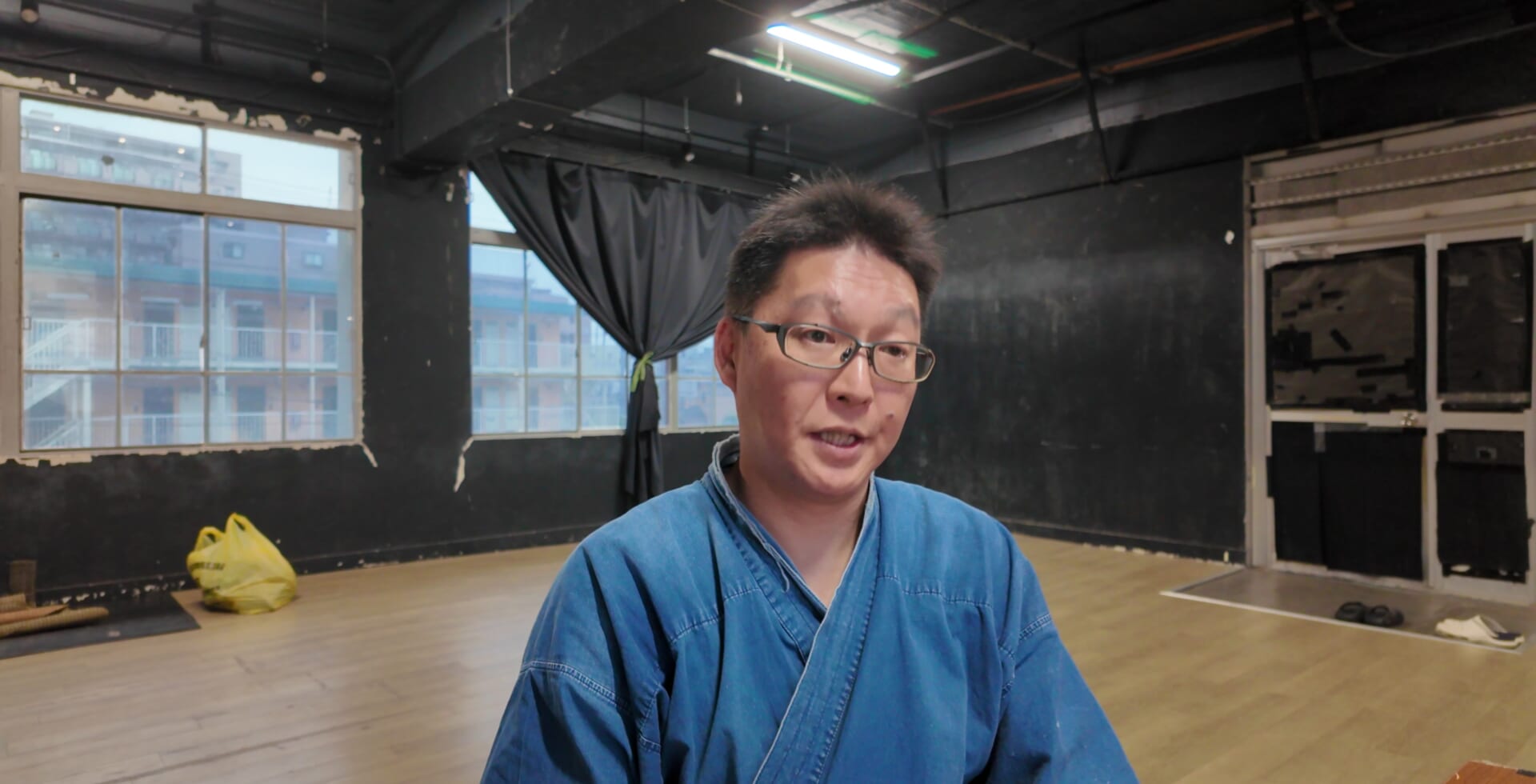
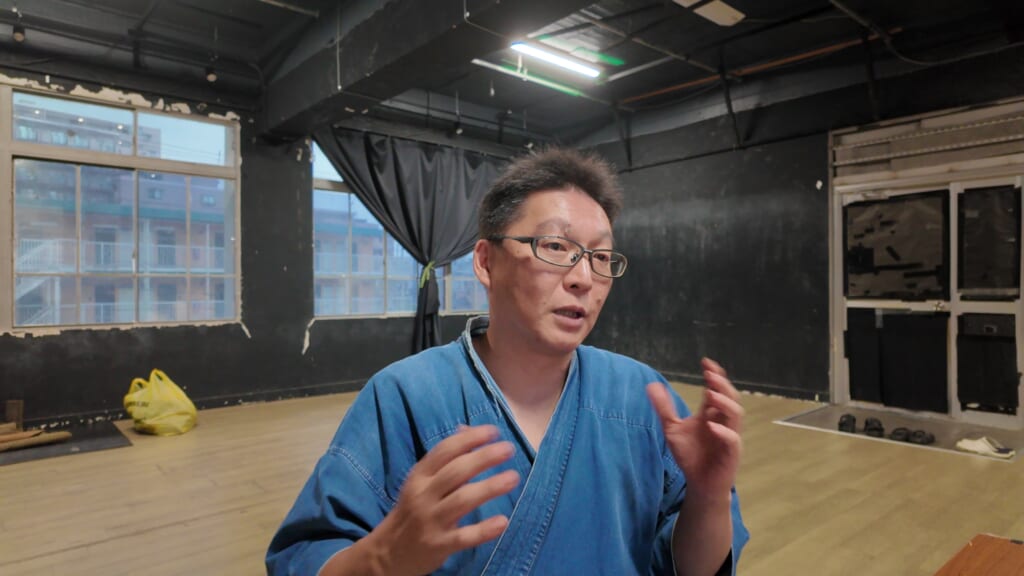
Gensei Kamiide teaches people to cut with a real Japanese sword. He heads the Nishi-Tokyo branch of the All Japan Battodo Federation, and by his own count more than 4,000 people have gone through his introductory sessions. Yet he never set out to become a swordsman. Twelve years ago, he walked into a dojo mostly to help a friend fill seats.
We sat down with him in the dojo to talk about what battodo actually is, why its targets are made of tatami, the uncomfortable history behind the Japanese sword, and why he believes the cut begins long before the blade is drawn.
A Seat to Fill at a Test-Cutting Event
Q: Please introduce yourself.
Kamiide: My name is Gensei Kamiide, and I’m 50 years old. I serve as head of the Nishi-Tokyo branch of the All Japan Battodo Federation.
Q: How long have you been practicing battodo, and what got you started?
Kamiide: About 12 years. Back then, I had just gone independent and was running my own company. A fellow business owner had taken on a rather unusual client: his consulting firm was advising, of all things, an iai dojo, a martial arts dojo that trains with the sword. They were planning a test-cutting experience, and my friend was worried nobody would show up, since it was such a niche thing. So I said, “All right, I’ll come,” mostly to help make up the numbers. That’s how it started.
Q: And from there, you got hooked?
Kamiide: Honestly, for the first year or so, I only did the trial cutting sessions. When I entered my second year, a dōgi [training uniform] had been prepared for me, and I was told it was time to get serious. So I ended up doing it properly.
Q: So there wasn’t much passion at first?
Kamiide: That’s right. My friends were involved, so I was doing it to support them. I hadn’t really thought about devoting myself to battodo or iaido.
Iaido, Battodo, and a Target Made of Tatami
Q: Everyone knows judo, but iaido and battodo may not be that well known, even in Japan. Could you explain what they are?
Kamiide: Of course. Iaido is basically a martial art where you cut an imaginary opponent. It isn’t like kendo, where you hold a shinai [bamboo sword] and try to score a point against someone. You train through kata [set forms], working on how well you can cut an imagined enemy. It’s a martial art you practice on your own.
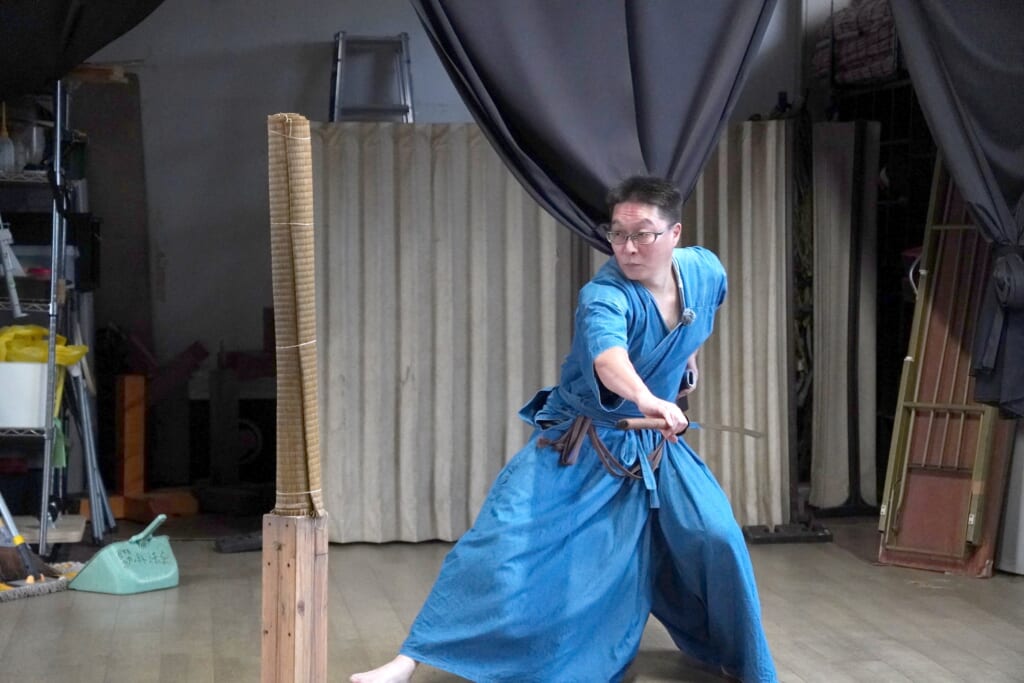
Battodo is a little different. It’s built on iai, and it uses the Japanese sword too. But we roll up tatami omote, the woven rush covering of tatami mats, soak it in water, and cut it. The imaginary opponent becomes an actual tatami target standing in front of you, and the question is how you cut it. Test cutting, tameshigiri, with a real sword: that’s battodo.
Q: Why tatami?
Kamiide: It’s easy to get hold of. And once it’s soaked, it comes very close to the human body, which is said to be about 70 percent water. So it makes the right kind of target.
Q: So the premise is cutting a person?
Kamiide: Of course, we never actually cut people. So how do you check whether you’ve really made a cut? You use rolled tatami, or bamboo. You may have seen someone slicing through bamboo in a grove. Those are ways of testing whether a sword really cuts. Say a swordsmith forges a sword to the dimensions you asked for. Once it’s finished, you can’t know whether it actually cuts until you try it.
There’s a Japanese word, dotanba. Today it means a last-ditch situation, the moment when you’re cornered and have to find your strength. But the dodan was originally a mound where the bodies of executed criminals were piled up, so swords could be tried on them to see how deeply they cut. A finished sword had to be tested, and in the old days, that’s what was used. It’s not a pleasant story.
Q: Does cutting bamboo feel different from cutting tatami?
Kamiide: It does. Bamboo varies in hardness and thickness with the season, so every piece you cut is different. Bamboo from a season when it cuts easily is less likely to chip the edge of the sword. But cut rock-hard bamboo, and the blade can chip. So I think bamboo from a slightly softer season is better.
With rolled tatami, you can change the thickness freely. Depending on how much tatami facing you use, you can set the target to stand for an arm, a neck, or a torso. Roll a thick one, and it becomes a torso. Line lots of them up side by side, and the difficulty jumps, because unless your hasuji, the line of the edge through the cut, is exactly right, you won’t get through them all.
Not a Pretty Story
Q: You still hold trial classes for beginners, including many people from abroad. What motivates you to do that?
Kamiide: As someone who practices battodo, I’m not going to make some grand claim that this is Japanese culture. But the Japanese sword was once used in duels and in war. It’s a grim subject, but that’s part of its history, and I keep it in mind when I train.
Today we have pistols, machine guns, cannons, and missiles, and war takes a different form. But the battodo people picture really comes from the Bakumatsu, the last years of the Edo period. People stormed into buildings on raids to cut down their enemies, at a time when political conflict had thrown Japan into chaos. In the struggle to restore order, the Japanese sword was used as a weapon. You can’t change that history. For me, swinging a sword while feeling it is something worth learning from.
A lot of people from abroad say their image of Japan is ninja and samurai. I’d like them to keep in mind that it isn’t always a heroic story.
A lot of people from abroad say their image of Japan is ninja and samurai. I’d like them to keep in mind that it isn’t always a heroic story.
Q: Does battodo itself go back to the Edo period?
Kamiide: As a discipline, battodo was really established after the war, in the Shōwa era, so it’s relatively new. But if you trace its roots, there was the Army Toyama School, out near Takadanobaba, where soldiers trained in close combat with the Japanese sword. I think the training developed there is the origin of battodo.
The Rikugun Toyama Gakkō, or Army Toyama School, was founded in 1873, and its sword curriculum, later known as Toyama-ryū, was created there in 1925.
Begin With a Bow, End With a Bow
Q: For people who come to your trial sessions, what do you hope they experience and take home?
Kamiide: I don’t do it just as entertainment. Battodo is quite minor, but it does exist in Japan. Shinken, real swords, are still being made, too. New swords are being forged today. So I want people to look beyond the cut itself, and become curious about the history around the sword and the craftspeople making swords today.
Around the world, I think Japan has a strong image as a country of entertainment, because of anime and manga. But I’d like people to take an interest in Japanese history as a whole: not only the fun parts, but also the sadness behind them, that swords were actually used in war and that many people died.
Q: What does a session look like, from the beginning?
Kamiide: It starts with rei, the bow. In Japan we say it begins with a bow and ends with a bow. And the real question is why you bow. We can’t give you every answer. I think many visitors have a vague idea that people in Japan say rei and lower their heads. I want them to think for themselves about what they’re bowing to. If they don’t know, they can look it up online or pick up a book and get a little closer to it. Then they might realize: I see, this was for the person in front of me. Or for this place. Or, facing the kamidana [household Shinto altar], it’s gratitude for being here, healthy enough to train. That’s what I’d like them to feel.
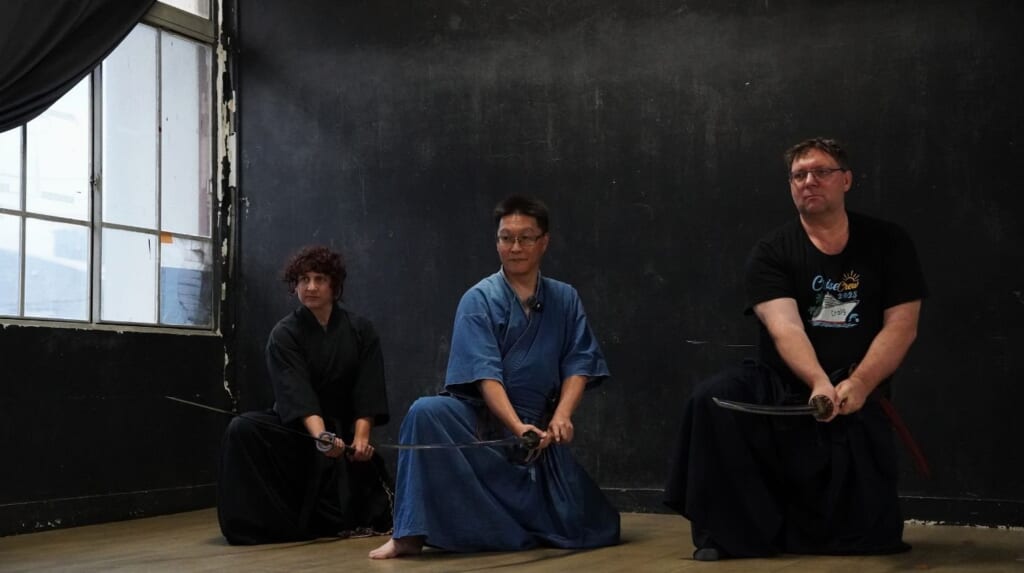
Next comes changing into uniform. Depending on someone’s build, the clothing can be tricky, so we sometimes skip part of it. Then, following etiquette, we sit in seiza, face each other, and begin with a bow.
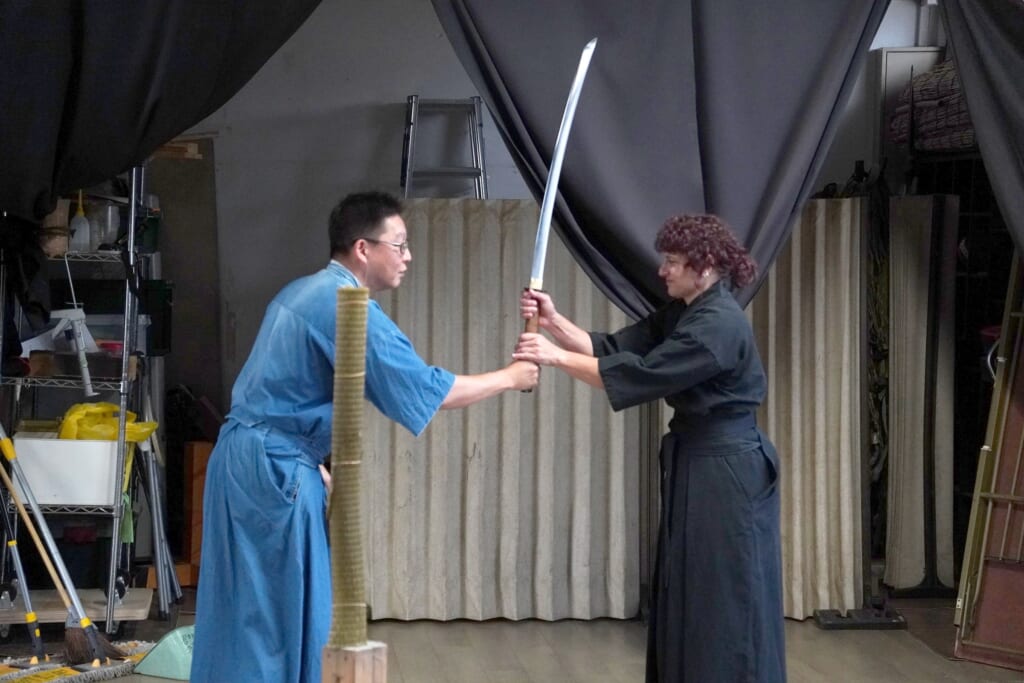
Then I go over safety. People tend to think a sword will cut if you just swing it, but that’s taking it too lightly. It isn’t that simple. So I explain what’s dangerous: if you don’t stop the sword here, you’ll cut the floor, or yourself. Then I explain how to grip the sword, how to handle it, and how to hand it to someone. After that, I pass on only the essentials. Too much information confuses people, and confusion is when accidents and injuries are most likely to happen. So I give them just the three most important points. Then they practice swinging safely and learn how a Japanese sword actually cuts.
At the end, they make a real cut. Then I demonstrate a cut myself, so they get a sense of what battodo looks like. Finally, we face each other, bow again, and that’s the end of the session.
Q: Are most participants able to cut?
Kamiide: Yes. Young or old, wherever they’re from, almost everyone so far has gone home able to cut properly.
Q: How many people have you taught?
Kamiide: A little over 4,000.
Q: Has anything dangerous ever happened?
Kamiide: There have been about two cases where elderly women without much strength cut all the way into the ground. But there has never been a single injury where someone cut themselves.
Q: What about in your own training? Have you ever had a frightening moment?
Kamiide: The most dangerous time is once you’ve gotten used to it. Nothing like that has happened to me. But when training partners have been injured, there’s more blood than you’d imagine. I’m used to seeing it by now, but it could come as a shock to someone who isn’t.
Mind, Sword, and Body as One
Q: Is there anything about battodo or your own background that we haven’t covered?
Kamiide: When it comes to martial arts, I actually had some experience back in high school. I’m originally from Kyoto, and in a certain combat sport, I represented Kyoto and made it all the way to the Budokan. So I learned the basics of how to use my body when I was young, and I had that foundation. But I didn’t come across battodo until nearly 30 years later. So I had to fuse the way I used to move with battodo, and that took a little time.
Once I could do that, it came down to what we call ki-ken-tai itchi: spirit, sword, and body acting as one. If your mind is churning like rough waves, you can’t make a good cut, however you swing the sword. It’s about how you calm and settle yourself. As long as you’re thinking about looking good, or making a cool-looking cut, you’ll never improve. It’s fine to look clumsy. It’s fine to fail. Not a problem at all. After all, you’re not actually putting your life on the line. Practice won’t run away from you, and you can do it as many times as you like.
It’s fine to look clumsy. It’s fine to fail. Not a problem at all.
There are competitions held regularly, too, and they test whether you can carry that state of mind into competition. I think that as adults, we get far fewer chances at a real contest. At work, success usually comes from cooperating with the people around you, and situations with a clear winner and loser become rare. Battodo gives you a taste of that world of competition, in a way.
Battodo has had a huge influence on the way I think, the way I live, and so much more. So I won’t tell anyone they have to train hard. But I’d like people to give it a try, and if they like it, to keep going.
Try Battodo With Kamiide-san
Japan Documented arranges private, English-friendly sessions with Kamiide-san in Tanashi, Tokyo, from etiquette and safety to cutting a real tatami target. See the Samurai Experience in Tokyo for details.
Want to hear more stories from people living in Japan? Explore more conversations in Humans of Japan.
Read Next
Share