
By the Japan Documented editorial team — we interview foreign residents and travellers across Japan for our Humans of Japan series.
Some everyday medications that are completely legal at home are illegal to bring into Japan — and travellers are stopped, detained, and even arrested for carrying them every year. Common ADHD prescriptions such as Adderall and Vyvanse, and popular cold and allergy medicines containing pseudoephedrine like Sudafed, are treated as controlled stimulants under Japanese law. A valid doctor’s prescription does not make them legal, and “I didn’t know” is not a defence at the border.
This guide explains, in plain English, which medications are banned outright, how much of a legal medicine you may bring without a permit, and how to apply for the import certificate (the Yakkan Shoumei, now officially called a Yunyu Kakunin-sho) if you need more. It is written for foreign visitors and residents heading to Japan who want to avoid a very avoidable problem.
Border trouble over everyday medication is a worry that comes up again and again in those interviews, and travellers we have spoken to have had medicine confiscated at customs because they did not realise it was restricted. This guide gathers what actually matters, checked line by line against Japan’s official rules.
Last reviewed: July 2026. This article is general information, not medical or legal advice. Rules depend on a medicine’s active ingredients and can change — always confirm your specific medication with Japan’s Ministry of Health, Labour and Welfare (MHLW) before you travel. Official links are at the bottom of this page.
The short answer
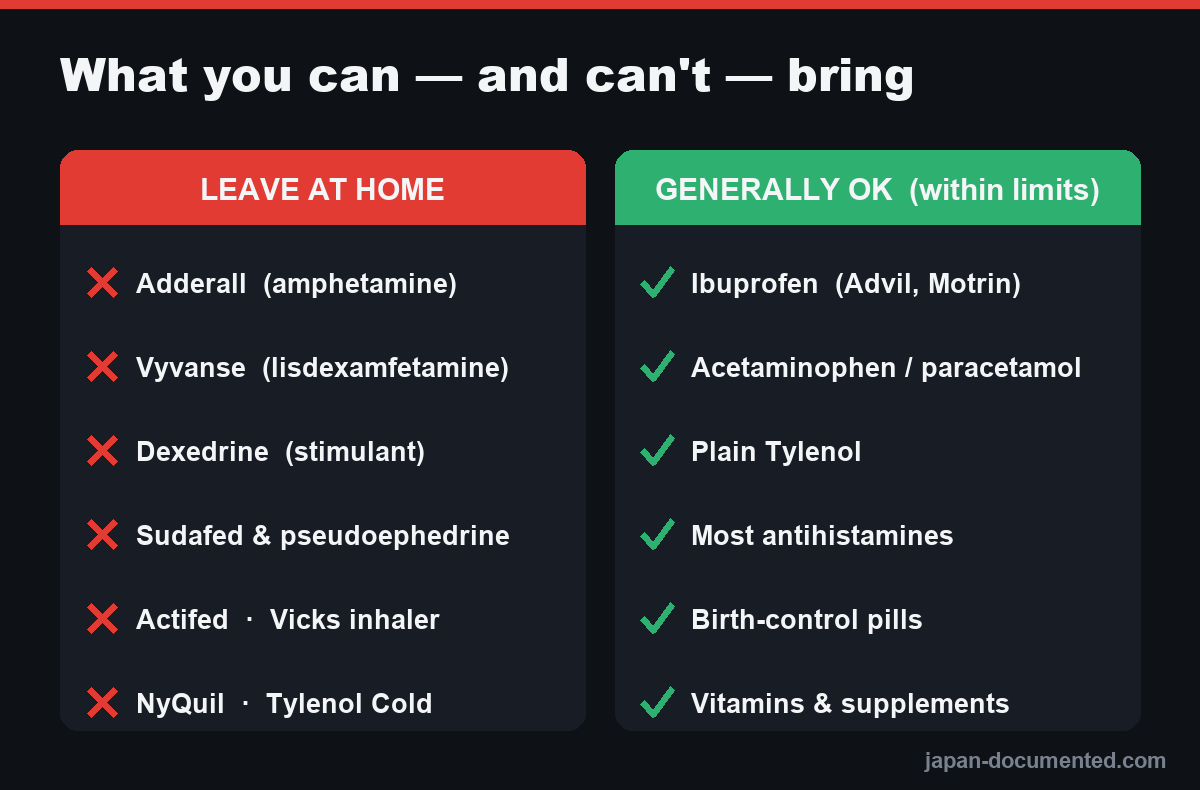
- Banned outright (never bring, even with a prescription): stimulant-based ADHD drugs (Adderall, Vyvanse, Dexedrine), and illegal narcotics. Carrying them can mean arrest.
- Usually blocked: cold and sinus medicines containing pseudoephedrine (Sudafed, Actifed, Vicks inhaler, NyQuil, Tylenol Cold, Advil Cold & Sinus).
- Generally fine within limits: most standard medicines — ibuprofen, acetaminophen/paracetamol, most antihistamines, birth-control pills.
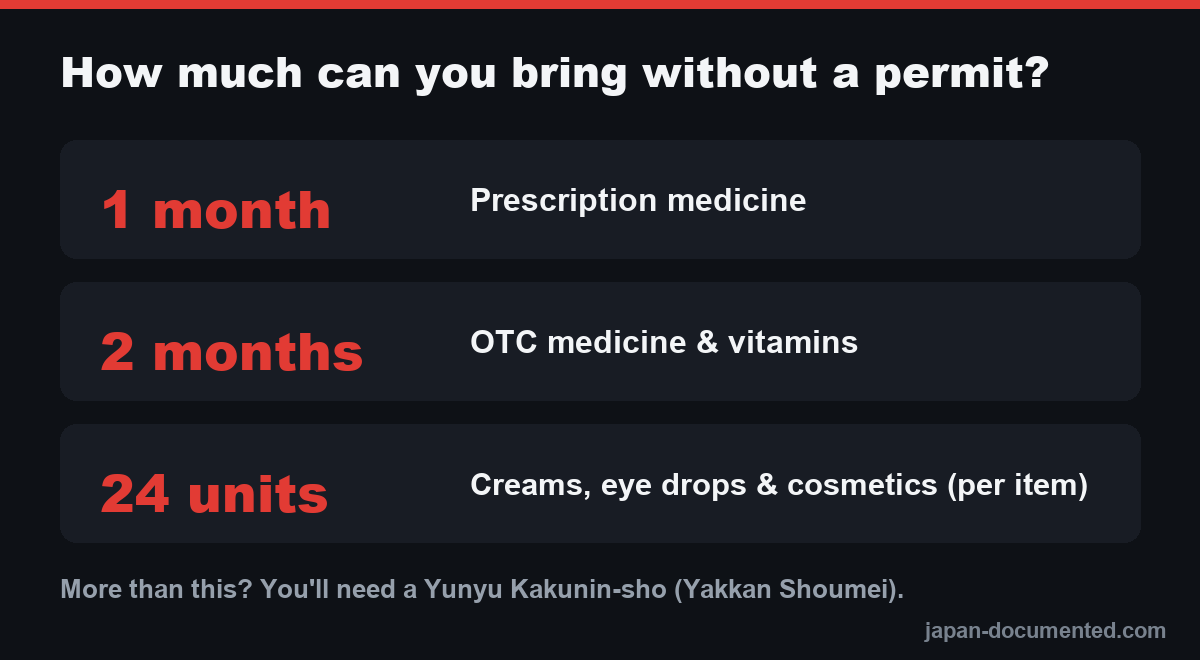
- Amounts without a certificate: up to 1 month of prescription medicine, 2 months of over-the-counter medicine or vitamins, and 24 units of external-use items or cosmetics.
- Need more, or carrying a controlled drug? Apply for a Yunyu Kakunin-sho / Yakkan Shoumei at least two weeks before you fly.
The single most important idea: it is the active ingredient that matters, not the brand or the fact that you have a prescription. The same brand name can be formulated differently in different countries, so always check the ingredients.
Medications that are banned outright
These are prohibited under Japan’s Stimulants Control Act and Narcotics Control Act. There is no exception for a foreign prescription, and declaring them on a customs form does not make them legal. Possession can lead to detention, arrest, and prosecution.
Stimulant-based ADHD medications
Medicines containing amphetamine or methamphetamine are the most common way ordinary travellers get into serious trouble. This includes:
- Adderall (amphetamine/dextroamphetamine)
- Vyvanse (lisdexamfetamine)
- Dexedrine (dextroamphetamine)
If you take one of these, do not bring it. Talk to your doctor well before your trip about a Japan-approved alternative (some non-stimulant ADHD medicines, and methylphenidate-based Concerta, may be handled differently — but this must be arranged in advance, often with a certificate). Never try to carry a stimulant in “just in case.”
Illegal drugs and narcotics
Heroin, cocaine, MDMA, opium and cannabis are illegal, and Japan enforces this strictly. Note that cannabis-derived products are a moving target: THC is prohibited, and Japan has been adding specific cannabis-related compounds to its controlled list in recent years. If you use any CBD or cannabis-derived product, verify its current status with MHLW before travelling — do not assume “it’s just CBD” is safe.
The cold-and-allergy medicine trap: pseudoephedrine
Pseudoephedrine is classed as a stimulant raw material in Japan, so many familiar cold, sinus and allergy products exceed the legal limit and are effectively banned. Commonly affected products include:
- Sudafed and Actifed
- Vicks inhaler
- NyQuil / DayQuil cold formulas
- Tylenol Cold, Advil Cold & Sinus, Dristan Sinus
The practical advice: leave these at home. Japan sells its own effective cold and allergy medicines at any pharmacy (kusuriya / ドラッグストア), and staff can help you find a legal equivalent. If you rely on a specific decongestant, ask your doctor about a pseudoephedrine-free option before you go.
What we hear from travellers: In our interviews, the medicines that catch people out are almost always the same two — everyday cold and sinus tablets containing pseudoephedrine, and ADHD stimulant prescriptions. Travellers have told us their medication was taken at customs simply because they did not know it was restricted. Checking the active ingredient before you pack is what prevents it.
How much medicine can you bring without a permit?
If your medicine is legal in Japan and not a controlled substance, you can bring a personal-use quantity without any paperwork. The standard limits are:
| Type of product | Amount allowed without a certificate |
|---|---|
| Prescription medicine | Up to a 1-month supply |
| Over-the-counter medicine | Up to a 2-month (60-day) supply |
| Vitamins & supplements | Up to a 2-month supply |
| External-use items & cosmetics (creams, eye drops, etc.) | 24 units or fewer per item |
Keep medicines in their original, labelled packaging, and carry a copy of your prescription and, ideally, a short letter from your doctor stating the medicine and why you need it. This makes any customs conversation far smoother.
When you need a Yakkan Shoumei (Yunyu Kakunin-sho)
A Yakkan Shoumei — officially renamed the Yunyu Kakunin-sho (輸入確認書) — is an import certificate you obtain before you travel. You need one if you are bringing:
- More than the personal-use amounts above (e.g. more than one month of a prescription medicine);
- Any medicine in injectable form (for example, self-injected pens), or certain medical devices such as a CPAP machine;
- Certain psychotropic medicines above set limits (for example, some sleep and anxiety medicines).
How to apply
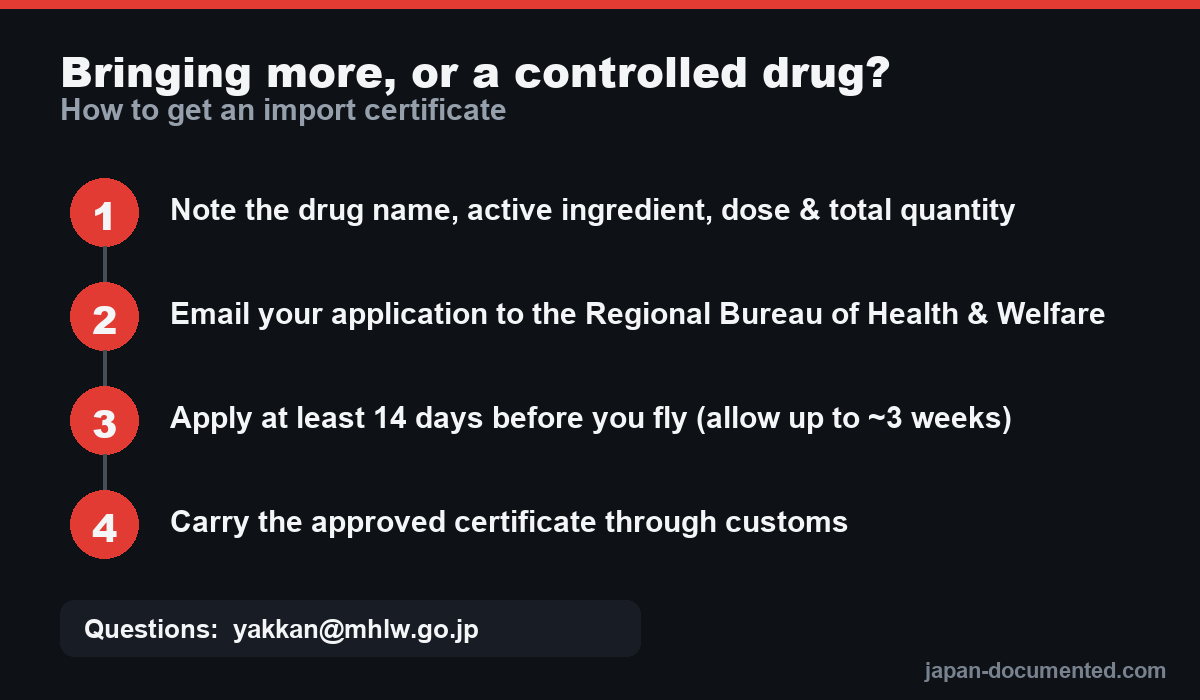
- Prepare details of your medicine: name, active ingredient, dosage, total quantity, and your arrival date.
- Complete the import-certificate application and email it to the relevant Regional Bureau of Health and Welfare. The MHLW contact for questions is yakkan@mhlw.go.jp.
- Apply at least two weeks (14 days) before departure — the whole process can take up to about three weeks, so start early.
- Bring the approved certificate with you and show it with your medicine at customs.
Narcotics and controlled painkillers
If your medication contains a narcotic — such as codeine, morphine, oxycodone, pethidine, hydrocodone or fentanyl — you must get advance permission from one of Japan’s Regional Bureaus of Health and Welfare before entering, regardless of the amount. This is a separate approval from the standard import certificate, so allow extra time and apply as early as possible.
Before you fly: a quick checklist
- ✅ Check the active ingredient of every medication (not just the brand name).
- ✅ Remove anything with amphetamine/methamphetamine (ADHD stimulants) or pseudoephedrine (cold medicine) — do not bring these.
- ✅ Keep medicines in original packaging with a copy of your prescription and a doctor’s letter.
- ✅ Bringing more than a month’s supply, an injectable, or a controlled drug? Apply for a Yunyu Kakunin-sho at least 2 weeks ahead.
- ✅ Unsure about anything? Email yakkan@mhlw.go.jp before you travel — get it in writing.
Sorting your medicines is one of a handful of rules worth checking before any flight to Japan. If you’re also flying with electronics, see our guide to the latest rules for carrying lithium-ion batteries and power banks on Japanese airlines.
Frequently asked questions
Can I bring Adderall into Japan?
No. Adderall contains amphetamine, a banned stimulant in Japan. It is illegal to bring in even with a valid prescription, and travellers have been detained for carrying it. Speak to your doctor about a Japan-legal alternative before you go.
Can I bring Sudafed or cold medicine into Japan?
Cold and sinus medicines containing pseudoephedrine (Sudafed, Actifed, Vicks inhaler, NyQuil, Tylenol Cold and similar) are generally not allowed, because pseudoephedrine is treated as a stimulant raw material. Leave them at home and buy a Japanese cold medicine at any pharmacy instead.
Can I bring Tylenol, ibuprofen or paracetamol?
Yes. Standard painkillers such as acetaminophen/paracetamol (plain Tylenol) and ibuprofen are fine within the personal-use limit — up to a two-month supply for over-the-counter medicine. Just avoid “cold & sinus” combination versions that add pseudoephedrine.
How much medication can I bring to Japan?
Without a certificate: up to a one-month supply of prescription medicine, a two-month supply of over-the-counter medicine or vitamins, and 24 units of external-use products or cosmetics. Above these amounts you need a Yunyu Kakunin-sho (Yakkan Shoumei).
What if I need more than one month of my prescription?
Apply for a Yunyu Kakunin-sho (import certificate) at least two weeks before you travel, using your medicine’s name, ingredient, dosage and total quantity. Email yakkan@mhlw.go.jp with any questions and keep the approval with you at customs.
Can I bring CBD products to Japan?
Be very careful. THC is prohibited, and Japan has been tightening rules on cannabis-derived compounds. A product sold legally as “CBD” at home may not be legal in Japan. Check its exact status with MHLW before travelling rather than assuming it is fine.
Do I need to declare my medication at customs?
Personal-use amounts of legal medicine within the limits generally do not require special paperwork, but you should carry your prescription and keep medicines in original packaging. If you hold a Yunyu Kakunin-sho or narcotics permission, present it with your medicine on arrival.
What happens if I’m caught with a banned medication?
The medication can be confiscated and you can be detained, questioned, and in serious cases arrested and prosecuted — even with a foreign prescription. The safe approach is to check every ingredient and never carry a prohibited stimulant or narcotic without the correct permit.
Official sources & where to check
Because your situation depends on your exact medication, always confirm with an official source before you travel:
- Japanese Embassy (USA) – Bringing Medications to Japan: a clear official summary of limits and the certificate.
- U.S. Embassy in Japan – Importing Medication: prohibited items and personal-use amounts.
- MHLW Narcotics Control Department: for narcotics and psychotropics permission.
- Email for questions: yakkan@mhlw.go.jp — apply at least 2 weeks before travel.
Final thoughts
Japan’s medication rules catch out thousands of well-meaning travellers, almost always over two things: stimulant ADHD prescriptions and pseudoephedrine cold medicine. Check the active ingredients of everything in your bag, leave the banned items at home, and apply for a Yunyu Kakunin-sho in good time if you need to bring more than a personal-use amount. A few minutes of checking before you fly is all it takes to keep a health necessity from becoming a border problem.
Share